
If you are looking for a reliable aluminum circle for cookware, lighting, or deep drawing applications, the 1100 aluminum circle is one of the most widely used options in the market. This grade combines excellent formability, corrosion resistance, and cost-effectiveness — making it a first choice for manufacturers worldwide.
This article covers everything buyers need to know: key specifications, typical applications, pricing factors, and how to choose the right aluminum circle plate for your project.
What Is a 1100 Aluminum Circle?
A 1100 aluminum circle is a round disc cut or rolled from 1100-series aluminum alloy. The 1100 alloy is commercially pure aluminum — it contains at least 99% aluminum with small amounts of copper (0.05–0.20%) and other trace elements.
Because of its high purity, 1100 aluminum offers:
- Excellent corrosion resistance
- High thermal and electrical conductivity
- Outstanding workability and formability
- Easy anodizing and surface treatment
It is available in a variety of diameters, thicknesses, and tempers to meet different production requirements. Common tempers include O (annealed), H12, H14, H16, and H18.
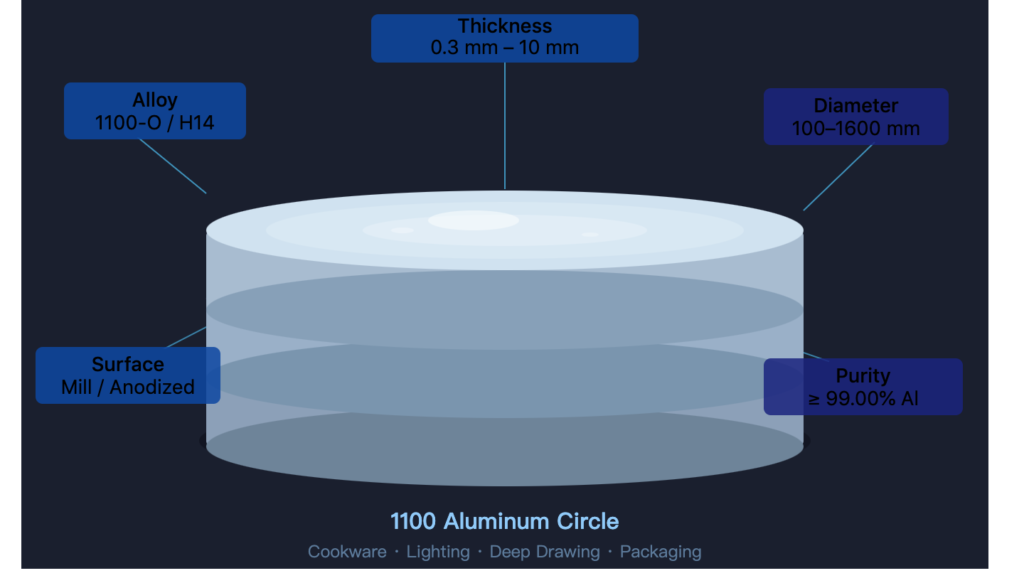
1100 Aluminum Circle Specifications
The table below shows the standard technical parameters for 1100 aluminum circles. Custom sizes are available upon request.
| Parameter | Standard Range |
|---|---|
| Alloy | 1100 (AA1100) |
| Temper | O, H12, H14, H16, H18, H24 |
| Diameter | 100 mm – 1,600 mm |
| Thickness | 0.3 mm – 10 mm |
| Surface Finish | Mill finish, bright finish, anodized |
| Standard | ASTM B209, EN 573-3, GB/T 3880 |
| Production Process | DC (Direct Casting), CC (Continuous Casting) |
Chemical Composition of 1100 Aluminum Alloy
| Element | Si + Fe | Cu | Mn | Zn | Al |
|---|---|---|---|---|---|
| Content (%) | ≤ 0.95 | 0.05–0.20 | ≤ 0.05 | ≤ 0.10 | ≥ 99.00 |
Mechanical Properties (Typical)
| Temper | Tensile Strength (MPa) | Yield Strength (MPa) | Elongation (%) | Hardness (HB) |
|---|---|---|---|---|
| O | 75–105 | 25–35 | ≥ 22 | ~23 |
| H12 | 95–130 | 75 | ≥ 8 | ~28 |
| H14 | 110–145 | 95 | ≥ 6 | ~32 |
| H16 | 130–165 | 115 | ≥ 4 | ~38 |
| H18 | ≥ 150 | ≥ 130 | ≥ 3 | ~44 |
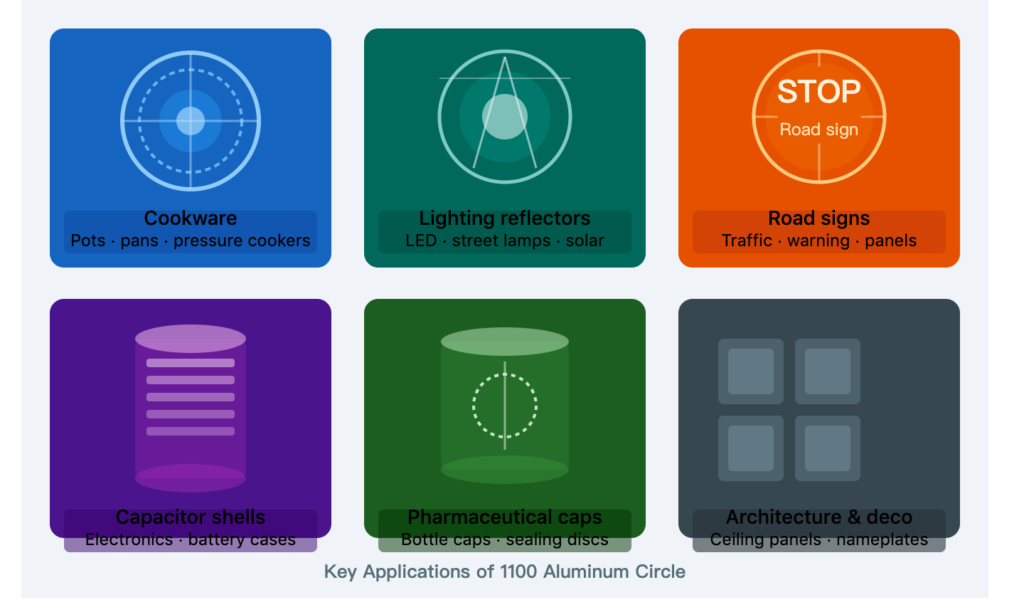
Key Applications of 1100 Aluminum Circle
The aluminum circle made from 1100 alloy is used across many industries. Below are the most common applications.
1. Cookware and Kitchenware
This is the largest application for aluminum circles for cookware. The 1100 grade is ideal for manufacturing:
- Pots and pans
- Pressure cookers
- Non-stick frying pans
- Rice cookers
- Milk pots and sauce pans
The O temper (fully annealed) is preferred for deep drawing because it offers maximum ductility. The aluminum circle plate is stamped or spun into the final cookware shape with minimal cracking.
2. Lighting Reflectors
Aluminum circle plate with mill finish or bright finish is widely used for LED lighting reflectors and lampshades. The high reflectivity of 1100 aluminum — typically 70–85% for mill finish and over 85% for bright finish — makes it effective for directing light.
Applications include:
- Street lamp reflectors
- Industrial LED fixtures
- Spotlight housing
- Solar reflectors
3. Road Signs and Traffic Panels
Circle aluminum discs are stamped and painted for road signs, traffic circles, and warning panels. The corrosion resistance of 1100 alloy ensures long outdoor service life with minimal maintenance.
4. Capacitor Shells and Electronic Components
DC-processed 1100 aluminum circles are used for capacitor shells due to their consistent grain structure and excellent deep drawing performance. They are also used for battery casings and electronic enclosures.
5. Pharmaceutical and Chemical Packaging
The 1100 alloy does not react with most chemicals and is non-toxic. It is approved for contact with food and pharmaceuticals. Aluminum round circles are used for bottle caps, sealing discs, and container lids.
6. Building and Decoration
Custom aluminum circles are used in architectural ceiling panels, decorative discs, nameplates, and logo plates. Anodized finishes allow a wide range of colors.
1100 vs Other Aluminum Circle Alloys
When selecting an aluminum circle, it is important to compare 1100 with other common alloys. The table below provides a direct comparison.
| Alloy | Purity / Composition | Strength | Formability | Corrosion Resistance | Main Use |
|---|---|---|---|---|---|
| 1100 | ≥ 99.0% Al | Low-Medium | Excellent | Excellent | Cookware, lighting, caps |
| 1050 | ≥ 99.5% Al | Low | Excellent | Excellent | Cookware, reflectors |
| 1060 | ≥ 99.6% Al | Low | Excellent | Excellent | Electrical, chemical |
| 3003 | Al-Mn alloy | Medium | Good | Good | Cookware, industrial |
| 3004 | Al-Mn-Mg alloy | Medium-High | Good | Good | Can stock, cookware |
The 1100 aluminum circle offers a good balance of formability and strength. It is often chosen over 1050 when slightly higher strength is needed, and over 3003 when lower cost and easier deep drawing are priorities.
How to Choose the Right 1100 Aluminum Circle
Selecting the correct aluminum circle plate depends on your specific application. Here are the key factors to consider:
1. Diameter and Thickness Match the disc size to your die or mold dimensions. Allow for material thinning during deep drawing — typically 10–20% reduction in thickness.
2. Temper Selection Use O temper for deep drawing (cookware, capacitor shells). Use H14 or H16 for applications needing higher stiffness (road signs, panels).
3. Surface Finish Mill finish is standard and lowest cost. Bright annealed finish gives higher reflectivity. Anodized finish adds color and wear resistance.
4. DC vs CC Process DC (direct chill casting) circles have finer grain structure, better deep drawing performance, and fewer surface defects. CC (continuous casting) circles are lower cost and suitable for less demanding applications.
5. Custom Sizes Most manufacturers offer custom aluminum circles cut to specific diameters from 100 mm to 1,600 mm. Minimum order quantities vary by supplier.
1100 Aluminum Circle Pricing Factors
The price of 1100 aluminum circle depends on several variables:
| Factor | Impact on Price |
|---|---|
| Aluminum LME price | Base cost driver — fluctuates daily |
| Thickness and diameter | Larger / thicker = higher cost per piece |
| Temper | O temper slightly lower; H18 higher due to processing |
| Surface treatment | Mill finish lowest; anodized finish highest |
| Processing method | DC process higher than CC process |
| Order quantity | Higher quantity = lower unit price |
| Delivery location | Freight cost varies by destination |
For current pricing, contact your 1100 aluminum suppliers directly with your required specifications. Prices are typically quoted per metric ton (MT) or per kilogram based on LME + processing premium.
Why Choose Us as Your 1100 Aluminum Circle Manufacturer
We are a direct manufacturer of aluminum circles with over 20 years of production experience. And our factory exports to more than 60 countries including the USA, Germany, Brazil, Mexico, Turkey, Indonesia, and South Africa.
Key advantages:
- Full alloy range: 1050, 1060, 1100, 3003, 3004, 5052, 8011 aluminum circles in stock
- Flexible sizing: Diameter 100–1,600 mm, thickness 0.3–10 mm
- DC and CC process: Available for different application requirements
- Fast delivery: Standard sizes ready in 7–15 days; custom orders in 20–30 days
- Quality certifications: ISO 9001, SGS, BV inspection available
- Low MOQ: Minimum order from 3 metric tons per specification
- OEM / custom aluminum circles: Welcome private label and custom packaging
Aluminum circle plates are used by leading cookware brands, lighting manufacturers, and packaging companies across Europe, Southeast Asia, and the Americas.
Frequently Asked Questions
Q: What is the difference between 1100 and 1050 aluminum circle? A: The 1050 alloy has slightly higher purity (≥99.5% vs ≥99.0%) and is marginally softer. Both are excellent for cookware. The 1100 grade offers slightly higher tensile strength and is more widely available from Chinese manufacturers.
Q: Can 1100 aluminum circles be anodized? A: Yes. 1100 aluminum anodizes well and produces a consistent oxide layer. It is commonly anodized for decorative and architectural applications.
Q: What is the standard size for cookware aluminum circles? A: The most common diameters for cookware are 200 mm, 240 mm, 260 mm, 280 mm, and 320 mm. Thickness typically ranges from 1.5 mm to 4.0 mm in O temper.
Q: What countries do you export aluminum circles to? A: We regularly export to the USA, Germany, France, Italy, Brazil, Mexico, Turkey, Egypt, Nigeria, Thailand, Vietnam, Indonesia, and many more countries.
Get a Quote for 1100 Aluminum Circle
If you need a competitive price for 1100 aluminum circle, aluminum circle plate, or custom aluminum circles, please contact us with your specifications:
- Alloy and temper
- Diameter and thickness
- Surface finish requirement (mill finish / bright / anodized)
- Required quantity (metric tons or pieces)
- Destination port
We will respond within 24 hours with a detailed quotation and material test report.