
What Is 8011 Aluminum Circle?
8011 aluminum circle is a round, flat aluminum disc made from 8011 alloy. Manufacturers punch or blank these circles from 8011 aluminum sheet or coil. The result is a precise round blank ready for stamping, spinning, or deep drawing into finished products.
8011 aluminum belongs to the 8000 series alloy family. Iron and silicon are its primary alloying elements beyond aluminum. This composition gives 8011 excellent formability, good corrosion resistance, and outstanding surface quality. The elongation of 8011 aluminum circles reaches 35–38% in O temper. This high elongation makes it one of the most formable aluminum alloys available.
8011 aluminum circles serve a wide range of applications. Pan lids are the most important market. The combination of excellent deep drawing performance, food-safe composition, and attractive surface finish makes 8011 the preferred alloy for cookware lid production worldwide. Other applications include bottle caps, shallow containers, and light cookware.
Unlike the more common 3003 aluminum circles used for deep pots and pressure cookers, 8011 aluminum circle specializes in thinner, shallower products where maximum formability and surface quality matter most.


What Is 8011 Grade Aluminium?
8011 grade aluminium is a wrought alloy in the 8000 series. The 8000 series uses iron as a primary alloying element — this sets it apart from other series that use copper, manganese, or magnesium.
Key facts about 8011 grade aluminium:
- Series: 8000 (Al-Fe-Si system)
- Primary elements: Iron (0.60–1.00%) and Silicon (0.50–0.90%)
- Aluminum content: ≥97.3%
- Non-heat-treatable: Strength comes from work hardening only
- Excellent formability: Elongation 35–38% in O temper
- Food safe: Approved for direct food contact worldwide
- Good surface quality: Clean, bright surface for visible applications
The high iron content gives 8011 better strength than pure aluminum alloys at thin gauges. The silicon works with iron to control microstructure during processing. Together these elements make 8011 ideal for thin, highly formable products.
8011 Aluminum Alloy Composition
The chemical composition of 8011 aluminum alloy follows strict international standards.
Chemical Composition Table
| Element | Symbol | Content (%) |
|---|---|---|
| Aluminum | Al | Balance ≥ 97.3% |
| Iron | Fe | 0.60 – 1.00 |
| Silicon | Si | 0.50 – 0.90 |
| Copper | Cu | Max 0.10 |
| Manganese | Mn | Max 0.20 |
| Magnesium | Mg | Max 0.05 |
| Chromium | Cr | Max 0.10 |
| Zinc | Zn | Max 0.10 |
| Titanium | Ti | Max 0.08 |
| Other (each) | — | Max 0.05 |
| Other (total) | — | Max 0.15 |
Role of Each Key Element
Iron (0.60–1.00%)
Iron is the most important alloying element in 8011. It increases tensile strength through intermetallic particle formation. Higher iron content compared to 1000 series alloys gives 8011 better structural integrity at thin gauges. This allows very thin circles to be stamped without tearing.
Silicon (0.50–0.90%)
Silicon works in combination with iron. It refines the microstructure and improves formability. The Si/Fe ratio in 8011 is carefully controlled to optimize both rolling performance and final product properties.
Low copper, manganese, zinc
These elements stay at very low levels. Keeping them low maintains the alloy’s excellent corrosion resistance and food safety compliance. High levels of these elements would make the alloy unsuitable for food contact applications.
8011 Aluminum Circle vs 8011a Aluminum
What Is 8011a Aluminum?
8011a aluminum is a variant of standard 8011 with tighter compositional control. The “a” suffix follows European EN standard designation practice.
Key Differences
| Feature | 8011 | 8011a |
|---|---|---|
| Standard | ASTM / Chinese GB | EN (European) |
| Fe range | 0.60–1.00% | Slightly tighter |
| Si range | 0.50–0.90% | Slightly tighter |
| Properties | Identical in practice | Identical in practice |
| Applications | Same | Same |
For practical purposes, 8011 and 8011a are interchangeable. Both produce circles with the same forming characteristics. The difference is mainly in the standard designation used in different markets. European buyers may specify 8011a per EN standards. North American and Asian buyers typically specify 8011 per ASTM or GB standards.
Always confirm with your supplier which standard applies for your market requirements.
8011 Aluminum Circle Properties
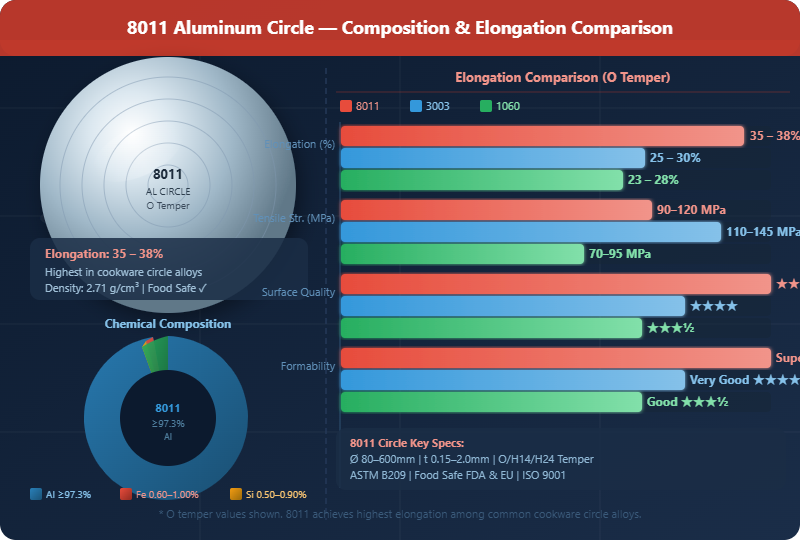
Understanding the properties of 8011 aluminum circle helps manufacturers select the right specifications.
Mechanical Properties by Temper
| Temper | Tensile Strength (MPa) | Yield Strength (MPa) | Elongation (%) | Hardness (HB) |
|---|---|---|---|---|
| O | 90 – 120 | 30 – 60 | 35 – 38 | 22 – 30 |
| H12 | 110 – 145 | 90 – 120 | 8 – 12 | 28 – 36 |
| H14 | 120 – 160 | 105 – 140 | 5 – 8 | 32 – 42 |
| H16 | 140 – 175 | 125 – 158 | 3 – 5 | 38 – 48 |
| H18 | 155 – 190 | 140 – 175 | 2 – 4 | 44 – 54 |
| H22 | 110 – 145 | 80 – 115 | 10 – 14 | 26 – 34 |
| H24 | 120 – 158 | 100 – 135 | 6 – 10 | 30 – 40 |
Physical Properties
| Property | Value |
|---|---|
| Density | 2.71 g/cm³ |
| Melting Range | 640 – 660°C |
| Thermal Conductivity | 190 W/m·K |
| Electrical Conductivity | 45–50% IACS |
| Coefficient of Thermal Expansion | 23.5 µm/m·°C |
| Elastic Modulus | 69 GPa |
Why 35–38% Elongation Matters
The elongation of 8011 aluminum circle in O temper reaches 35–38%. This is significantly higher than most other aluminum alloys used for circles:
| Alloy | O Temper Elongation |
|---|---|
| 8011 | 35 – 38% |
| 3003 | 25 – 30% |
| 1060 | 23 – 28% |
| 1100 | 25 – 35% |
| 5052 | 22 – 25% |
Higher elongation means:
- The metal stretches more before breaking
- Shallower draws need less material thickness
- Complex lid shapes form without cracking
- Less rejects and material waste in production
- Better value for thin-gauge applications
8011 Aluminum Circle Specifications
Diameter Range
| Category | Diameter |
|---|---|
| Small circles | 80mm – 200mm |
| Medium circles | 200mm – 400mm |
| Large circles | 400mm – 600mm |
| Custom sizes | Any diameter on request |
Thickness Range
| Application | Thickness |
|---|---|
| Bottle caps and seals | 0.15mm – 0.50mm |
| Pan lids (thin) | 0.50mm – 1.0mm |
| Pan lids (standard) | 1.0mm – 1.5mm |
| Shallow containers | 0.80mm – 1.5mm |
| Light cookware | 1.0mm – 2.0mm |
Available Tempers for Circles
- O temper — Most popular for deep drawing and pan lid production
- H14 — For applications needing more stiffness
- H24 — Balance of strength and formability
Surface Finish Options
| Finish | Description | Best Use |
|---|---|---|
| Mill finish | Standard as-rolled | General production |
| Bright finish | Polished, reflective | Premium visible lids |
| One-side bright | Bright top, mill bottom | Economy premium option |
| Anodized | Hard oxide surface | Scratch-resistant lids |
Dimensional Tolerances
| Parameter | Tolerance |
|---|---|
| Diameter | ±0.5mm – ±1.0mm |
| Thickness | ±4% – ±6% of nominal |
| Flatness | Max 1.5mm per 1000mm |
| Edge quality | Smooth, burr-free |
What Is 8011 Aluminum Used For?
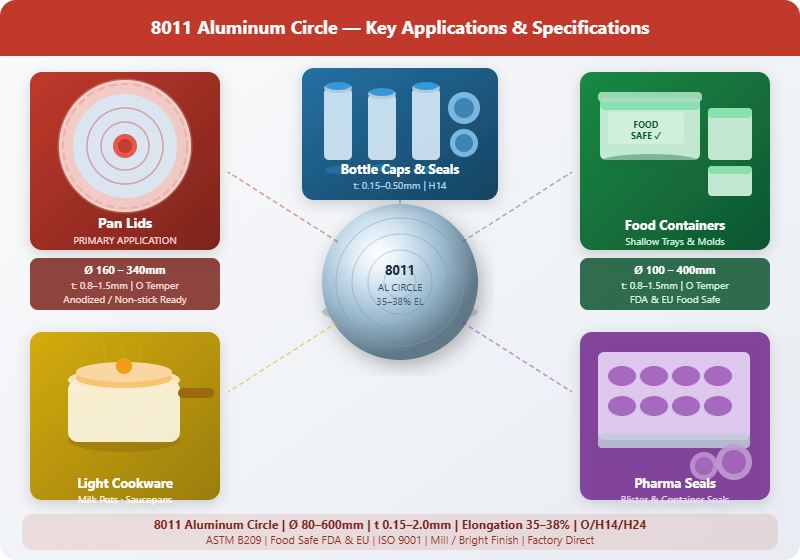
Pan Lids — Primary Application
Pan lids are the most important application for 8011 aluminum circles. The glass-topped or aluminum-topped lids for frying pans, woks, soup pots, and casseroles use 8011 circles as the base blank.
Why 8011 suits pan lids:
The lid stamping process requires the aluminum to form a shallow dome shape with a flanged rim. The metal must stretch over the forming die without cracking. The 35–38% elongation of 8011 O temper handles this forming demand easily.
After forming, lid manufacturers apply various surface treatments:
- Anodizing — Hard, scratch-resistant surface
- Polishing — Bright, attractive appearance
- Non-stick coating — Easy-clean interior surface
- Painting — Colored exterior finish
The high surface quality of 8011 circles ensures a smooth, defect-free base for all these treatments.
Typical lid specifications:
- Diameter: 160mm – 340mm (matching standard pot sizes)
- Thickness: 0.8mm – 1.5mm
- Temper: O
- Surface: Mill finish or one-side bright
Bottle Caps and Closure Seals
8011 aluminum circles in thinner gauges (0.15mm–0.50mm) make bottle caps and container closure seals.
Applications include:
- Wine bottle foil caps
- Beverage bottle pull-tab seals
- Yogurt cup and dairy product lids
- Pharmaceutical container seals
- Cosmetic jar and bottle caps
The H14 temper is standard for bottle caps. It provides enough stiffness to crimp cleanly while remaining formable enough to seal properly.
Shallow Containers and Trays
Shallow aluminum food containers use 8011 circles as blanks. The high formability allows clean forming of rectangular and round tray shapes from circular blanks.
Common products:
- Individual food portions
- Takeaway meal containers
- Baking cups and molds
- Catering trays
Light Cookware
For lightweight pots, small saucepans, and milk pots, 8011 circles provide an economical alternative to 3003 where maximum depth is not required.
8011 Aluminum Foil Connection
8011 aluminum foil is the thin-gauge product made from the same alloy. While foil (below 0.2mm) and circles (typically 0.5mm and above) are different products, they share the same alloy base.
Buyers familiar with 8011 aluminum foil for packaging will find the same excellent formability and food safety characteristics in 8011 aluminum circles for cookware production.
8011 Aluminum Circle vs Other Alloys
8011 vs 3003 Aluminum Circle
| Property | 8011 O | 3003 O |
|---|---|---|
| Tensile Strength | 90–120 MPa | 110–145 MPa |
| Elongation | 35–38% | 25–30% |
| Primary Elements | Fe + Si | Mn |
| Surface Quality | Excellent | Good |
| Formability | Superior | Very Good |
| Best For | Lids, caps, shallow items | Deep pots, pressure cookers |
| Cost | Slightly lower | Standard |
Choose 8011 for pan lids, bottle caps, and shallow formed products where surface quality and formability are priorities.
Choose 3003 for deep pots, soup pots, pressure cookers, and products requiring higher strength in the finished item.
8011 vs 1060 Aluminum Circle
| Property | 8011 O | 1060 O |
|---|---|---|
| Tensile Strength | 90–120 MPa | 70–95 MPa |
| Elongation | 35–38% | 23–28% |
| Iron Content | 0.60–1.00% | Max 0.35% |
| Surface Quality | Excellent | Good |
| Strength | Higher | Lower |
| Cost | Similar | Lower |
Choose 8011 when higher elongation and better surface quality are needed.
Choose 1060 for the most economical option where strength requirements are minimal.
8011 vs 1100 Aluminum Circle
| Property | 8011 O | 1100 O |
|---|---|---|
| Tensile Strength | 90–120 MPa | 75–105 MPa |
| Elongation | 35–38% | 25–35% |
| Surface Quality | Excellent | Very Good |
| Purity | ≥97.3% Al | ≥99.0% Al |
| Food Safety | Yes | Yes |
Choose 8011 for better formability at thin gauges.
Choose 1100 when very high aluminum purity is specifically required.
How 8011 Aluminum Circles Are Made
Production Process
Step 1: Raw Material
High-quality 8011 aluminum ingots are the starting point. Chemical composition is verified before production begins.
Step 2: Hot Rolling
Ingots are heated and rolled through hot rolling mills. Thickness reduces from ~500mm to 6–8mm. This creates a uniform wrought microstructure.
Step 3: Cold Rolling
Hot-rolled coils pass through cold rolling mills at room temperature. Multiple passes reduce thickness to the target gauge. Cold rolling increases strength through work hardening.
Step 4: Annealing (O Temper)
For O temper circles, cold-rolled coils are annealed in controlled atmosphere furnaces at 300–380°C. This fully recrystallizes the metal and maximizes ductility. The 35–38% elongation characteristic of 8011 O temper comes from this annealing process.
Step 5: Slitting
Wide coils are slit to the appropriate width for blanking operations.
Step 6: Blanking
Aluminum sheet or coil feeds into high-speed blanking presses. Circular dies punch out round discs at high production rates.
Step 7: Deburring
Blanked circles pass through deburring equipment. Smooth, burr-free edges are critical for trouble-free forming in customer production lines.
Step 8: Quality Inspection
Every batch undergoes:
- Diameter and thickness measurement
- Visual surface inspection
- Elongation and tensile testing
- Chemical composition verification
Step 9: Packaging
Circles are stacked with protective interleaving paper and packed on wooden pallets for shipment.
What Is the Price of 8011 Aluminum Circle?
The price of 8011 aluminum circles depends on several factors.
Price Factors
LME Aluminum Price
Base aluminum cost follows the London Metal Exchange. This changes with global market conditions.
Alloy Premium
8011 carries a small premium over pure aluminum due to iron and silicon content and processing requirements.
Thickness
Thinner circles require more rolling passes and cost more per kg. Very thin gauges below 0.5mm carry higher processing premiums.
Diameter
Larger diameter circles cost more per piece. Price per kg stays relatively stable across standard sizes.
Temper
O temper adds annealing cost. H14 and H18 tempers have different processing requirements.
Surface Finish
Mill finish is the base price. Bright finish adds 5–15%. Anodized surfaces add more.
Order Quantity
Larger orders get lower per-kg pricing.
Indicative Price Range
| Product | Approximate Price |
|---|---|
| 8011 O circle (mill finish, standard) | $2.6 – $4.0 per kg |
| 8011 O circle (bright finish) | $3.0 – $4.8 per kg |
| 8011 H14 circle | $2.8 – $4.2 per kg |
Prices change with LME aluminum rates. Contact us for current pricing.
Quality Standards
International Standards
| Standard | Region | Scope |
|---|---|---|
| ASTM B209 | USA | Aluminum sheet and plate |
| EN 573-3 | Europe | Chemical composition (8011a) |
| EN 485 | Europe | Mechanical properties |
| GB/T 3880 | China | Aluminum sheet standard |
| GB/T 8005 | China | Aluminum alloy designation |
Quality Inspection Checklist
Chemical Composition
Spectrometer analysis confirms Fe and Si within specification. Out-of-spec iron or silicon affects both forming performance and food safety compliance.
Mechanical Properties
Tensile and elongation testing confirms O temper characteristics. Elongation must reach 35–38% for premium lid production applications.
Dimensional Accuracy
- Diameter: ±0.5mm to ±1.0mm
- Thickness: ±4% to ±6%
- Flatness: within specification
Surface Quality
No scratches, roll marks, oxidation, or oil contamination. Surface must be clean and uniform for visible lid applications.
Edge Quality
Smooth, burr-free edges confirmed by tactile inspection. Critical for automatic feeding in stamping presses.
Food Safety
FDA and EU food contact compliance documentation available for all food-contact applications.
Packaging and Delivery
Standard Packaging
- Circles stacked on wooden pallets
- Protective interleaving paper between each circle
- Waterproof outer wrap (kraft paper or stretch film)
- Steel strapping bands for pallet security
- Corner protectors on all four sides
Special Packaging Options
- Individual plastic bag wrapping for bright finish circles
- Wooden crates for sensitive surface finishes
- Custom pallet configurations for specific warehouse requirements
Shipping Options
| Method | Transit Time | Best For |
|---|---|---|
| Sea freight (FCL) | 15–40 days | Large production orders |
| Sea freight (LCL) | 20–50 days | Medium orders |
| Air freight | 3–7 days | Samples and urgent orders |
Why Buy 8011 Aluminum Circles from Us?
Consistent Elongation Performance
Our 8011 aluminum circles consistently achieve 35–38% elongation in O temper. This is the key performance characteristic for pan lid production. We test every batch and provide test certificates confirming elongation values.
Superior Surface Quality
Our circles have clean, bright surfaces free from scratches, oil stains, and oxidation. The surface quality meets the requirements for visible cookware lid applications.
Full Size Range
We produce 8011 aluminum circles in:
- Diameter: 80mm – 600mm
- Thickness: 0.15mm – 2.0mm
- Any custom size on request
All Tempers Available
O, H12, H14, H16, H18, H22, H24 — all tempers available. We recommend O temper for most lid and forming applications.
Complete Documentation
Every shipment includes:
- Mill Test Certificate (MTC)
- Chemical composition report
- Mechanical property test results (including elongation)
- Food safety compliance documentation
- Certificate of origin
Fast Sample Service
Sample orders of 50–200 kg ship within 3–7 business days. Test our material in your stamping press before placing production orders.
Export Markets
We supply 8011 aluminum circles to manufacturers in:
| Region | Key Markets |
|---|---|
| Southeast Asia | Vietnam, Thailand, Indonesia, Malaysia |
| South Asia | Bangladesh, Pakistan, India |
| Middle East | Turkey, Iran, UAE, Egypt |
| Africa | Nigeria, Ethiopia, Kenya, Ghana |
| Europe | Germany, Poland, Italy, Spain |
| Americas | Brazil, Mexico, Colombia |
Frequently Asked Questions
What is 8011 grade aluminium?
8011 grade aluminium is a wrought alloy in the 8000 series. Its main alloying elements are iron (0.60–1.00%) and silicon (0.50–0.90%). It is known for its outstanding formability — elongation reaches 35–38% in O temper. The main uses are pan lids, bottle caps, and aluminum foil production.
What is 8011 aluminum?
8011 aluminum is a non-heat-treatable alloy with excellent formability, good corrosion resistance, and food-safe composition. It is the most widely used alloy for aluminum foil production and is also popular for thin-gauge circles used in pan lid and bottle cap manufacturing.
What is the difference between 8011 and 3003 aluminum circle?
8011 has higher elongation (35–38%) than 3003 (25–30%). This makes 8011 better for shallow formed products like pan lids and bottle caps. 3003 is stronger and better suited for deep-drawn products like soup pots and pressure cookers. 8011 also has better surface quality for visible applications.
What is the price of aluminum 8011?
8011 aluminum circle prices range from approximately $2.6 to $4.0 per kg for standard mill finish O temper material. Bright finish and specialty tempers cost more. Prices change with LME aluminum market rates. Contact us for current pricing based on your specifications.
Is 8011 aluminum food safe?
Yes. 8011 aluminum meets FDA and EU food contact material regulations. It is widely used for food packaging, cookware lids, and beverage closures. Its low levels of copper, zinc, and other potentially harmful elements ensure safe food contact performance.
What temper is best for pan lid production?
O temper is the standard choice for pan lid production. The 35–38% elongation of 8011 O temper allows clean forming of dome-shaped lids with flanged rims without cracking. Other tempers are available for specific applications.
What is the minimum order quantity?
Minimum order is typically 1–3 tons per specification. Contact us to discuss your production requirements.
Product Summary and Inquiry
Quick Reference Specifications
| Parameter | Details |
|---|---|
| Alloy | 8011 (also 8011a per EN standard) |
| Temper | O, H12, H14, H16, H18, H22, H24 |
| Diameter | 80mm – 600mm |
| Thickness | 0.15mm – 2.0mm |
| Elongation (O) | 35 – 38% |
| Surface | Mill finish, bright finish, anodized |
| Standard | ASTM B209, EN 573-3, GB/T 3880 |
| Food Safe | Yes — FDA & EU compliant |
| Certifications | ISO 9001, SGS, MTC |
| MOQ | 1 – 3 tons per specification |
| Lead Time | 15 – 20 days |
| Packaging | Pallets with interleaving paper |
Get a Free Quote
Contact our sales team today. We respond within 24 hours.
Please include in your inquiry:
- Diameter and thickness required
- Temper (O temper for most lid applications)
- Surface finish preference
- Quantity needed
- Annual volume estimate
- Destination country
- Certification requirements