
If you are sourcing aluminum circles for cookware, traffic signs, lighting, or industrial applications, 3003 aluminum circle is one of the most practical and cost-effective choices on the market. This guide covers everything you need to know — from alloy composition and technical specifications to pricing, bending performance, and why manufacturers worldwide choose 3003 over other grades.
What Is 3003 Aluminum?
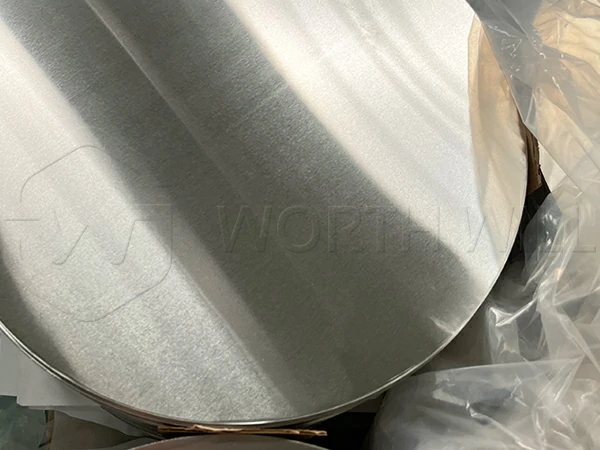
3003 aluminum is a medium-strength, non-heat-treatable alloy in the 3xxx series. Manganese (Mn) is the primary alloying element, making up approximately 1.0–1.5% of the composition. This addition gives 3003 roughly 20% higher strength than 1100 aluminum while keeping the same excellent formability, corrosion resistance, and weldability.


Chemical Composition of 3003 Aluminum
| Element | Content (%) |
|---|---|
| Aluminum (Al) | Balance (≥97.0%) |
| Manganese (Mn) | 1.0 – 1.5 |
| Copper (Cu) | 0.05 – 0.20 |
| Silicon (Si) | ≤ 0.60 |
| Iron (Fe) | ≤ 0.70 |
| Zinc (Zn) | ≤ 0.10 |
| Other (each) | ≤ 0.05 |
| Other (total) | ≤ 0.15 |
This balanced chemistry gives 3003 aluminum circle its signature combination of workability and durability — a key reason it dominates the cookware blank and stamped disk market.
What Is the Difference Between 1100 and 3003 Aluminum?
This is one of the most common technical questions buyers ask. Here is a direct comparison:
| Property | 1100 Aluminum | 3003 Aluminum |
|---|---|---|
| Primary Alloying Element | None (99%+ Al) | Manganese (1.0–1.5%) |
| Tensile Strength (annealed) | 75–105 MPa | 110–145 MPa |
| Yield Strength (annealed) | 25–35 MPa | 40–55 MPa |
| Elongation | ~25% | ~20–25% |
| Formability | Excellent | Excellent |
| Corrosion Resistance | Excellent | Excellent |
| Weldability | Excellent | Excellent |
| Relative Cost | Lower | Slightly higher |
| Typical Use | Chemical equipment, foil | Cookware, pressure vessels, signs |
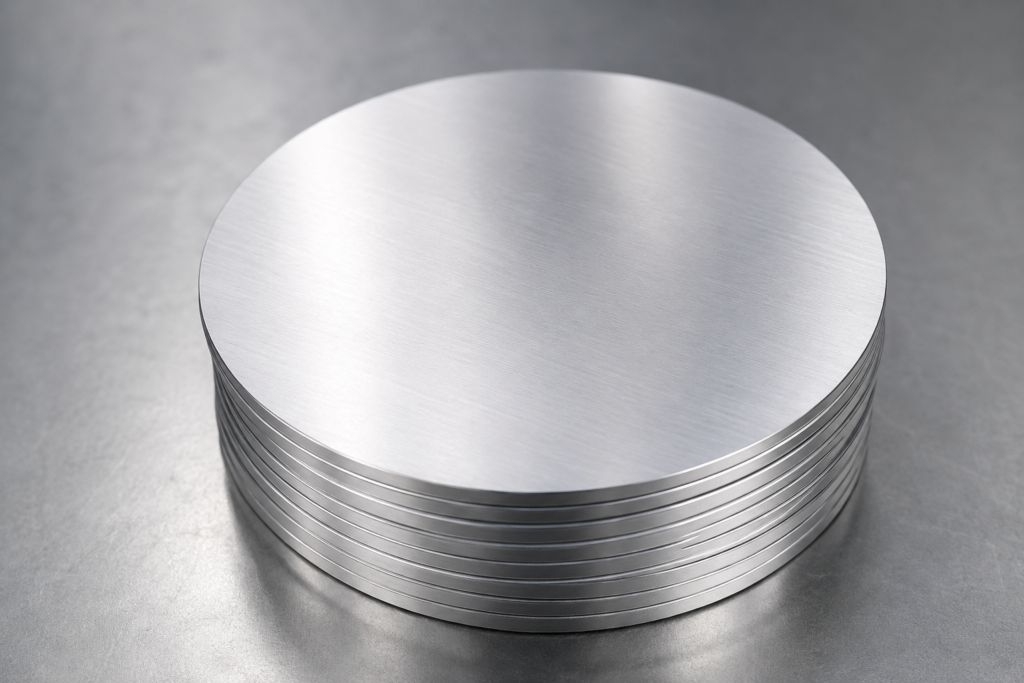
The bottom line: Choose 1100 when you need maximum ductility and the lowest cost. Choose 3003 aluminum when your application needs higher strength without giving up deep-drawing or spinning capability — which is exactly what aluminum circles for pots, pans, and round disks require.
3003 Aluminum Circle: Technical Specifications
Our 3003 aluminum circle stock covers a wide range of dimensions to match stamping, spinning, and deep-drawing production lines.
Standard Size Range
| Parameter | Range |
|---|---|
| Diameter | 100 mm – 1,200 mm (custom sizes available) |
| Thickness | 0.3 mm – 6.0 mm |
| Temper | O (annealed), H12, H14, H16, H18, H22, H24 |
| Surface Finish | Mill finish, bright finish, coated |
| Edge Type | Sheared or slit edge |
| Flatness Tolerance | ≤ 2 mm/m |
| Diameter Tolerance | +0 / -1.0 mm (standard) |
Mechanical Properties by Temper
| Temper | Tensile Strength (MPa) | Yield Strength (MPa) | Elongation (%) | Common Application |
|---|---|---|---|---|
| O (Annealed) | 110 – 145 | 40 – 55 | 20 – 25 | Deep drawing, cookware blanks |
| H12 | 130 – 165 | 115 – 150 | 6 – 10 | Light forming |
| H14 | 150 – 185 | 130 – 170 | 5 – 8 | General sheet use |
| H16 | 165 – 205 | 145 – 185 | 4 – 6 | Stiffened panels |
| H18 | 185 – 220 | 165 – 200 | 2 – 4 | Hard temper, minimal forming |
| H24 | 150 – 185 | 115 – 150 | 6 – 10 | Forming with moderate strength |
For cookware manufacturing and deep-drawing applications, O temper (fully annealed) is the standard choice. It delivers the highest elongation and the lowest flow stress, which lets dies fill cleanly without cracking.
Can You Bend 3003 Aluminum?
Yes — 3003 aluminum bends very well, especially in the O and H14 tempers. Its high manganese content improves grain refinement, which means the material stretches evenly at the bend zone without micro-cracking.
3003 Aluminum Bend Radius Guidelines
The minimum bend radius depends on temper and material thickness (t = material thickness):
| Temper | Minimum Bend Radius |
|---|---|
| O (Annealed) | 0 × t (flat bend possible) |
| H12 | 0 × t |
| H14 | 1 × t |
| H16 | 1.5 × t |
| H18 | 2.5 × t |
| H24 | 1 × t |
Practical tips for bending 3003 aluminum circles and sheet:
- Bend across the grain direction (transverse) whenever possible — you get a tighter radius before cracking.
- Use a sharp, well-lubricated die to minimize surface scratching.
- For thick circles (≥3 mm) in H14 or harder, anneal locally before a tight-radius bend.
- Cold working during bending will slightly raise the local hardness — factor this into springback calculations.
Key Applications of 3003 Aluminum Circle
The 3003 aluminum circle serves a remarkable range of industries. Its combination of deep-drawing capacity, food-grade surface quality, and mid-range strength makes it one of the most-specified round blanks globally.
Cookware and Kitchen Equipment
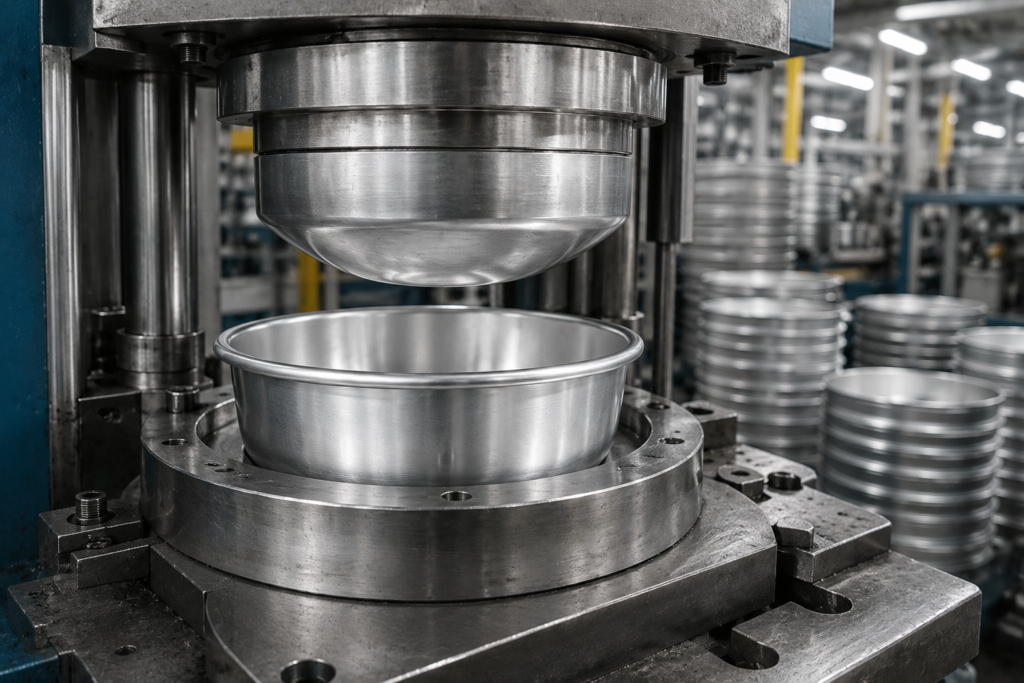
This is the largest application segment. Pot bottoms, pan blanks, pressure cooker discs, and wok circles all start as 3003 aluminum O-temper circles. The annealed temper allows multiple drawing passes without intermediate annealing in most cases. The surface stays clean and bright through spinning and forming, which supports both bare-aluminum and anodized finishes.
Road Signs and Traffic Equipment
Traffic sign blanks demand a flat, uniform surface and good outdoor corrosion resistance. 3003 aluminum circle meets both requirements. The H14 temper provides enough stiffness for sign panels while keeping weight low — critical for post-load calculations in high-wind zones.
Lighting Reflectors and Lamp Covers
Round aluminum disc blanks in 3003 H14 or H24 stamp cleanly into reflector housings. The alloy’s high reflectivity after polishing or bright-rolling makes it a natural fit for LED module housings and lamp shades.
Chemical Storage and Pressure Vessels
The non-heat-treatable nature of 3003 means its corrosion resistance stays stable even after welding. Round bottom blanks for tanks, vessels, and closures frequently use 3003 aluminum circle in thicknesses of 2.0–6.0 mm.
Spinning and Metal Craft
Artisan metalworkers and production spinning shops both prefer 3003 O-temper circles. The material flows smoothly over a mandrel without galling, and it work-hardens gradually, giving the spinner time to shape the part across multiple passes.
3003 Aluminum Circle vs. Other Common Grades
| Grade | Strength | Formability | Corrosion Resistance | Typical Circle Application |
|---|---|---|---|---|
| 1050 / 1100 | Low | Excellent | Excellent | Chemical circles, foil blanks |
| 3003 | Medium | Excellent | Excellent | Cookware, signs, lighting |
| 3004 | Medium-High | Good | Excellent | Bottle caps, deeper draws |
| 5052 | High | Good | Very Good | Structural discs, marine use |
| 6061 | Very High | Moderate | Good | Machined discs, aerospace |
For most stamped and spun circle applications, 3003 hits the sweet spot between strength, formability, and cost. It outperforms 1100 in strength, outperforms 5052 in deep-drawing ease, and costs significantly less than 6061.
3003 Aluminum Circle Price and Cost Factors
3003 aluminum price tracks the London Metal Exchange (LME) aluminum price plus a fabrication premium. As of mid-2025, mill-run 3003 aluminum coil trades in the range of USD 2,400 – 2,900 per metric ton (FOB China mill), with circle blanks carrying an additional processing premium of USD 300 – 600/ton depending on diameter, tolerance, and quantity.
Factors That Affect 3003 Aluminum Circle Cost
| Cost Driver | Impact |
|---|---|
| LME aluminum price | High — base metal accounts for 60–70% of total cost |
| Thickness | Thicker circles cost more per piece; thinner costs more per kg to process |
| Diameter | Larger diameter = more scrap from nesting; higher per-piece price |
| Temper | Annealed (O) carries a slight premium over as-rolled (H14) |
| Surface quality | Bright or mirror finish adds cost versus standard mill finish |
| Order quantity | Full-pallet or container orders attract the best 3003 aluminum price |
| Tolerance class | Tight diameter or flatness tolerance adds inspection cost |
Request a quote with your specific diameter range, thickness, temper, and annual volume — this lets us optimize the blank nesting and offer the most competitive 3003 aluminum cost per piece.
3003 Aluminum Coil: The Source Material
Every 3003 aluminum circle starts as a 3003 aluminum coil. We cast, roll, and slit coil to the exact width needed for circle blanking, which minimizes scrap and keeps your per-circle cost competitive.
3003 Aluminum Coil Specifications
| Parameter | Specification |
|---|---|
| Coil Width | 200 mm – 2,650 mm |
| Thickness | 0.2 mm – 6.0 mm |
| Inner Diameter | 505 mm or 610 mm |
| Outer Diameter | Max 1,800 mm |
| Coil Weight | 2 – 8 MT (standard), up to 12 MT on request |
| Temper | O, H12, H14, H16, H18, H22, H24, H26 |
| Surface | Mill finish, PE coated, PVDF coated |
Customers who run their own stamping lines can purchase slit 3003 aluminum coil in the exact strip width matching their blank diameter — the most cost-efficient supply format.
Quality Standards and Certifications
Our 3003 aluminum circles meet or exceed the following international standards:
| Standard | Scope |
|---|---|
| ASTM B209 | Aluminum sheet and plate — composition and mechanical properties |
| EN 573-3 | European chemical composition standard |
| EN 485-2 | Mechanical property requirements for sheet and strip |
| GB/T 3880 | Chinese national standard for aluminum alloy sheet |
| ISO 9001:2015 | Quality management system certification |
| SGS / BV | Third-party inspection available on request |
All shipments include a Mill Test Certificate (MTC) showing heat number, chemical analysis, mechanical test results, and dimensional inspection data.
Why Source 3003 Aluminum Circle from a Dedicated Manufacturer?
As a vertically integrated aluminum circle producer, we control the entire process from casting to final blanking. This gives buyers several advantages:
- Consistent chemistry — our own DC casting ensures heat-to-heat composition stability within ±0.05% on Mn.
- Flatness guarantee — leveled on a precision 21-roll leveler; flatness ≤1.5 mm/m for cookware-grade circles.
- Fast lead times — standard sizes ship from stock in 7–15 days; custom diameters in 20–35 days.
- Flexible packaging — interleaved with kraft paper, stacked on wooden pallets, or coiled strip for auto-fed presses.
- Export experience — we ship 3003 aluminum circles to over 40 countries including the USA, Germany, Brazil, Turkey, Vietnam, and South Africa.
Frequently Asked Questions
Q: What is the minimum order quantity for 3003 aluminum circle? A: Standard MOQ is 2 metric tons per size. Mixed-size orders can combine diameters to reach the minimum.
Q: Can 3003 aluminum circle be anodized? A: Yes. O-temper and H14-temper circles anodize cleanly. The manganese content creates a slightly grey anodic layer compared to 1xxx alloys — specify your finish requirement and we will recommend the correct pre-treatment.
Q: Do you supply 3003 aluminum round bar or 3003 aluminum angle in addition to circles? A: Our core product is flat-rolled circles and coil. For 3003 aluminum round bar or 3003 aluminum angle products, contact our sales team — we partner with extruded product suppliers who can supply alongside your circle order.
Q: What is the difference in price between 3003 and 1100 aluminum circle? A: 3003 typically runs 3–8% higher than 1100 on a per-kilogram basis, reflecting the added manganese and slightly higher processing cost. The strength premium usually makes it the better value for structural or cookware applications.
Get a Quote for 3003 Aluminum Circle
Tell us your required diameter(s), thickness, temper, surface finish, and estimated monthly volume. Our technical team will confirm dimensional feasibility, recommend the right temper for your process, and return a competitive 3003 aluminum price within 24 hours.
Contact us today to request samples, a Mill Test Certificate from current stock, or a full container price for your next production run.