
What Is an Aluminium Circle for Utensil?
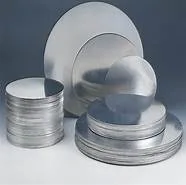
An aluminium circle for utensil is a round, flat aluminum blank cut or rolled into disc form. It serves as the starting material for making pots, pans, pressure cookers, and other kitchen utensils. It is one of the most widely traded aluminum semi-finished products in global cookware manufacturing.
The term utensil circle or aluminium circle utensil is commonly used by procurement teams across South Asia, the Middle East, Africa, and Southeast Asia — regions with high cookware production volume.
Unlike general-purpose aluminum circle plates or aluminum circle rings used in signage or engineering, utensil-grade aluminium circles require strict food-safety alloy standards, consistent surface quality, and excellent formability to withstand deep drawing without cracking.
Common Alloys and Tempers
Alloy choice is the first decision in any aluminium circle for utensil project. Each alloy offers different strength, corrosion resistance, and deep-drawing performance.
| Alloy | Temper | Key Feature | Typical Use |
|---|---|---|---|
| 1050 | O / H14 / H24 | High purity (≥99.5%), excellent formability | Pressure cookers, thin pans |
| 1060 | O / H12 | Slightly stronger than 1050, good surface | Fry pans, sauce pans |
| 1100 | O / H14 | Good corrosion resistance, food-grade | General cookware circles |
| 3003 | O / H14 / H24 | Mn alloy, higher strength | Pressure cookers, heavy-duty pans |
| 8011 | O | Flexible, cost-effective | Lid circles, shallow containers |
For most standard aluminium circle pans and aluminium circle pan with lid applications, alloys 1050, 1060, and 3003 in annealed (O) temper are the most common choices. They offer the best balance of deep-drawing capability and finished-product strength.
Standard Specifications
When sourcing an aluminium circle for utensil, buyers typically specify the following parameters.
| Parameter | Typical Range | Notes |
|---|---|---|
| Thickness | 0.5 mm – 6.0 mm | 1.0–3.0 mm most common for pans |
| Diameter | 100 mm – 1200 mm | 200–600 mm covers most cookware |
| Alloy | 1050 / 1060 / 1100 / 3003 / 8011 | Specified by buyer |
| Temper | O, H12, H14, H22, H24 | O (annealed) preferred for deep draw |
| Surface | Mill finish / bright / one-side bright | Bright finish for non-stick coating base |
| Edge | Shear cut / milled edge | Milled edge reduces cracking in drawing |
| Thickness tolerance | ±0.02 mm – ±0.05 mm | Tighter tolerance = fewer rejects |
| Tensile strength (1050-O) | ≥65 MPa | Per GB/T 3880 or EN 485 |
| Elongation (1050-O) | ≥23% | Key indicator for formability |
Surface quality matters especially for aluminum circle pans that receive non-stick (PTFE/ceramic) or anodizing finishes. Scratches, inclusions, or edge burrs in the base circle create coating defects in the finished pan.
Applications
The aluminium circle for utensil market serves a wide range of end products. Understanding the application helps buyers choose the correct alloy and surface specification.
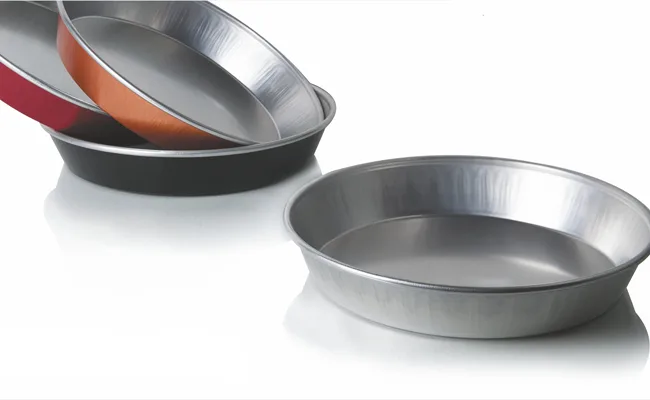
Cookware pans — Fry pans, sauce pans, woks. Drawn from aluminium circle, then non-stick coated or polished. Alloy 1050/1060-O is standard.
Pressure cookers — Require 3003 alloy for higher wall strength. Body and lid are separate circles, drawn to shape.
Aluminium circle pan with lid — Both pan body and lid are sourced from circles of different diameters and thicknesses. Often ordered as paired sets.
Aluminum circle container — Food storage containers, tiffin boxes, baking trays. Thinner gauge (0.5–1.2 mm), alloy 8011 or 1100.
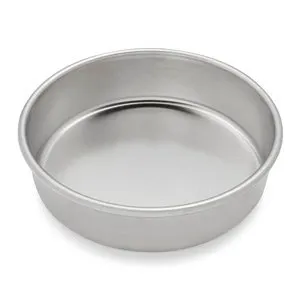
Aluminum circle tin — Baking tins and cake moulds. Requires consistent thickness and flat surface for even heat distribution.
Aluminum rings and flanges — Some buyers cut aluminum rings from circle blanks for utensil handles or pot rim reinforcement.
Price Factors
The price of an aluminium circle for utensil depends on several variables. Understanding these factors helps buyers negotiate effectively.
- Alloy grade — 3003 costs more than 1050/1060 due to higher manganese content and additional processing steps.
- Thickness and diameter — Larger and thicker circles use more raw material per piece.
- Temper — Annealed (O) temper requires an additional annealing step and adds cost.
- Surface finish — Bright or one-side bright finish adds polishing cost.
- Order quantity — MOQ typically starts at 3–5 metric tons. Larger orders reduce per-kg cost significantly.
- LME aluminum price — Base price fluctuates with London Metal Exchange quotes. Most suppliers quote as LME + processing premium.
- Edge treatment — Milled edge costs more than plain shear cut but reduces drawing defects.
For reference, FOB China pricing for standard 1050-O aluminium circles for utensil in the 1–3 mm thickness range typically falls in the USD 2,400–3,200 per metric ton range, depending on alloy, finish, and order size. Always request a current quote with a clear LME reference date.
How to Test Quality Before Mass Order
Before placing a large order of aluminium circle utensils blanks, experienced buyers request samples and perform the following checks.
| Test | What to Check | Pass Criterion |
|---|---|---|
| Thickness measurement | 10+ points across the disc | Within ±0.03 mm of spec |
| Diameter check | Two perpendicular measurements | Within ±1 mm |
| Surface inspection | Scratches, oil stains, inclusions | No visible defects |
| Cup test (Erichsen) | Deep-drawing simulation | No cracks at target draw ratio |
| Tensile test | UTS, yield strength, elongation | Per EN 485 / GB/T 3880 |
| Chemical composition | Al purity, Mn, Si, Fe content | Per alloy standard |
| Hardness (HB) | Uniformity across disc | Per temper spec |
Why Choose a Manufacturer Over a Trading Company?
When sourcing aluminium circles for utensil production, buying from a verified manufacturer offers clear advantages.
- Direct control over alloy composition and processing parameters
- Ability to customize diameter, thickness, temper, and surface finish to your exact drawing specifications
- Mill test certificates (MTC) issued directly — no third-party paperwork chain
- Consistent batch-to-batch quality, critical for automated drawing lines
- Competitive pricing without trader markup
- Faster response to custom aluminum circle plate or aluminum circle ring requirements
Look for manufacturers with ISO 9001 certification, verifiable production capacity of at least 5,000 MT/month, and proven export experience to your target region.
Export Markets
| Region | Key Countries | Common Product |
|---|---|---|
| South Asia | India, Bangladesh, Pakistan, Sri Lanka | Pressure cooker circles, 3003 alloy |
| Middle East | Turkey, Iran, UAE, Saudi Arabia | 1050/1060 fry pan circles |
| Africa | Nigeria, Ethiopia, Egypt, Kenya | General cookware blanks, 1050-O |
| Southeast Asia | Vietnam, Indonesia, Thailand | Thin gauge circles for stamped lids |
| Europe | Poland, Italy, Germany | High-tolerance circles, EN 485 standard |
Packaging and Shipping
Standard packaging for aluminium circle for utensil export shipments:
- Stacked in bundles with interleaving paper between circles to prevent surface scratching
- Wrapped in kraft paper and plastic film, strapped with steel bands
- Wooden pallet base (ISPM 15 heat-treated for international shipping)
- Each bundle typically 500–1,000 kg depending on circle size
- Full container load (FCL): a 20 ft container holds approximately 18–22 MT
Frequently Asked Questions
What is the difference between an aluminium circle and an aluminium disc? They are the same product. “Aluminium circle” and “aluminium disc” are interchangeable terms in the industry. “Circle” is more common in Chinese export documentation; “disc” appears more in European and North American specifications.
Can aluminium circles for utensil be anodized? Yes. After drawing into pan form, many manufacturers anodize the finished utensil for hard-surface durability. The circle blank should have a bright or mill finish and low iron content for best anodizing results. Alloy 1050 and 1060 anodize better than 3003.
What is the standard MOQ for aluminium circles? Most manufacturers set a minimum order quantity of 3–5 metric tons per specification. Mixed specifications in one order are accepted by most suppliers at a slightly higher price.
Are aluminium circles for utensil food-safe? Yes. Alloys 1050, 1060, 1100, and 3003 are all food-grade aluminum alloys. They comply with FDA 21 CFR and EU food contact material regulations when produced without prohibited lubricants or coatings.
Need a quote for aluminium circles for utensil? Contact us with your alloy, thickness, diameter, and monthly quantity requirements. We provide mill test certificates and free samples for qualified buyers.