Round Aluminum Circles for Cooking
When cookware factories and kitchenware producers source raw materials, round aluminum circles for cooking are the starting point for almost every aluminum pot, pan, wok, and lid on the market. The quality of the aluminum circle directly determines how well the finished cookware draws, how evenly it heats, how cleanly it anodizes, and how long it performs in daily kitchen use.
This guide covers everything manufacturers and procurement teams need to know: what round aluminum circles for cooking are, which alloys perform best, temper selection, standard sizes, surface quality requirements, how to evaluate deep drawing performance, price factors, and how to order.


1. What Are Round Aluminum Circles for Cooking?
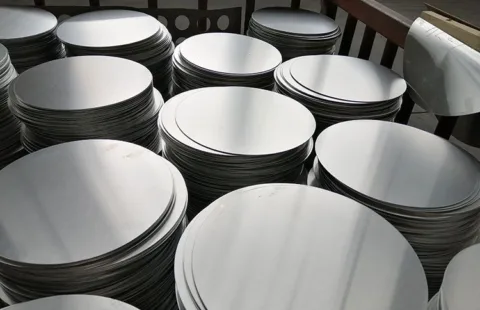
Round aluminum circles for cooking are flat, circular aluminum blanks punched or cut from aluminum sheet or coil. They are the primary raw material for manufacturing:
- Frying pans
- Sauce pans and cooking pots
- Woks
- Pressure cooker bodies
- Rice cooker inner pots
- Milk pans and saucepans
- Cooking lids and covers
- Kettle bodies
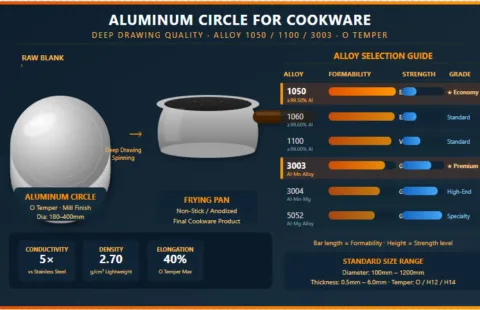
The circle is formed into the final cookware shape through deep drawing, spinning, or stamping. This means the aluminum circle must have the right alloy, temper, surface finish, and grain structure to form cleanly without cracking or surface defects.
Round aluminum circles for cooking are also called:
- Aluminum disc for cookware
- Aluminum circle blank
- Round aluminum cooking blank
- Deep drawing aluminum circle
- Aluminium circle for cookware
2. Why Aluminum Is the Best Material for Cooking Circles
Aluminum dominates the cookware raw material market for practical reasons.
Thermal conductivity is the most important factor. Aluminum conducts heat approximately five times better than stainless steel. This means faster, more uniform heating across the cooking surface — less hot spots, more even cooking results.
Lightweight makes aluminum cookware easier to handle in the kitchen. A standard aluminum frying pan weighs significantly less than an equivalent stainless steel or cast iron pan.
Formability allows complex shapes — deep pots, curved wok profiles, and flat pan bases — to be produced reliably by deep drawing with low scrap rates.
Food safety is well established. Aluminum alloys 1050, 1060, 1100, and 3003 are all food-safe and meet FDA, EU, and GB standards for food contact.
Cost is lower than stainless steel or copper for equivalent thermal performance, making aluminum the material of choice for mass-market and mid-range cookware.
Surface compatibility with non-stick coatings, hard anodizing, ceramic coating, and polishing makes aluminum suitable for every category of finished cookware.
3. Best Alloys for Round Aluminum Circles for Cooking
Alloy selection is the most important specification decision. Different alloys offer different combinations of purity, strength, formability, and surface quality for anodizing.
1050 Aluminum Cooking Circle
1050 aluminum is one of the most widely used alloys for cooking circles in standard and economy product lines.
- Aluminum content: ≥ 99.50%
- Strength: low
- Formability: excellent
- Thermal conductivity: very high
- Surface quality: good for non-stick coating
- Food safe: yes
Best for: standard pots, frying pans, lids, rice cooker parts, economy cookware
1060 Aluminum Cooking Circle
1060 aluminum offers marginally higher purity than 1050.
- Aluminum content: ≥ 99.60%
- Slightly better electrical and thermal conductivity than 1050
- Excellent formability
Best for: standard cookware, heating elements, economy to mid-range products
1100 Aluminum Cooking Circle
1100 aluminum is a commercial-purity alloy that offers slightly more strength than 1050 and 1060 while maintaining excellent formability.
- Aluminum content: ≥ 99.00%
- Strength: low to medium
- Very good formability
Best for: general cookware, food processing equipment, moderate forming depths
3003 Aluminum Cooking Circle
3003 aluminum is an aluminum-manganese alloy. It is approximately 20% stronger than 1100 while maintaining good formability.
- Alloy type: Al-Mn
- Strength: medium
- Formability: good
- Excellent corrosion resistance
- Very good for hard anodizing
Best for: quality frying pans, woks, pressure cooker bodies, hard-anodized cookware, mid-range to premium products
Alloy Comparison for Cooking Circles
| Alloy | Al Content | Strength | Formability | Hard Anodizing | Best Use |
|---|---|---|---|---|---|
| 1050 | ≥99.50% | Low | Excellent | Good | Economy pots and pans |
| 1060 | ≥99.60% | Low | Excellent | Good | Standard cookware |
| 1100 | ≥99.00% | Low-Med | Excellent | Good | General cookware |
| 3003 | Al-Mn | Medium | Good | Very Good | Premium and hard-anodized cookware |
4. Temper Selection for Cooking Circles
The temper determines how soft or hard the circle is when it arrives at the cookware factory. The right temper depends on the forming method and draw depth required.
O Temper (Annealed) — Best for Deep Drawing
O temper is the softest and most ductile condition. Fully annealed. Maximum elongation. Minimum cracking risk.
- Elongation: 25–40% depending on alloy
- Best for: deep pots, sauce pans, woks, pressure cooker bodies
- Standard for: most deep drawing cookware production
H12 Temper — Light Forming
- 1/4 hard — slightly stronger than O
- Suitable for shallow forming operations
- Used for: lids, shallow pans, stamped components
H14 Temper — Shallow Stamping
- 1/2 hard
- Good rigidity for flat parts and lids
- Less suitable for deep drawing
Temper Quick Guide for Cooking
| Temper | Elongation | Best Forming | Typical Cookware Use |
|---|---|---|---|
| O | 25–40% | Deep drawing ✅ | Pots, pans, woks, pressure cookers |
| H12 | 10–18% | Light forming ✅ | Shallow pans, lids |
| H14 | 4–10% | Stamping only | Flat lids, shallow parts |
For most cooking circle applications, O temper is the standard specification.
5. Standard Sizes of Round Aluminum Circles for Cooking
Thickness
| Thickness | Typical Cookware Application |
|---|---|
| 0.8 – 1.2 mm | Thin lids, lightweight inserts |
| 1.2 – 2.0 mm | Standard lids, shallow sauce pans |
| 2.0 – 3.0 mm | Standard frying pans, quality pots |
| 3.0 – 4.5 mm | Quality frying pans, woks |
| 4.5 – 6.0 mm | Heavy-duty pots, pressure cooker bodies |
Diameter
| Diameter | Typical Finished Cookware |
|---|---|
| 100 – 160 mm | Small lids, milk pan blanks |
| 160 – 220 mm | Small frying pans, sauce pans |
| 220 – 280 mm | Standard frying pans (22–28 cm) |
| 280 – 340 mm | Large frying pans, woks |
| 340 – 420 mm | Extra-large pans, stock pot blanks |
| 420 – 600 mm | Large woks, industrial cookware |
| 600 – 1200 mm | Oversized industrial blanks |
Most residential cookware production uses circles in the 180 mm to 380 mm diameter range.
Round Aluminum Food Containers and Dishes
Round aluminum food containers and round aluminum dishes use thinner and smaller circles. These products are formed by shallower stamping rather than deep drawing.
| Product | Circle Diameter | Thickness |
|---|---|---|
| Round aluminum food container | 100–280 mm | 0.04–0.10 mm foil / 0.5–1.5 mm sheet |
| Round aluminum cooking pan (disposable) | 150–350 mm | 0.05–0.12 mm foil |
| Round aluminum dish (baking) | 180–320 mm | 0.08–0.15 mm foil |
| Round aluminum cooking pan (reusable) | 200–400 mm | 1.5–3.5 mm sheet |
6. Round Aluminum Cooking Pans: From Circle to Finished Pan
Understanding how a round aluminum cooking pan is made from a circle helps buyers specify correctly.
Deep Drawing Process
Step 1 — Circle blanking: Flat aluminum sheet or coil is stamped into round circles of the required diameter.
Step 2 — First draw: The circle is drawn into a shallow cup shape by a punch pressing through a die.
Step 3 — Re-drawing: The cup is progressively drawn deeper and narrower through additional draw stages until the target depth is reached.
Step 4 — Trimming: The uneven top edge is trimmed to a clean, even rim.
Step 5 — Finishing: The pan receives its final surface treatment — non-stick coating, hard anodizing, polishing, or painting.
Key Forming Parameters
| Parameter | Typical Value |
|---|---|
| Draw ratio (blank Ø / punch Ø) | 1.6 – 2.2 for single draw |
| Number of draw stages | 1–3 depending on depth |
| Lubrication | Dry or light oil |
| Annealing between draws | Required for deep pots |
The drawing ratio and number of stages depend on the alloy, temper, and target depth. Your circle supplier should be able to confirm suitability for your specific draw ratio.
7. Surface Quality Requirements
For round aluminum circles for cooking, surface quality is as important as mechanical properties. Poor surface creates visible defects in finished cookware.
Surface Quality Checklist
| Requirement | Why It Matters |
|---|---|
| No cracks | Cracks cause forming failure and rejection |
| No scratches | Scratches appear after anodizing and polishing |
| No oil stains | Contamination affects non-stick coating adhesion |
| No oxidation spots | Dark spots appear after hard anodizing |
| No roll marks | Rolling defects show on finished cookware surface |
| Uniform thickness | Variation causes uneven wall thickness after drawing |
| Good flatness | Warped circles cause tooling alignment problems |
| Low burr edge | Sharp edges damage tooling and cause coating failure |
| Consistent grain structure | Fine, even grain gives better drawing performance |
Surface Finish Options
| Finish | Description | Best For |
|---|---|---|
| Mill finish | Standard as-rolled surface | Standard non-stick cookware |
| Bright finish | Polished surface | Anodized and decorative cookware |
| Anodizing quality | Premium surface, tight tolerances | Hard anodized premium cookware |
| Cleaned / degreased | Oil-free surface | Sensitive coating processes |
8. Round Aluminum Circles for Crafts vs Cooking Circles
Some buyers search for aluminum circles for crafts alongside cooking circles. These are similar products but have different requirements.
| Specification | Cooking Circles | Craft Circles |
|---|---|---|
| Alloy | 1050, 1060, 1100, 3003 | 1050, 1100, 3003 |
| Temper | O (deep drawing) | O, H14 (flat work) |
| Thickness | 1.0–6.0 mm | 0.5–3.0 mm |
| Diameter | 100–1200 mm | 50–500 mm |
| Surface | Anodizing quality | Mill / anodized / colored |
| Key requirement | Formability, grain structure | Surface appearance, flatness |
| Typical use | Pots, pans, woks | Decorative discs, signs, art |
If you are producing cookware, specify deep drawing quality and confirm grain structure with your supplier. Craft circles do not require the same forming performance.
9. Hard Anodized Cookware Circles
Hard anodized cookware is a premium product category. The round aluminum circle for hard anodized pans has stricter requirements than standard cookware circles.
Requirements for Hard Anodizing Quality
- Alloy: 3003 preferred (1050, 1060 also used)
- Surface: anodizing quality — no defects, no inclusions
- Grain structure: uniform and fine
- Thickness tolerance: tight — typically ±0.05 mm
- Edge: fully deburred — no sharp edges or burrs
- Cleanliness: oil-free or light lubrication compatible with anodizing
Hard anodizing creates a thick, hard oxide layer on the surface. Any surface defect in the base circle becomes magnified and visible after anodizing. Surface quality must be verified before bulk production.
10. Price Factors for Round Aluminum Circles for Cooking
The price of round aluminum circles for cooking depends on several variables.
| Factor | Effect on Price |
|---|---|
| Alloy | 3003 > 1100 > 1060 > 1050 |
| Temper | O temper may require additional annealing |
| Diameter | Larger diameter increases material and scrap rate |
| Thickness | Thicker = more material per circle |
| Surface finish | Anodizing quality and bright finish cost more |
| Edge condition | Deburred and rounded edge adds cost |
| Quantity | Larger orders reduce unit cost significantly |
| Packaging | Interleaved paper packing adds cost but protects surface |
| Certification | Test reports and third-party inspection add cost |
| LME aluminum price | Base metal price changes with market conditions |
For accurate pricing, send your complete specification: alloy, temper, diameter, thickness, surface, edge, quantity, and delivery destination.
11. Packaging for Export Shipment
Cookware factories often import circles in bulk. Packaging protects surface quality during long-distance shipping.
| Packaging Method | Description | Recommended For |
|---|---|---|
| Interleaved paper | Paper between each disc | Anodizing quality, bright finish |
| Wooden export pallet | Circles stacked on pallet | Standard bulk shipment |
| Moisture barrier film | Outer wrap protects from humidity | Ocean freight |
| Carton box | Small circles in sealed box | Air freight, small orders |
| Steel strapping | Secures pallet for transit | Heavy loads |
For hard anodized and bright finish circles, interleaved paper between every disc is essential. Direct contact causes surface scratches.
12. How to Order: RFQ Checklist
Send the following information for an accurate quote:
- Alloy: 1050 / 1060 / 1100 / 3003
- Temper: O / H12 / H14
- Diameter: mm — with tolerance requirement
- Thickness: mm — with tolerance requirement
- Surface: mill finish / bright finish / anodizing quality
- Edge: sheared / deburred / rounded
- Application: deep drawing / spinning / stamping
- Final product: frying pan / pot / wok / lid / pressure cooker
- Quantity: pieces or metric tons per order
- Packaging: interleaved paper / wooden pallet / export carton
- Certification: mill test certificate / food contact declaration
- Delivery term: FOB / CIF / DDP
- Destination port or address
13. Why Source Round Aluminum Circles for Cooking From Us
We supply round aluminum circles for cooking to cookware manufacturers across Asia, Europe, the Middle East, and the Americas.
Our advantages:
✅ Full alloy range — 1050, 1060, 1100, 3003 available
✅ O, H12, and H14 tempers in stock
✅ Deep drawing quality — tested and confirmed
✅ Anodizing quality surface for hard anodized cookware
✅ Any diameter from 100 mm to 1200 mm
✅ Any thickness from 0.5 mm to 6.0 mm
✅ Interleaved paper packaging for surface protection
✅ Food contact compliance — FDA, EU, GB standards
✅ Mill test certificate with every order
✅ Competitive factory pricing
✅ Fast RFQ — reply within 24 hours
Frequently Asked Questions
Q: What alloy is best for round aluminum circles for cooking?
A: For standard cookware, 1050 or 1060 in O temper is most common. For hard anodized and premium cookware, 3003 is recommended.
Q: What temper should I use for deep drawing cooking pans?
A: O temper (fully annealed) gives maximum elongation and minimum cracking risk. It is the standard for deep drawing pots and pans.
Q: What is the standard diameter for frying pan circles?
A: Most 20–28 cm frying pans use circles in the 220–340 mm diameter range. The exact diameter depends on the draw ratio and wall height of the finished pan.
Q: What is the difference between round aluminum circles for cooking and for crafts?
A: Cooking circles require deep drawing quality with controlled grain structure and anodizing-quality surface. Craft circles focus on surface appearance and flatness rather than forming performance.
Q: Can round aluminum circles be used for round aluminum food containers?
A: Thinner circles (0.04–0.15 mm foil grade) are used for disposable food containers. Thicker circles (1.0–3.5 mm) are used for reusable cookware.
Q: Do you provide food contact compliance documentation?
A: Yes. We provide food contact declarations for FDA, EU Regulation 1935/2004, and GB standards on request.
Conclusion
Round aluminum circles for cooking are precision raw materials. Alloy, temper, diameter, thickness, surface quality, and edge condition all affect forming performance and finished cookware quality.
Whether you produce standard non-stick frying pans, premium hard-anodized woks, or pressure cooker bodies, the aluminum circle is where cookware quality begins. Choosing the right specification from the start reduces forming failures, surface defects, and rework costs.
Contact us with your diameter, thickness, alloy, temper, quantity, and application. We respond within 24 hours with pricing, availability, and samples on request.