Deep Drawing Aluminium Circle 3003
What Is Deep Drawing Aluminium Circle 3003?
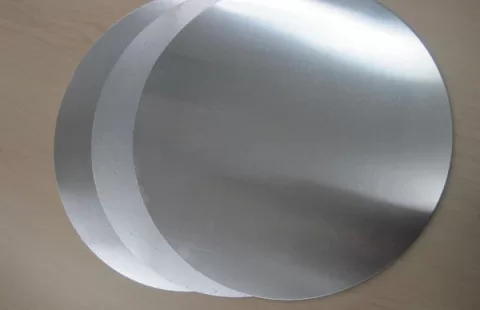
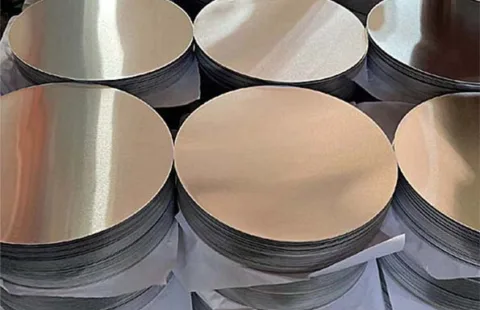
Deep drawing aluminium circle 3003 is a specially processed aluminum disc used in deep drawing manufacturing. It is one of the most popular materials for producing deep drawn aluminum parts. The 3003 alloy belongs to the manganese-aluminum series. It offers excellent formability, corrosion resistance, and moderate strength.
Manufacturers worldwide choose 3003 aluminum circles for deep drawing because of their superior ductility. This means the material can be stretched and formed without cracking or tearing.


Why Choose 3003 Alloy for Deep Drawing Aluminum?
Not all aluminum alloys work well for deep drawing. The 3003 alloy stands out for several reasons.
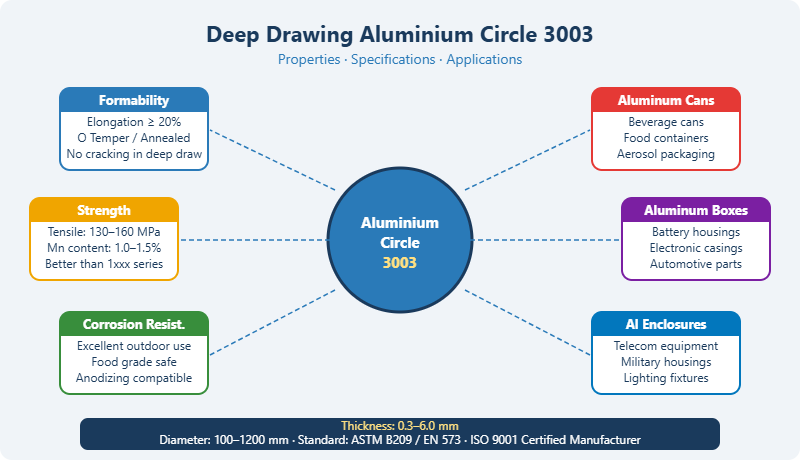
Key properties of 3003 aluminum circle:
- Manganese content: 1.0%–1.5%
- Tensile strength: 130–160 MPa
- Elongation rate: ≥20%
- Excellent surface finish after drawing
- Good weldability and anodizing performance
- Corrosion resistant in most environments
These properties make it ideal for deep drawn aluminum cans, deep drawn aluminum boxes, and deep drawn aluminum enclosures.
Main Applications of Deep Drawing Aluminium Circle 3003
1. Deep Drawing Aluminum Cans
The food and beverage industry relies heavily on deep drawn aluminum cans. 3003 aluminum circles provide the thin walls and smooth surfaces needed. They resist corrosion from acidic foods and beverages. The material also meets food-grade safety standards.
Common products include:
- Beverage cans
- Food storage cans
- Aerosol cans
- Oil containers
2. Deep Drawn Aluminum Boxes
Deep drawn aluminum boxes are used in electronics, automotive, and industrial packaging. The 3003 circle allows manufacturers to form complex box shapes in a single or multi-step process. The result is a seamless, strong enclosure.
Applications include:
- Battery housings
- Electronic component boxes
- Medical device casings
- Automotive parts storage
3. Deep Drawn Aluminum Enclosures
Deep drawn aluminum enclosures protect sensitive equipment. They are lightweight yet durable. The 3003 alloy ensures uniform wall thickness during forming. This is critical for enclosures that need precise dimensions.
Industries using deep drawn aluminum enclosures:
- Telecommunications
- Military and defense
- Consumer electronics
- Lighting fixtures
4. Cookware and Kitchen Products
Deep drawing aluminium circle 3003 is widely used in cookware production. Pots, pans, and pressure cookers often start as flat aluminum circles. The deep drawing process forms them into the final shape.
5. Automotive Components
The automotive industry uses deep drawn aluminum for fuel system parts, filters, and structural components. The 3003 alloy handles the mechanical stress of drawing while keeping the part lightweight.
Deep Drawing Aluminum Process: How It Works
Understanding the process helps buyers choose the right material specifications.
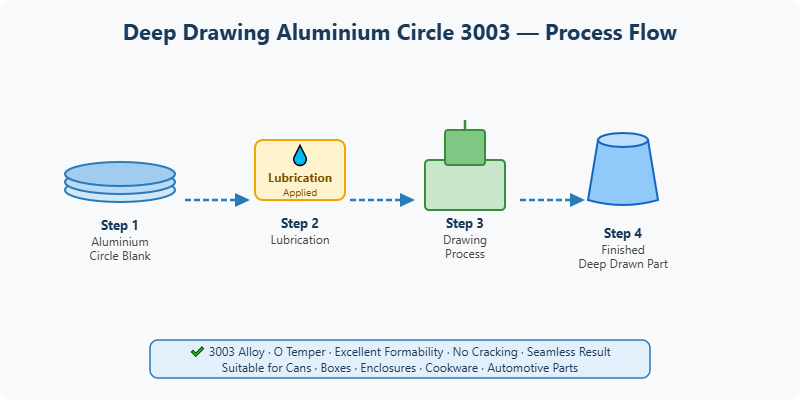
Step 1: Blank cutting
Flat aluminium circles are cut from rolled sheets or produced directly as discs.
Step 2: Lubrication
The circle is coated with lubricant to reduce friction during forming.
Step 3: Drawing
A punch presses the aluminum circle into a die. The material flows inward and forms the desired shape.
Step 4: Re-drawing (if needed)
For deep parts, the process repeats in multiple stages. Each stage deepens the form gradually.
Step 5: Trimming and finishing
Excess material is trimmed. The surface may be anodized, polished, or coated.
The 3003 alloy handles multiple re-drawing steps without annealing in many cases. This saves time and production cost.
Specifications of Deep Drawing Aluminium Circle 3003
| Parameter | Typical Range |
|---|---|
| Alloy | 3003 |
| Temper | O (fully annealed) |
| Thickness | 0.3 mm – 6.0 mm |
| Diameter | 100 mm – 1200 mm |
| Surface | Mill finish, bright finish |
| Standard | ASTM B209, EN 573 |
The O temper (annealed) is the most common for deep drawing. It provides maximum ductility and minimum hardness.
How to Select the Right Deep Drawing Aluminum Circle
Choosing the correct specifications affects your production quality and cost.
Consider these factors:
Thickness: Thinner circles (0.3–1.0 mm) suit cans and lightweight enclosures. Thicker circles (1.5–6.0 mm) suit heavy-duty boxes and industrial parts.
Diameter: The blank diameter depends on the final product size and drawing ratio. A general rule is that the blank diameter should be larger than the finished part diameter by a calculated amount based on draw depth.
Surface quality: For anodized or polished final products, choose bright finish circles. Mill finish is acceptable for painted or coated products.
Temper: Always use O temper for deep drawing. H temper alloys are too hard and will crack.
Deep Drawing Aluminum vs. Other Materials
| Property | Aluminum 3003 | Steel | Stainless Steel |
|---|---|---|---|
| Weight | Light | Heavy | Medium |
| Corrosion resistance | Excellent | Poor | Excellent |
| Formability | Excellent | Good | Moderate |
| Cost | Medium | Low | High |
| Recyclability | High | High | High |
Deep drawing aluminum clearly wins on weight and corrosion resistance. This is why it replaces steel in many modern applications.
What Makes a Good Deep Drawing Aluminium Circle Supplier?
When sourcing deep drawing aluminium circle 3003, the supplier’s quality control matters greatly.
Look for these qualities in a supplier:
- Consistent chemical composition across batches
- Tight thickness tolerance (±0.02 mm or better)
- Smooth, defect-free surface (no scratches, oil stains, or edge cracks)
- Certified to international standards (ISO, ASTM, EN)
- Ability to customize diameter and thickness
- Reliable delivery schedule
- Export experience to your target market
Advantages of Deep Drawn Aluminum Products
Deep drawing produces aluminum parts with specific advantages over other manufacturing methods.
Seamless construction: No welds or joints mean better strength and leak resistance.
Tight tolerances: The process achieves consistent dimensions across large production runs.
Material efficiency: Deep drawing wastes less material compared to machining.
Surface quality: The drawn surface is smooth and ready for finishing.
High production speed: Once tooling is set, production runs are fast and cost-effective.
Lightweight: Aluminum parts weigh about one-third of equivalent steel parts.
Common Quality Issues in Deep Drawing Aluminum
Understanding quality issues helps buyers inspect incoming material.
Wrinkling: Occurs when the blank holder pressure is too low. The material folds instead of flowing smoothly.
Cracking: Happens when the alloy is too hard, the draw ratio is too high, or lubrication is poor. 3003 O temper minimizes this risk.
Thinning: Excessive thinning at the bottom radius weakens the part. Proper tooling design prevents this.
Surface defects: Scratches or marks on the circle transfer to the finished part. High-quality circles prevent this.
Choosing certified 3003 aluminium circles from a reputable supplier reduces all these risks.
Price Factors for Deep Drawing Aluminium Circle 3003
The price of 3003 aluminum circles depends on several variables.
Main price factors:
- London Metal Exchange (LME) aluminum price — the base cost fluctuates with global market conditions
- Thickness and diameter — larger and thicker circles require more material and processing
- Surface finish — bright finish costs more than mill finish
- Order quantity — larger orders receive better unit pricing
- Delivery terms — FOB, CIF, or DDP affects the final landed cost
For accurate pricing, contact suppliers with your exact specifications including alloy, temper, thickness, diameter, and required quantity.
Why We Are a Reliable Manufacturer of Deep Drawing Aluminium Circles
As a professional aluminium circle manufacturer, we supply deep drawing aluminium circle 3003 to customers in over 30 countries. Our production capabilities include:
- Monthly capacity exceeding 3,000 metric tons
- Thickness range: 0.3 mm to 6.0 mm
- Diameter range: 100 mm to 1,200 mm
- Strict quality control at every production stage
- ISO 9001 certified production facility
- Competitive factory-direct pricing
- On-time delivery with full shipping documentation
We serve customers producing deep drawn aluminum cans, deep drawn aluminum boxes, deep drawn aluminum enclosures, cookware, automotive components, and more.
Frequently Asked Questions
What is the best aluminum alloy for deep drawing?
3003 and 1050/1060 are the most common. 3003 offers better strength than 1050/1060 while maintaining excellent formability.
What temper should I use for deep drawing aluminum?
Always use O temper (fully annealed). It provides the highest ductility needed for deep drawing.
Can 3003 aluminum be anodized after deep drawing?
Yes. 3003 anodizes well, though the surface appearance may differ slightly from 1xxx series alloys due to its manganese content.
What is the maximum draw ratio for 3003 aluminum?
A draw ratio of approximately 2.0 to 2.2 is achievable in a single draw. Multiple draws can achieve greater depths.
Is 3003 aluminum food safe?
Yes. 3003 aluminum meets food-contact safety requirements and is widely used in food packaging and cookware.
Conclusion
Deep drawing aluminium circle 3003 is the preferred material for producing deep drawn aluminum cans, deep drawn aluminum boxes, and deep drawn aluminum enclosures. Its combination of formability, corrosion resistance, and moderate strength makes it suitable for a wide range of industries.
Choosing the right alloy, temper, and supplier ensures consistent quality in your deep drawing aluminum production. Contact us today for specifications, samples, and competitive pricing on 3003 aluminium circles.