Round Aluminum Circles Plate Disc
What Is a Round Aluminum Circle Plate Disc?
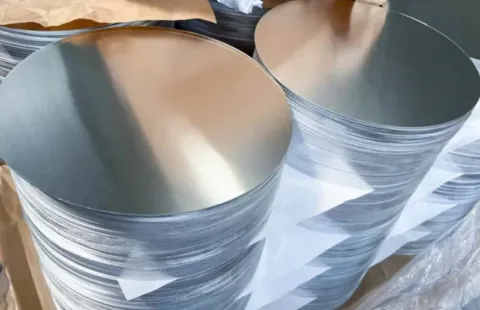
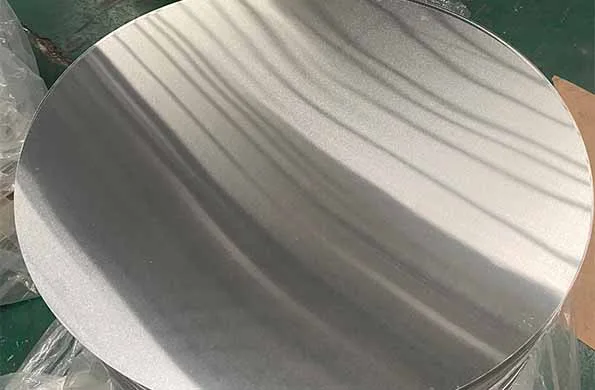
A round aluminum circle is a flat, disc-shaped piece of aluminum. Manufacturers cut it from aluminum sheets or coils. The result is a perfectly round aluminum blank with smooth edges and a uniform surface.
People use different names for this product:
- Round aluminum circle
- Aluminum disc
- Aluminum circle plate
- Round aluminum plate
- Aluminium discs circles
- Aluminum circle blank
All these names refer to the same product. The shape is always round. The material is always aluminum. The difference is usually in thickness, diameter, alloy grade, and surface finish.
Round aluminum circles are one of the most widely used aluminum products in the world. They are the starting material for cookware, signs, lighting reflectors, road signs, and many other products.
Why Choose Round Aluminum Circles?
Buyers around the world choose aluminum circles and discs for good reasons. Here are the main advantages:
Lightweight and Strong
Aluminum is much lighter than steel or copper. A round aluminum disc weighs about one-third of a steel disc of the same size. This makes aluminum discs easier to handle, transport, and fabricate. Despite being light, aluminum still offers excellent strength for most applications.
Excellent Corrosion Resistance
Aluminum naturally forms a thin oxide layer on its surface. This layer protects the metal from moisture, chemicals, and environmental exposure. Round aluminum circles last a long time without rusting or degrading.
Easy to Form and Shape
Aluminum is very easy to stamp, press, spin, and deep draw. Round aluminum circle plates are the ideal starting shape for deep drawing operations. Cookware manufacturers use them to press pots, pans, and lids. The round shape fits perfectly into pressing dies.
Good Thermal Conductivity
Aluminum conducts heat very well. This makes aluminum discs and circles the top choice for cookware and heat exchanger components. Heat spreads evenly across the surface.
Food Safe
High-purity aluminum alloys like 1050, 1060, and 3003 are safe for food contact. Cookware manufacturers rely on aluminum circle plates as their primary raw material.
Recyclable and Sustainable
Aluminum is 100% recyclable. Recycling aluminum uses only 5% of the energy needed to produce new aluminum. Choosing aluminum discs and circles is an environmentally responsible decision.
Cost Effective
Aluminum is more affordable than copper, titanium, or stainless steel. For large production runs, round aluminum plates offer excellent value for money.
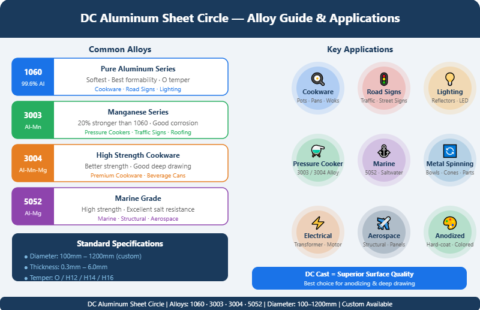
Common Alloy Grades for Round Aluminum Circles
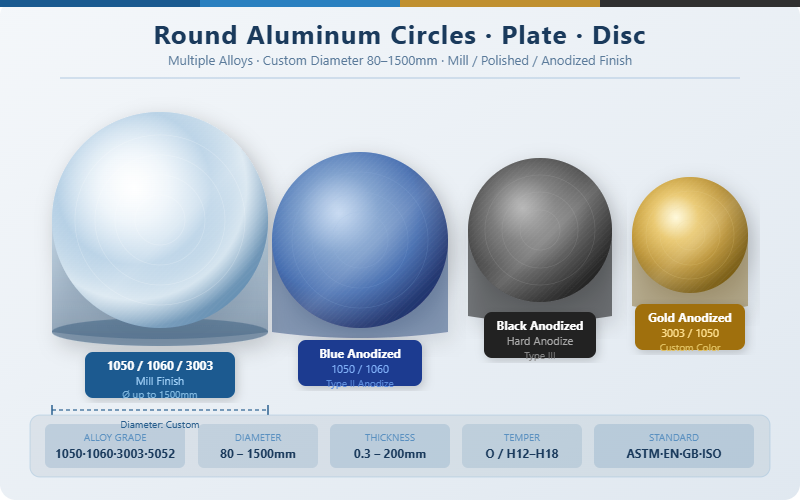
Choosing the right alloy is important. Different alloys offer different properties. Here are the most common alloy grades for aluminum discs and circles:
1050 Aluminum Circle
- Aluminum content: ≥ 99.5%
- Excellent formability
- Best surface finish after polishing or anodizing
- High thermal and electrical conductivity
- Best for: cookware, reflectors, lighting, chemical equipment
1060 Aluminum Circle
- Aluminum content: ≥ 99.6%
- Similar to 1050 but slightly higher purity
- Excellent corrosion resistance
- Best for: electrical conductors, chemical tanks, food equipment
1100 Aluminum Circle
- Aluminum content: ≥ 99.0%
- Good formability and workability
- Widely used in North American markets
- Best for: cookware, nameplates, decorative items
3003 Aluminum Circle
- Main alloy: Manganese (Mn 1.0–1.5%)
- About 20% stronger than 1050
- Good formability and corrosion resistance
- Best for: pressure cookers, deep-drawn cookware, storage tanks
5052 Aluminum Circle
- Main alloy: Magnesium (Mg 2.2–2.8%)
- Higher strength than 3003
- Excellent corrosion resistance in marine environments
- Best for: marine equipment, structural parts, pressure vessels
6061 Aluminum Circle
- Main alloys: Magnesium and Silicon
- High strength and hardness
- Good machinability
- Best for: engineering parts, machine components, structural discs
Alloy Selection Guide
| Application | Recommended Alloy |
|---|---|
| Cookware (pots, pans) | 1050, 1060, 3003 |
| Pressure cookers | 3003, 5052 |
| Lighting reflectors | 1050, 1060 |
| Road signs | 1100, 3003 |
| Marine parts | 5052 |
| Engineering discs | 6061 |
| Decorative items | 1050, 1100 |
| Chemical equipment | 1060, 3003 |
Round Aluminum Circle Plate Specifications
When ordering round aluminum circles or aluminum disc plates, you need to provide clear specifications. Here are the key parameters:
Diameter
We supply aluminum circles in a wide range of diameters:
- Minimum diameter: 80mm
- Maximum diameter: 1500mm
- Custom diameters: Available on request
Common diameters include 100mm, 150mm, 200mm, 250mm, 300mm, 400mm, 500mm, and larger. We cut to your exact size.
Thickness
Thickness range for round aluminum circle plates:
- Sheet range: 0.3mm – 6.0mm
- Plate range: 6.0mm – 200mm
- Most common: 0.5mm – 4.0mm for cookware and general use
Temper
| Temper | Description | Best Application |
|---|---|---|
| O (Annealed) | Fully soft | Deep drawing, spinning, cookware |
| H12 | Lightly hardened | Light forming |
| H14 | Half hard | General fabrication |
| H16 | Three-quarter hard | Structural panels |
| H18 | Fully hard | Maximum strength |
| H22 / H24 | Strain-hardened and annealed | Balance of strength and formability |
For deep drawing applications like cookware, always choose O temper (annealed). This temper gives maximum ductility and prevents cracking during forming.
Surface Finish
We offer multiple surface finish options for aluminum circles and discs:
- Mill finish: Natural aluminum surface, no additional treatment
- Bright / polished finish: Smooth, shiny surface
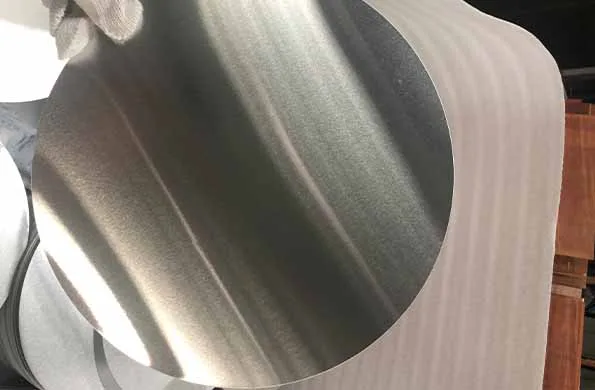
- Brushed finish: Satin, directional grain texture
- Mirror finish: High-reflectivity, near-perfect reflection
- Anodized: Hard oxide layer for protection and color
- Non-stick coated: For cookware applications
Edge Condition
- Sheared edge: Standard, slight burr possible
- Deburred edge: Smooth, safe to handle
- Machined edge: Precise, tight tolerance
We deburr all edges as standard to ensure safe handling.
How Are Round Aluminum Circles Made?
Understanding the production process helps you evaluate supplier quality.
Step 1: Raw Material Preparation
We start with aluminum coils or sheets. The alloy, temper, and thickness are selected based on your order requirements. We source raw materials from certified smelters with full chemical composition traceability.
Step 2: Blanking / Stamping
The aluminum sheet feeds into a stamping press. A circular die cuts the round disc from the sheet. This process is fast and precise. Modern stamping presses can cut thousands of circles per hour.
For large diameters, we may use laser cutting or water jet cutting for more precision.
Step 3: Deburring and Edge Finishing
After cutting, the edges of each disc may have small burrs. We remove these using deburring machines. The result is a smooth, safe edge on every aluminum circle plate.
Step 4: Surface Treatment (Optional)
Depending on your requirements, we apply surface treatments:
- Polishing for mirror or brushed finish
- Anodizing for protective oxide layer
- Painting or coating for color applications
Step 5: Quality Inspection
Every batch goes through strict quality control:
- Diameter measurement (±0.5mm tolerance standard)
- Thickness measurement (±0.05mm tolerance)
- Surface defect inspection
- Weight check
- Chemical composition verification
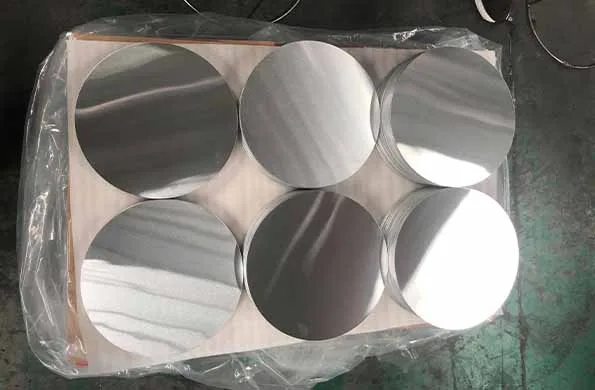
Step 6: Packaging
We pack aluminum circles and discs carefully to prevent scratching and damage during shipping:
- Interleaf paper between discs
- Plastic stretch wrap
- Wooden pallets or cartons
- Custom packaging on request
Round Aluminum Circle Applications
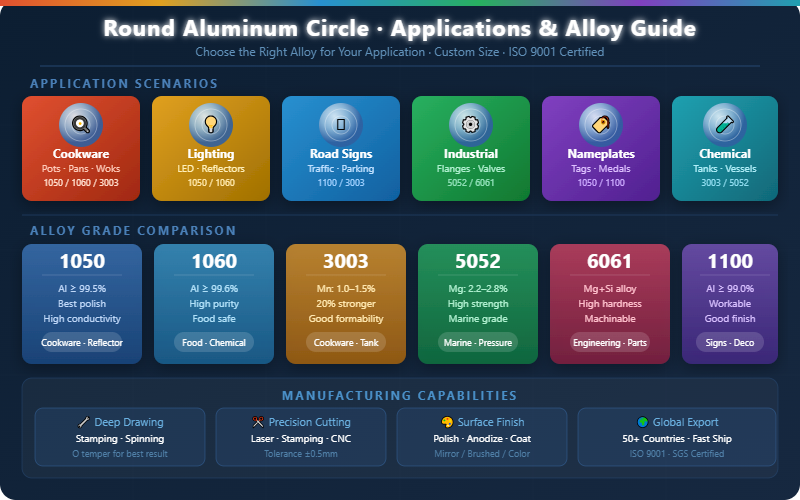
Round aluminum circles, plates, and discs are used in many industries worldwide. Here are the main applications:
Cookware Manufacturing
This is the largest market for aluminum circle plates. Manufacturers use them to produce:
- Frying pans
- Sauce pans and stock pots
- Woks
- Pressure cooker bodies and lids
- Pizza pans
- Baking trays and molds
The round shape is perfect for deep drawing into curved cookware shapes. Alloys 1050, 1060, and 3003 are most popular for cookware.
Lighting and Reflectors
The smooth, reflective surface of polished aluminum discs makes them ideal for:
- LED light reflectors
- Lamp shades
- Spotlights and downlight housings
- Solar energy reflectors
- Automotive lighting components
High-purity 1050 aluminum achieves the best reflectivity after polishing.
Road Signs and Traffic Signs
Round aluminum circle plates are the standard material for round road signs worldwide. Advantages include:
- Lightweight (easy to install)
- Corrosion resistant (lasts outdoors for 20+ years)
- Good surface for printing and reflective film
- Easy to recycle
Alloy 1100 and 3003 are popular for sign blanks.
Nameplates and Tags
Small aluminum discs make excellent nameplates, dog tags, and identification tags. The anodized surface accepts laser engraving, sublimation printing, and chemical etching very well. Common uses:
- Pet ID tags
- Military dog tags
- Equipment nameplates
- Award medals and medallions
- Key fobs
Chemical and Industrial Equipment
Round aluminum plates and discs appear in many industrial applications:
- Flanges and gaskets
- Valve discs
- Machine spacers
- Heat sink bases
- Filter plates
- Pressure vessel components
5052 and 6061 alloys are preferred for structural and pressure applications.
Decorative and Consumer Products
- Watch faces and dials
- Loudspeaker cones
- Musical instrument components
- Sporting goods
- Craft and hobby projects
Electrical Applications
High-purity 1050 and 1060 aluminum circles conduct electricity well. They are used in:
- Electrical transformer components
- Busbar blanks
- Capacitor cases
- Motor components
Round Aluminum Circle vs Round Aluminum Plate: What Is the Difference?
Many buyers ask about the difference between a round aluminum circle and a round aluminum plate.
The terms are often used interchangeably. But there is a general distinction:
| Term | Typical Thickness | Typical Use |
|---|---|---|
| Aluminum Circle / Disc | 0.3mm – 6.0mm | Cookware, signs, reflectors |
| Round Aluminum Plate | 6.0mm – 200mm | Engineering, structural, machine parts |
Thin discs (under 6mm) are usually called circles or discs. Thicker pieces are usually called plates. Both are round in shape.
In practice, most suppliers use these terms interchangeably. Always specify the exact thickness and diameter you need regardless of the term used.
How to Choose the Right Round Aluminum Circle Supplier
Finding a reliable supplier for round aluminum circles and discs is critical. Here is what to look for:
Certifications and Standards
Choose suppliers with:
- ISO 9001 — Quality management certification
- SGS / BV / TÜV — Third-party testing capability
- Material test reports — Chemical and mechanical property data
- REACH / RoHS compliance — For European markets
Production Capacity
A capable supplier should offer:
- In-house stamping and cutting equipment
- Wide diameter and thickness range
- Multiple alloy grades in stock
- Surface treatment options (polish, anodize, coat)
- Fast turnaround for standard sizes
Quality Control
Ask about:
- Incoming raw material inspection
- In-process dimensional checks
- Final inspection before shipment
- Defect rate and quality guarantee
Minimum Order Quantity (MOQ)
Check the MOQ before ordering. Good suppliers offer:
- Sample orders with low or no MOQ
- Competitive pricing for bulk orders
- Flexible order sizes
Delivery and Logistics
- Lead time for standard sizes: 7–15 days
- Lead time for custom sizes: 15–30 days
- Sea freight, air freight, and express delivery options
- Export documentation support
Why Choose Us for Round Aluminum Circles and Discs?
We are a professional manufacturer and exporter of round aluminum circles, plates, and discs. Here is why customers worldwide trust us:
Complete Product Range
We supply aluminum circles and discs in:
- Alloys: 1050, 1060, 1100, 3003, 5052, 6061
- Diameter: 80mm – 1500mm
- Thickness: 0.3mm – 200mm
- Temper: O, H12, H14, H16, H18, H22, H24
- Surface: Mill, polished, brushed, mirror, anodized
Direct Factory Pricing
We manufacture everything in-house. No middlemen. You get competitive factory-direct pricing on every order.
Strict Quality Control
Every batch is tested and inspected. We provide:
- Mill test certificates
- Chemical composition reports
- Dimensional inspection records
- Third-party inspection support
Custom Processing
We offer value-added services:
- Cut to exact diameter
- Hole punching (center holes or custom patterns)
- Surface polishing and brushing
- Anodizing in multiple colors
- Custom packaging
Global Export Experience
We export aluminum circles and discs to the USA, Germany, France, Australia, Canada, UAE, India, Southeast Asia, and over 50 other countries. We handle all export paperwork and shipping arrangements.
Fast Delivery
- Standard sizes: ship in 7–15 days
- Custom orders: ship in 15–30 days
- Express delivery available for urgent orders
Responsive Customer Service
Our team responds within 24 hours. We offer:
- Free samples for standard sizes
- Technical support for alloy and temper selection
- Competitive quotes within 24 hours
- After-sales support and issue resolution
Frequently Asked Questions
Q: What is an aluminum disc circle?
An aluminum disc circle is a flat, round piece of aluminum cut from an aluminum sheet or coil. It is used as a raw material for manufacturing cookware, signs, reflectors, nameplates, and many other products.
Q: What alloy is best for cookware aluminum circles?
For cookware, the best alloys are 1050, 1060, and 3003. These alloys offer good formability, food safety, and thermal conductivity. 3003 is preferred when more strength is needed.
Q: What is the standard thickness for round aluminum circle plates?
The most common thicknesses are 1.0mm, 1.5mm, 2.0mm, 2.5mm, and 3.0mm. Thicker plates (up to 200mm) are available for engineering applications.
Q: Can I get custom diameter aluminum circles?
Yes. We cut aluminum circles to any diameter from 80mm to 1500mm. Custom diameters are available with standard lead times.
Q: Do you provide anodized aluminum circles?
Yes. We supply anodized aluminum circles in clear, black, gold, blue, red, and custom colors. Anodizing improves corrosion resistance and adds decorative value.
Q: What is the minimum order quantity?
MOQ varies by product. Contact us with your specifications and we will confirm the MOQ and pricing for your order.
Q: Can aluminum circles be welded?
Yes. Most aluminum alloys used for circles and discs are weldable. 3003 and 5052 have excellent weldability. 1050 and 1060 are also weldable with standard MIG or TIG welding processes.
Q: What packaging do you use for aluminum circles?
We use interleaf paper between each disc, plastic stretch wrap, and wooden pallets or cartons. Custom packaging is available on request.
Conclusion
Round aluminum circles, plates, and discs are versatile, high-performance products used across dozens of industries worldwide. Whether you need them for cookware, lighting, road signs, industrial components, or decorative applications, the right alloy, temper, and size make all the difference.
We offer a complete range of aluminum circle plates and discs with custom sizing, multiple alloy grades, and a variety of surface finishes. Our factory-direct pricing, strict quality control, and global export experience make us the ideal partner for your aluminum needs.
Contact us today for a free quote. Send us your diameter, thickness, alloy, temper, surface finish requirements, and quantity. We will respond within 24 hours with competitive pricing and full technical support.