3003 Series Aluminum Circles
What Is 3003 Series Aluminum?
3003 series aluminum is one of the most popular aluminum alloys used in manufacturing worldwide. It belongs to the 3xxx series of aluminum alloys. Manganese (Mn) is the primary alloying element, making up 1.0–1.5% of the composition. This manganese addition gives 3003 series aluminium about 20% more strength than pure aluminum alloys like 1050 and 1100.
3003 aluminum is not heat treatable. It gains strength through cold working (work hardening). This means temper designations like H14, H16, and H18 are very important when ordering this material.
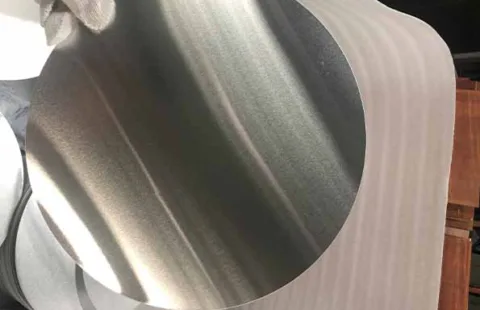
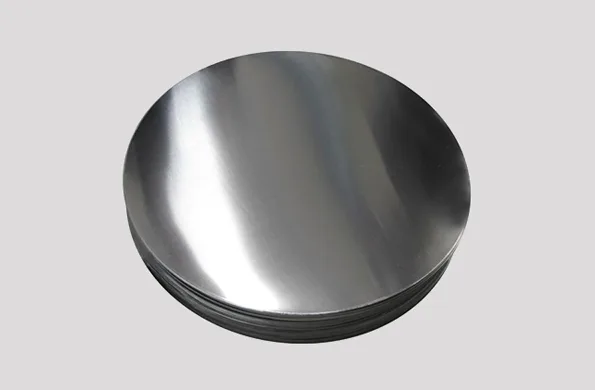
The 3003 series aluminum circle is one of the most widely produced forms of this alloy. Manufacturers stamp or cut round discs from 3003 aluminum sheet or coil. These circles serve as the starting material for cookware, lighting reflectors, road signs, and many other products.
This guide covers everything you need to know about 3003 series aluminum circles — from specifications and thickness charts to applications and frequently asked questions.
What Is 3003 Grade Aluminum?
3003 grade aluminum is a manganese-based aluminum alloy. Here are the key facts:
- Alloy series: 3xxx (Manganese alloys)
- Primary alloying element: Manganese (Mn) 1.0–1.5%
- Heat treatable: No
- Strengthening method: Cold working / work hardening
- Corrosion resistance: Very good
- Formability: Excellent
- Weldability: Excellent
- Machinability: Fair to good
Chemical Composition of 3003 Aluminum
| Element | Content (%) |
|---|---|
| Aluminum (Al) | Balance (~98%) |
| Manganese (Mn) | 1.00 – 1.50 |
| Copper (Cu) | 0.05 – 0.20 |
| Silicon (Si) | ≤ 0.60 |
| Iron (Fe) | ≤ 0.70 |
| Zinc (Zn) | ≤ 0.10 |
| Other elements | ≤ 0.05 each |
The manganese content is the defining characteristic of 3003 grade aluminum. Manganese strengthens the aluminum matrix without significantly reducing corrosion resistance or formability. This balance makes 3003 one of the most versatile general-purpose aluminum alloys available.
3003 Series Aluminum Circles: Product Overview
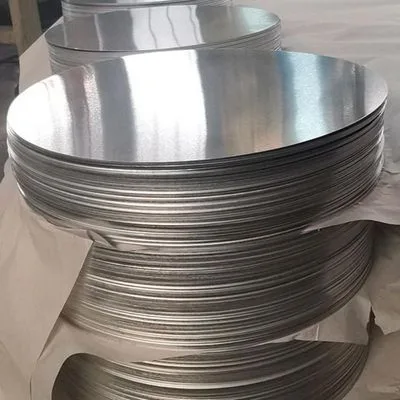
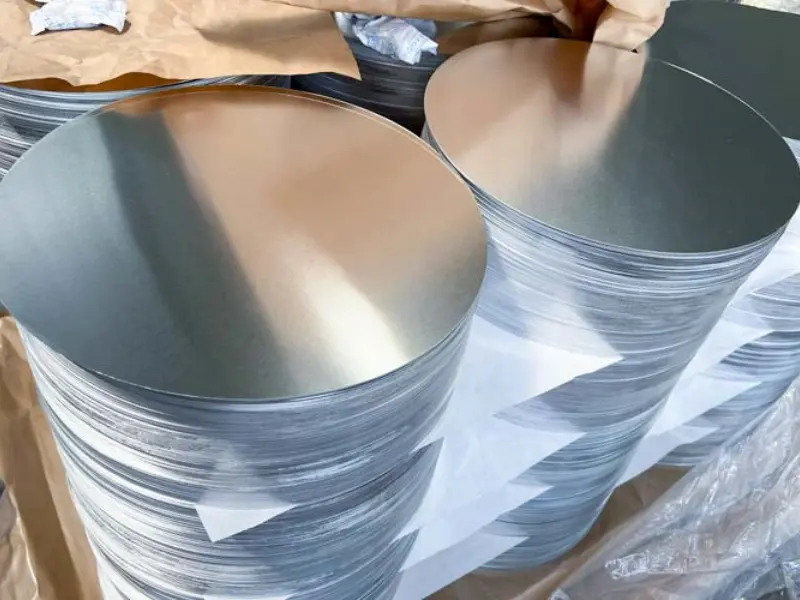
A 3003 aluminum circle (also called a 3003 aluminum disc) is a flat, round piece of aluminum cut from 3003 aluminum sheet or coil. It is a precision-cut blank used as the raw material for many downstream manufacturing processes.
Key Features of 3003 Aluminum Circles
Excellent Formability
3003 aluminum circles are ideal for deep drawing, spinning, and pressing. The O temper (annealed) gives maximum ductility for deep-drawn cookware. The H14 temper provides a balance of strength and formability for lids, trays, and signs.
Good Corrosion Resistance
3003 aluminum naturally resists corrosion. The manganese content helps stabilize the alloy against oxidation. This makes 3003 circles suitable for both indoor and outdoor applications.
Food Safe
3003 aluminum meets food safety standards. It contains no harmful alloying elements at normal concentrations. This makes it the standard choice for cookware circles.
Consistent Quality
3003 series aluminum circles are produced from carefully controlled alloy compositions. This ensures consistent forming behavior across production batches.
Wide Range of Sizes
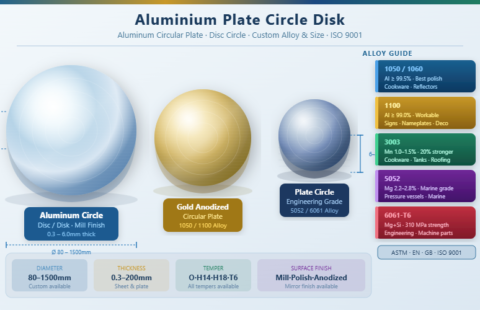
We supply 3003 aluminum circles in diameters from 80mm to 1500mm and thicknesses from 0.3mm to 6.0mm. Custom sizes are available on request.
3003 Aluminum Specifications
Standard Specifications and Certifications
3003 series aluminum circles comply with the following international standards:
| Standard | Description |
|---|---|
| ASTM B209 | American standard for aluminum sheet and plate |
| EN 573-3 | European standard for aluminum alloy designation |
| EN 485-1/2 | European standard for aluminum sheet mechanical properties |
| GB/T 3880 | Chinese national standard |
| JIS H4000 | Japanese industrial standard |
| ISO 6361 | International standard for wrought aluminum |
3003 Aluminum Circle Specifications
| Parameter | Range |
|---|---|
| Alloy | 3003 |
| Temper | O, H12, H14, H16, H18, H22, H24 |
| Diameter | 80mm – 1500mm |
| Thickness | 0.3mm – 6.0mm |
| Edge condition | Deburred (standard), machined (optional) |
| Surface finish | Mill finish, polished, anodized |
| Tolerance (diameter) | ±0.5mm (standard) |
| Tolerance (thickness) | ±0.05mm (standard) |
3003 Aluminum Thickness Chart
Choosing the right thickness is critical for your application. Here is a complete 3003 aluminum sheet thickness chart with corresponding applications:
3003 Aluminum Sheet Thickness Chart
| Thickness (mm) | Gauge (approx.) | Weight (kg/m²) | Common Applications |
|---|---|---|---|
| 0.3mm | 28 ga | 0.82 | Thin decorative panels, foil-like applications |
| 0.5mm | 24 ga | 1.37 | Light reflectors, nameplates, labels |
| 0.8mm | 22 ga | 2.19 | Thin cookware blanks, light signs |
| 1.0mm | 20 ga | 2.73 | General cookware circles, road signs |
| 1.2mm | 18 ga | 3.28 | Pots, lids, ceiling tiles |
| 1.5mm | 16 ga | 4.10 | Standard cookware, roofing panels |
| 2.0mm | 14 ga | 5.46 | Heavy cookware, pressure cooker bodies |
| 2.5mm | 12 ga | 6.83 | Thick cookware, structural panels |
| 3.0mm | 11 ga | 8.19 | Heavy duty trays, tank components |
| 4.0mm | — | 10.92 | Thick structural discs, machine parts |
| 5.0mm | — | 13.65 | Heavy plate applications |
| 6.0mm | — | 16.38 | Maximum coil thickness |
Most Common Thicknesses for 3003 Aluminum Circles
The most frequently ordered thicknesses for 3003 aluminum circles are:
- 1.0mm — Standard pots and pans
- 1.5mm — Pressure cooker bodies and lids
- 2.0mm — Heavy-duty cookware
- 2.5mm — Thick-base frying pans
- 3.0mm — Industrial discs and heavy trays
If you are unsure which thickness to choose, contact our technical team. We help you select the right thickness based on your forming process, final product wall thickness, and draw ratio.
3003 H14 Aluminum Sheet and Circle
3003 H14 aluminum is the most popular temper for general-purpose applications. Here is what you need to know:
What Does H14 Mean?
- H = Strain hardened (cold worked)
- 1 = Strain hardened only
- 4 = Half-hard (50% of maximum cold work)
3003-H14 Mechanical Properties
| Property | Value |
|---|---|
| Tensile Strength | 150 MPa (22 ksi) |
| Yield Strength | 145 MPa (21 ksi) |
| Elongation | 8% |
| Hardness (Brinell) | 40 HB |
| Shear Strength | 97 MPa |
When to Choose 3003-H14
Choose 3003-H14 for:
- Road signs and traffic signs
- Roofing and wall panels
- Ceiling tiles
- Mail boxes and enclosures
- Flat cookware lids and baking trays
- General sheet metal fabrication
When to Choose 3003-O Instead
Choose 3003-O (annealed) when:
- Deep drawing is required (pots, pans, pressure cookers)
- Complex forming with high draw ratios
- Maximum ductility is needed
- Cracking during forming must be avoided
Can You Bend 3003 Aluminum?
Yes. 3003 aluminum is one of the easiest aluminum alloys to bend. It has excellent formability in all temper conditions.
Bending Guidelines for 3003 Aluminum
3003-O (Annealed)
- Best for bending and forming
- Can handle very tight bend radii
- Minimum bend radius: approximately equal to material thickness (1T)
- Ideal for deep drawing and complex shapes
3003-H14 (Half Hard)
- Good for moderate bending
- Minimum bend radius: approximately 1.5 × material thickness (1.5T)
- Suitable for straight bends, roll forming, and light pressing
3003-H18 (Full Hard)
- Less formable than O and H14
- Minimum bend radius: approximately 2.5 × material thickness (2.5T)
- Only for simple bends and applications with minimal forming
Tips for Bending 3003 Aluminum Circles and Sheet
- Always bend across the grain direction when possible
- Use a clean, smooth die to prevent surface scratching
- For thicker material (above 3mm), pre-heat to improve ductility
- Use back-gauging to ensure consistent bend angles
- Deburr edges before bending to prevent cracking at edges
Is 3003 Aluminum Machinable?
3003 aluminum is fair to good in machinability. It machines better than pure aluminum alloys (1050, 1060) but not as well as 6061-T6. Here are the key points:
- 3003 tends to produce long, stringy chips during machining
- Use sharp tools and higher cutting speeds for best results
- Carbide tooling is recommended for production machining
- Good results achievable with CNC milling, drilling, and turning
- Not recommended for precision machining where 6061 would be the better choice
For 3003 aluminum circles that require machined center holes or precise edge finishing, we can supply pre-machined discs from our factory.
3003 Aluminum Plate
3003 aluminum plate refers to 3003 aluminum material with thickness above 6mm. Here are the key differences between sheet and plate:
| Feature | 3003 Sheet / Circle | 3003 Aluminum Plate |
|---|---|---|
| Thickness | 0.3mm – 6.0mm | 6.0mm – 200mm |
| Form | Sheet, coil, circle | Flat plate only |
| Typical temper | O, H12, H14, H18 | H14, H24, O |
| Applications | Cookware, signs, roofing | Machine bases, tanks, structural |
| Weight | Light to medium | Heavy |
| Formability | Excellent | Moderate |
Common Applications for 3003 Aluminum Plate
- Storage tank bottoms and walls
- Machine base plates
- Chemical equipment components
- Structural support plates
- Thick heat exchanger plates
- Marine deck plates
We supply 3003 aluminum plate in thicknesses from 6mm to 200mm. Custom cutting to size is available.
What Is the Difference Between 3003 and 6061 Aluminum?
This is one of the most common questions about 3003 series aluminum. Here is a clear, simple comparison:
Composition Difference
| Feature | 3003 Aluminum | 6061 Aluminum |
|---|---|---|
| Series | 3xxx | 6xxx |
| Main alloy element | Manganese (Mn) | Magnesium + Silicon |
| Heat treatable | No | Yes |
Strength Difference
| Property | 3003-H14 | 6061-T6 |
|---|---|---|
| Tensile Strength | 150 MPa | 310 MPa |
| Yield Strength | 145 MPa | 276 MPa |
| Hardness | 40 HB | 95 HB |
6061-T6 is more than twice as strong as 3003-H14. If structural strength is the priority, choose 6061.
Key Practical Differences
Formability
3003 is far more formable than 6061. For deep drawing cookware circles, 3003-O is the standard choice. 6061 is too hard and springy for deep drawing.
Machinability
6061-T6 machines much better than 3003. For precision CNC parts, choose 6061.
Cost
3003 is less expensive than 6061. Simpler composition and no heat treatment needed keep costs lower.
Applications
3003 suits cookware, roofing, tanks, and signs. 6061 suits aerospace parts, structural components, and precision machined parts.
Weldability
Both weld well. 3003 has a slight edge. Welding 6061 reduces strength in the heat-affected zone.
Quick Decision Guide
Choose 3003 when:
- Deep drawing or complex forming
- Cookware manufacturing
- Cost is a key factor
- Good corrosion resistance in mild environments
- Roofing, panels, and general fabrication
Choose 6061 when:
- High structural strength needed
- Precision machining required
- Heat treatment capability matters
- Aerospace, automotive, or engineering applications
3003 Series Aluminum Circles Applications
3003 aluminum circles and discs serve a wide range of industries. Here are the most important applications:
Cookware Manufacturing
This is the largest market for 3003 series aluminum circles. Deep drawing presses transform flat 3003 circles into finished cookware:
- Frying pans and sauce pans
- Woks and stock pots
- Pressure cooker bodies
- Pressure cooker lids and covers
- Rice cooker inner pots
- Baking trays and pizza pans
Why 3003 for cookware?
- Food safe composition
- Excellent deep drawing characteristics
- Good thermal conductivity (193 W/m·K)
- Resists food acids and moisture
- Easy to clean and maintain
3003-O temper is standard for deep drawn cookware. 3003-H14 is used for flat items like baking trays and lids.
Lighting Reflectors
Polished 3003 aluminum circles serve as reflector blanks for:
- LED light housings
- Downlight and spotlight reflectors
- Solar energy reflectors
- Automotive interior lighting
- Stage and studio lighting
The smooth surface of 3003 polishes well. After spinning or pressing into a reflector shape, the surface achieves good reflectivity.
Road Signs and Traffic Signs
Round 3003 aluminum circle plates are the global standard for circular road signs. Advantages:
- Lightweight for easy installation
- Does not rust or corrode outdoors
- Good surface for reflective film adhesion
- Easy to recycle at end of life
- Long service life (20+ years outdoors)
3003-H14 temper provides the right balance of stiffness and weight for sign applications.
Nameplates and Tags
Small 3003 aluminum discs make excellent nameplates and identification tags:
- Equipment nameplates
- Award medals and medallions
- Pet identification tags
- Key fobs and tokens
- Military and industrial tags
The anodized surface of 3003 accepts laser engraving and sublimation printing very well.
Chemical and Industrial Equipment
- Storage tank components
- Chemical vessel discs and flanges
- Filter plates and screens
- Heat exchanger fins
- Industrial machine spacers
Roofing and Architectural Panels
- Roofing sheets and panels
- Wall cladding blanks
- Ceiling tile substrates
- Architectural trim components
How to Order 3003 Series Aluminum Circles
When placing an order for 3003 aluminum circles, provide these specifications:
Required Information
- Alloy: 3003
- Temper: O, H12, H14, H16, H18, H22, or H24
- Diameter: in mm (e.g., 300mm, 500mm, 800mm)
- Thickness: in mm (e.g., 1.0mm, 1.5mm, 2.0mm)
- Surface finish: mill finish, polished, brushed, or anodized
- Edge condition: deburred or machined
- Quantity: in pieces or kg
- Standard: ASTM B209, EN 485, GB/T 3880, or other
Optional Information
- Special flatness requirements
- Center hole diameter (if needed)
- Custom packaging requirements
- Inspection and certification requirements
- Destination port for shipping calculation
Why Choose Us for 3003 Series Aluminum Circles?
We are a professional manufacturer of 3003 series aluminum circles and related aluminum products. Here is why buyers worldwide choose us:
Complete Size Range
We supply 3003 aluminum circles in:
- Diameter: 80mm – 1500mm
- Thickness: 0.3mm – 6.0mm
- All tempers: O, H12, H14, H16, H18, H22, H24
- Surface: mill, polished, brushed, anodized
Strict Quality Control
Every production batch goes through:
- Chemical composition testing (OES spectrometer)
- Mechanical property testing (tensile, hardness)
- Dimensional inspection (diameter and thickness)
- Surface quality visual inspection
- Full mill test certificate provided with every order
Meets International Standards
Our 3003 series aluminum circles comply with:
- ASTM B209
- EN 573 / EN 485
- GB/T 3880
- ISO 9001:2015 certified
Custom Processing
We offer value-added services:
- Precision cutting to exact diameter
- Center hole punching
- Surface polishing and brushing
- Anodizing in multiple colors
- Custom packaging and labeling
Competitive Factory Pricing
We manufacture in-house. No middlemen. Direct factory pricing means you get the best value for your order. Volume discounts are available for large orders.
Fast Delivery
- Standard sizes (stocked): 7–15 days
- Custom diameters and thicknesses: 15–30 days
- Sample orders: available on request
Global Export Experience
We export 3003 aluminum circles and discs to the USA, Germany, UK, France, Australia, Canada, UAE, Japan, South Korea, Southeast Asia, and over 60 countries worldwide.
Frequently Asked Questions
What is 3003 grade aluminum?
3003 grade aluminum is a manganese-based aluminum alloy with approximately 1.0–1.5% Mn content. It is one of the most widely used general-purpose aluminum alloys. It offers good formability, corrosion resistance, and weldability at a competitive price. It is not heat treatable and is strengthened through cold working.
Can you bend 3003 aluminum?
Yes. 3003 aluminum bends very easily. In O temper (annealed), it can handle very tight bend radii. In H14 temper, moderate bending is possible with a minimum bend radius of about 1.5 times the material thickness. It is one of the most formable aluminum alloys available.
What is the difference between 3003 and 6061 aluminum?
3003 is a manganese alloy with moderate strength (150 MPa in H14) and excellent formability. It is not heat treatable. 6061 is a magnesium-silicon alloy with high strength (310 MPa in T6) and excellent machinability. It is heat treatable. Choose 3003 for forming, cookware, and general fabrication. Choose 6061 for structural and machined parts.
Is 3003 aluminum machinable?
3003 aluminum is machinable but not as well as 6061. It produces long chips and requires sharp tooling for best results. For basic drilling, milling, and turning operations, 3003 performs adequately. For precision CNC machining, 6061-T6 is a better choice.
What thickness does 3003 aluminum circle come in?
We supply 3003 aluminum circles in thicknesses from 0.3mm to 6.0mm. The most common thicknesses for cookware are 1.0mm, 1.5mm, 2.0mm, and 2.5mm. Thicker plates up to 200mm are also available for industrial applications.
What is the standard temper for 3003 aluminum circles?
The two most common tempers are 3003-O (annealed, fully soft — for deep drawing) and 3003-H14 (half hard — for general fabrication and signs). Other tempers like H12, H16, H18, H22, and H24 are also available on request.
Can 3003 aluminum circles be anodized?
Yes. 3003 aluminum circles anodize well. The anodized surface adds corrosion protection and can be colored. However, the anodized finish on 3003 may be slightly less clear than on higher-purity alloys like 1050 or 1060. For the best anodized finish quality, 1050 or 1060 aluminum circles are recommended.
Conclusion
3003 series aluminum circles are one of the most versatile and widely used aluminum products in global manufacturing. Their combination of good formability, corrosion resistance, food safety, and competitive pricing makes them the top choice for cookware, lighting, road signs, and industrial applications.
Whether you need 3003-O circles for deep-drawn cookware or 3003-H14 circles for signs and panels, we supply the full range with certified quality, competitive pricing, and fast global delivery.
Contact us today for a free quote. Tell us your diameter, thickness, temper, surface finish, and quantity. We respond within 24 hours with pricing and full technical support.