Hot Rolling Round Aluminum Circle
What Is a Hot Rolling Round Aluminum Circle?
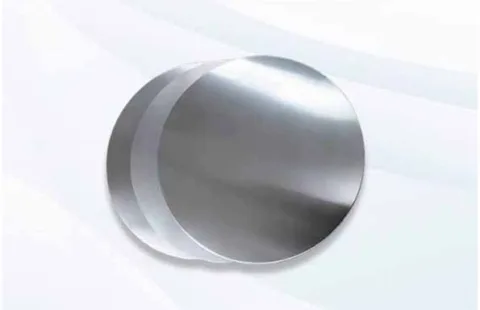
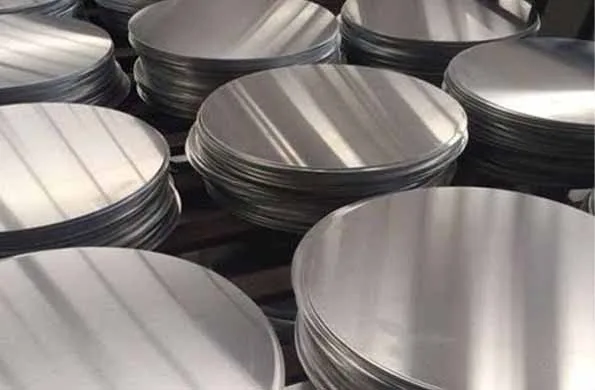
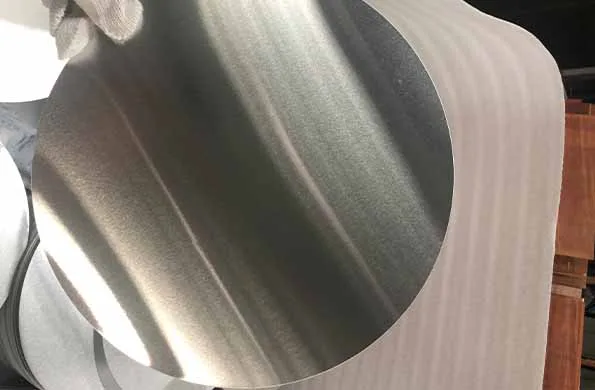
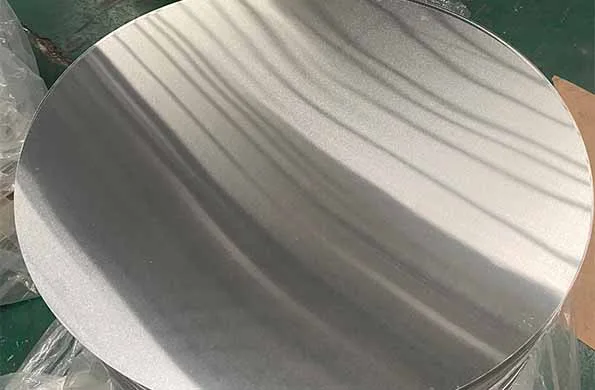
A hot rolling round aluminum circle is a flat, disc-shaped aluminum blank produced through the hot rolling process. Manufacturers cut these circles from hot-rolled aluminum coil or sheet. The result is a smooth, round blank ready for deep drawing, spinning, and stamping operations.
Hot rolling aluminum involves passing aluminum slabs through heavy rolling mills at temperatures above the recrystallization point — typically between 300°C and 500°C. This process reduces thickness, refines grain structure, and improves mechanical properties. The final product has better surface quality and more uniform properties than cast aluminum.
Industries worldwide use hot rolling round aluminum circles for cookware, road signs, lighting reflectors, pressure vessels, and many other products. The hot rolling process makes these circles stronger, more uniform, and easier to form than cold-rolled alternatives for certain applications.
If you need a high-quality aluminum blank for deep drawing or spinning, understanding the hot rolling process helps you choose the right product.
What Is the Hot Rolling Aluminum Process?
The hot rolling aluminum process is the foundation of aluminum circle production. Understanding each step helps you evaluate product quality.
Step 1: Aluminum Slab Preparation
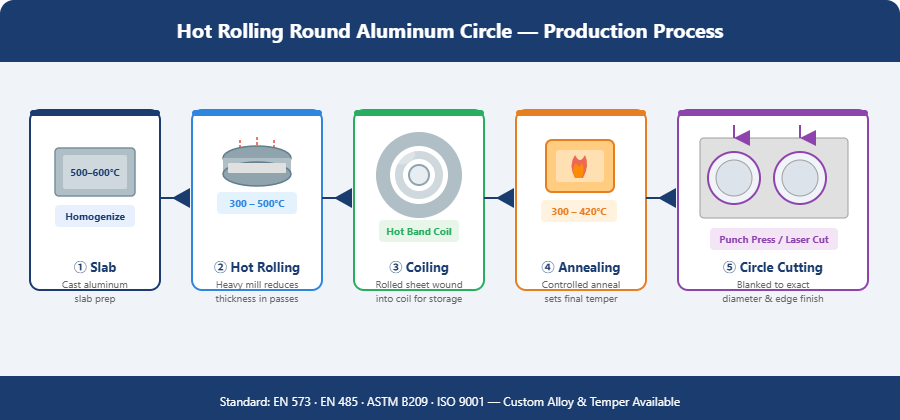
The process starts with a cast aluminum slab. Smelters produce these slabs from primary aluminum ingots or recycled aluminum. The slab is typically 400–600 mm thick and can weigh several tons.
Before rolling, the slab goes through homogenization. Furnaces heat the slab to 500–600°C for several hours. This step:
- Equalizes the chemical composition throughout the slab
- Dissolves coarse intermetallic compounds
- Improves workability during rolling
- Reduces the risk of cracking
Step 2: Hot Rolling Mill Processing
The heated slab enters the hot rolling mill. Large rollers press the slab repeatedly, reducing its thickness in stages.
Key parameters of hot rolling aluminum:
| Parameter | Typical Value |
|---|---|
| Entry temperature | 480 – 520°C |
| Exit temperature | 280 – 350°C |
| Reduction per pass | 10% – 40% |
| Final thickness (hot band) | 2.0 mm – 8.0 mm |
| Rolling speed | Up to 600 m/min |
The rolling mill uses lubricants and coolants to control temperature and surface quality. Modern mills use computer-controlled roll gap adjustment to maintain tight thickness tolerances.
As the slab passes through multiple rolling stands, it gets longer and thinner. The aluminum recrystallizes between passes. This keeps the material soft and workable throughout the process.
Step 3: Coiling
After the final rolling pass, the hot-rolled aluminum sheet winds into a coil. This rolled aluminum coil is the intermediate product. It goes to further processing — either cold rolling for thinner gauges or direct cutting for thicker circles.
Step 4: Circle Cutting (Blanking)
Factories cut aluminum round circles from the hot-rolled coil or sheet using:
- Punch press blanking — high-speed production, clean edges
- Laser cutting — precise cuts for special sizes
- Rotary cutting — continuous production from coil
The cutting process produces a clean, burr-free edge. Good edge quality is critical for downstream forming operations.
Step 5: Annealing (Optional)
Some circles go through annealing after cutting. This softens the material to O temper for maximum formability. Other circles go through controlled partial annealing to achieve H14, H24, or other temper designations.
Hot Rolling vs. Cold Rolling: What Is the Difference?
Many buyers ask about the difference between hot rolling aluminum and cold rolling. The process affects the final properties of the aluminum circle.
Process Comparison
| Feature | Hot Rolling | Cold Rolling |
|---|---|---|
| Temperature | Above recrystallization (300–500°C) | Room temperature |
| Thickness range | 2.0 mm – 200 mm | 0.1 mm – 6.0 mm |
| Surface finish | Mill finish (slightly rough) | Smoother, brighter |
| Dimensional tolerance | ±0.1 mm – ±0.3 mm | ±0.01 mm – ±0.05 mm |
| Grain structure | Recrystallized, uniform | Elongated, work-hardened |
| Residual stress | Low | Higher |
| Strength | Lower than cold rolled | Higher due to work hardening |
| Formability | Excellent | Good |
| Cost | Lower for thick gauges | Higher processing cost |
Which Is Better for Aluminum Circles?
For aluminum round circles in the 2.0–6.0 mm thickness range, hot rolling offers key advantages:
- Better formability — recrystallized grain structure deforms without cracking
- Lower residual stress — circles stay flat during storage and processing
- More uniform properties — consistent performance across the full circle
- Lower cost — hot rolling is more efficient for thicker gauges
For very thin circles (below 1.5 mm), cold rolling produces better surface finish and tighter tolerances.
Most cookware manufacturers prefer hot rolling round aluminum circles for pots and pans above 2.0 mm thickness. The hot rolling process delivers the formability needed for deep drawing heavy-gauge cookware.
Aluminum Round Circle: Key Specifications
When ordering aluminum round circles, confirm these specifications with your supplier.
Standard Size Range
| Parameter | Standard Range |
|---|---|
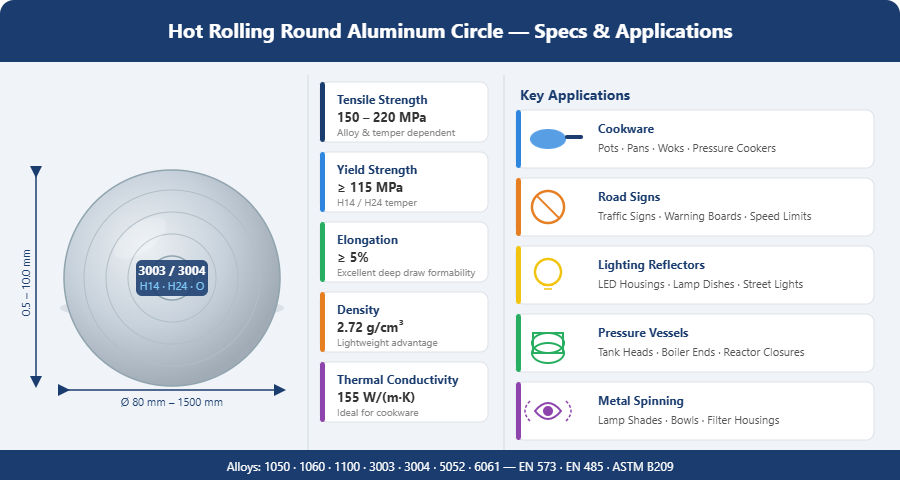
| Diameter | 80 mm – 1500 mm |
| Thickness | 0.5 mm – 10.0 mm |
| Hot rolled thickness | 2.0 mm – 8.0 mm |
| Diameter tolerance | ± 0.5 mm |
| Thickness tolerance | ± 0.05 mm – ± 0.15 mm |
| Surface finish | Mill finish, bright, anodizing quality |
| Edge condition | Clean, burr-free |
Common Alloys for Hot Rolling Round Aluminum Circles
| Alloy | Key Properties | Main Applications |
|---|---|---|
| 1050 / 1060 | High purity, soft, excellent formability | Road signs, lighting, decorative |
| 1100 | Good formability, food-safe | Cookware, food containers |
| 3003 | Better strength than 1xxx, corrosion resistant | Cookware, general fabrication |
| 3004 | Higher strength than 3003, good formability | Premium cookware, beverage cans |
| 5052 | High strength, excellent corrosion resistance | Marine parts, pressure vessels |
| 6061 | High strength, heat treatable | Structural components |
Common Tempers for Aluminum Circles
| Temper | Condition | Formability | Strength |
|---|---|---|---|
| O | Fully annealed | Excellent | Low |
| H12 | Quarter hard | Very good | Low-medium |
| H14 | Half hard | Good | Medium |
| H22 | Strain hardened + partial anneal | Very good | Medium-low |
| H24 | Strain hardened + partial anneal | Good | Medium |
For deep drawing operations, O temper and H14 are most common. For spinning operations, H14 and H24 work well.
Key Properties of Hot Rolled Aluminum Circles
Hot rolling round aluminum circles have specific properties that make them suitable for demanding forming applications.
Mechanical Properties (3003 H14 Example)
| Property | Value |
|---|---|
| Tensile Strength | 150 – 195 MPa |
| Yield Strength | ≥ 115 MPa |
| Elongation | ≥ 5% |
| Hardness (HB) | 40 – 50 |
| Shear Strength | 97 MPa |
Physical Properties
| Property | Value |
|---|---|
| Density | 2.73 g/cm³ |
| Melting Range | 643 – 654°C |
| Thermal Conductivity | 155 W/(m·K) |
| Electrical Conductivity | 34% IACS |
| Modulus of Elasticity | 69 GPa |
Why Hot Rolled Circles Perform Better in Forming
Uniform grain structure
Hot rolling produces a recrystallized grain structure. The grains are equiaxed — roughly equal in all directions. This means the material deforms evenly during deep drawing. Cold-rolled material has elongated grains that can cause anisotropic behavior (different properties in different directions).
Low residual stress
Hot rolling above the recrystallization temperature removes internal stresses. Low residual stress means circles stay flat and do not spring back unexpectedly during forming.
Consistent thickness
Modern hot rolling mills maintain tight thickness tolerances across the full width of the coil. Consistent thickness means consistent forming results across every circle in a production batch.
Main Applications of Hot Rolling Round Aluminum Circles
Hot rolling round aluminum circles serve a wide range of industries. Their formability and consistent properties make them the preferred blank for high-volume manufacturing.
1. Cookware Manufacturing
Cookware is the largest market for aluminum round circles. Factories use hot-rolled circles for:
- Pots and saucepans
- Frying pans and skillets
- Woks and stir-fry pans
- Pressure cookers
- Steamer inserts
- Milk pans and butter warmers
Thick hot-rolled circles (2.5–5.0 mm) give cookware the mass needed for good heat retention. The uniform grain structure from hot rolling allows deep drawing without cracking or thinning unevenly.
After forming, manufacturers apply:
- Non-stick PTFE coating
- Hard anodizing
- Polishing and mirror finish
- Ceramic coating
- Stainless steel cladding (sandwich base)
2. Road Signs and Traffic Signs
Traffic authorities worldwide use aluminum circles for round road signs. Hot-rolled aluminum offers:
- High strength-to-weight ratio
- Excellent corrosion resistance without painting the base metal
- Flat, smooth surface for reflective sheeting adhesion
- Easy fabrication — drilling, bending, and punching
Large diameter circles (400–900 mm) produce warning signs, speed limit signs, and information roundels. The hot rolling process produces circles flat enough to accept high-quality reflective films without air bubbles or adhesion problems.
3. Lighting and Reflectors
The lighting industry uses aluminum round circles for:
- Lamp reflector dishes
- LED downlight housings
- Street light reflectors
- Industrial high-bay light reflectors
- Solar concentrator dishes
Aluminum reflects 85–95% of visible light. Polished or bright-anodized hot-rolled circles maximize light output. The smooth, uniform surface from hot rolling produces better reflective finishes than cast aluminum.
4. Pressure Vessels and Storage Tanks
Industrial manufacturers use thick hot rolling round aluminum circles as:
- Pressure vessel end caps
- Storage tank dished heads
- Heat exchanger tube plates
- Boiler end plates
- Chemical reactor closures
Alloys like 5052, 5083, and 6061 provide the strength needed for pressure applications. The hot rolling process ensures consistent mechanical properties throughout the disc — critical for pressure vessel safety.
5. Spinning and Metal Spinning Parts
Metal spinning transforms flat aluminum circles into hollow shapes by rotating the circle against a mandrel. Hot-rolled circles are ideal for spinning because:
- The recrystallized grain structure flows smoothly over the mandrel
- Low residual stress prevents distortion during spinning
- Consistent thickness gives predictable wall thickness after spinning
Spun products include:
- Lamp shades and reflectors
- Decorative bowls and dishes
- Aerospace components
- Musical instrument bells
- Filter housings
6. Food Processing Equipment
Food-grade aluminum circles serve the food processing industry. Applications include:
- Baking pans and trays
- Pizza pans
- Commercial baking sheets
- Food storage container lids
- Dairy equipment components
Alloys 1100 and 3003 meet food contact regulations. Hot rolling produces a clean, non-contaminating surface suitable for food contact without additional surface treatment.
7. Automotive and Transportation
The automotive industry uses aluminum round circles for:
- Wheel center caps
- Decorative hubcaps
- Heat shields
- Fuel system components
- Brake system parts
Weight reduction drives aluminum adoption in vehicles. Hot-rolled aluminum circles deliver the strength needed for functional automotive parts without the weight of steel.
How to Choose the Right Hot Rolling Round Aluminum Circle
Selecting the correct aluminum round circle requires matching alloy, temper, size, and surface finish to your application.
Step 1: Choose the Right Alloy
| Application | Recommended Alloy |
|---|---|
| Budget cookware | 1050, 1060, 1100 |
| Mid-range cookware | 3003, 3004 |
| Road signs | 1050, 1100, 3003 |
| Lighting reflectors | 1050, 1060 (bright finish) |
| Pressure vessels | 5052, 5083 |
| Structural parts | 6061 |
Step 2: Select the Right Temper
| Forming Method | Recommended Temper |
|---|---|
| Deep drawing (severe) | O (fully annealed) |
| Deep drawing (moderate) | H14, H22 |
| Spinning | H14, H24 |
| Light forming | H24, H26 |
| No forming needed | H18 |
Step 3: Specify the Correct Size
Measure your tooling carefully. The circle diameter should be 3–8% larger than the finished product diameter to account for material draw-in during forming. Thickness affects the wall thickness and weight of the finished product.
Step 4: Choose Surface Finish
- Mill finish — standard, cost-effective, suitable for most applications
- Bright finish — higher reflectivity for lighting and decorative use
- Anodizing quality — ultra-clean surface for decorative anodizing
- Pre-lubricated — light oil film reduces tooling wear during drawing
Quality Standards for Aluminum Round Circles
Reputable manufacturers of hot rolling round aluminum circles follow international quality standards.
Relevant Standards
| Standard | Scope |
|---|---|
| EN 573-3 | Chemical composition of aluminum alloys |
| EN 485-1 | Technical delivery conditions |
| EN 485-2 | Mechanical properties |
| ASTM B209 | Aluminum sheet and plate |
| GB/T 3880 | Chinese national aluminum sheet standard |
| ISO 9001 | Quality management system |
Quality Checks During Production
Good manufacturers perform these checks at every stage:
Incoming slab inspection
- Chemical composition verification (spectrometer analysis)
- Surface quality check
- Dimensional measurement
Rolling process control
- Temperature monitoring at entry and exit
- Thickness measurement every coil
- Flatness and crown measurement
Circle cutting inspection
- Diameter measurement (every batch)
- Thickness check (multiple points per circle)
- Edge quality inspection (burr height)
- Surface quality visual inspection
Final inspection
- Mechanical property testing (tensile, yield, elongation)
- Hardness testing
- Surface defect inspection under controlled lighting
Always request a Mill Test Certificate (MTC) with every shipment. This document confirms the chemical composition and mechanical properties match your order specification.
Hot Rolling Round Aluminum Circle: Pricing Guide
Several factors determine the price of hot rolling round aluminum circles.
Factors That Affect Price
LME Aluminum Price
The London Metal Exchange (LME) spot price sets the aluminum base cost. It changes daily. Most suppliers quote as LME price plus a processing premium.
Alloy Selection
Higher alloy content costs more. 5052 and 6061 circles cost more than 1050 or 3003 circles per kilogram.
Thickness
Thicker circles use more aluminum per piece. Very thick circles also require more rolling passes, increasing processing cost.
Diameter
Larger diameter circles waste more material during blanking. Manufacturers factor this material utilization rate into pricing. A 1000 mm circle has much lower material utilization than a 200 mm circle from the same coil width.
Surface Finish
Bright and anodizing-quality finishes require additional processing. They cost more than mill finish.
Temper
O temper (annealed) requires a furnace annealing step after rolling. This adds cost. H14 and H24 require controlled partial annealing — also an added cost.
Order Quantity
Larger orders reduce per-kilogram pricing significantly. Most manufacturers price better above 3 metric tons.
Typical Price Tiers
| Order Quantity | Price Level |
|---|---|
| Sample (< 100 kg) | Highest — setup cost included |
| Small (100 kg – 1 MT) | Above market |
| Medium (1 MT – 5 MT) | Standard market price |
| Large (5 MT – 20 MT) | Competitive |
| Very large (> 20 MT) | Best available |
Request a current quotation based on your specific alloy, temper, size, and quantity. Prices change frequently with LME movements.
Why Source Hot Rolling Round Aluminum Circles from a Manufacturer?
Buying directly from a manufacturer of hot rolling round aluminum circles gives you the best combination of quality, price, and service.
Advantages of Direct Manufacturing
Complete process control
A manufacturer controls everything from aluminum slab selection to final circle cutting. Quality problems are caught early. Batch consistency is higher than buying from traders who source from multiple mills.
Custom specifications
Need a non-standard diameter? A specific temper? A special surface finish? Manufacturers accommodate custom requirements. Traders stock only common sizes.
Competitive pricing
No middleman markup. Factory pricing is the most competitive for volume orders.
Full documentation
Manufacturers provide complete traceability — from slab heat number to finished circle. MTC, Certificate of Conformance, and inspection reports come with every shipment.
Technical expertise
Factory engineers understand the hot rolling process deeply. They recommend the right alloy and temper for your forming operation. They troubleshoot forming problems caused by material issues.
Production capacity
Established manufacturers handle large orders consistently. Supply chain reliability is better than smaller traders.
What to Look for in a Supplier
- Dedicated circle cutting equipment (not just coil slitting)
- In-house hot rolling capability or certified mill supply
- ISO 9001 certification
- Experience in your target industry
- Proven export track record
- Responsive technical and commercial support
- Ability to provide complete documentation
Packaging and Export Shipping
Proper packaging protects aluminum round circles during international shipping.
Standard Export Packaging
| Packaging Element | Details |
|---|---|
| Interleaving | Protective paper between each circle |
| Bundle wrap | PE film or kraft paper |
| Pallet | ISPM 15 certified wooden pallet |
| Edge protection | Cardboard or plastic edge guards |
| Strapping | Steel or polyester strapping |
| Labels | Alloy, temper, diameter, thickness, quantity, weight |
Stacking and Loading
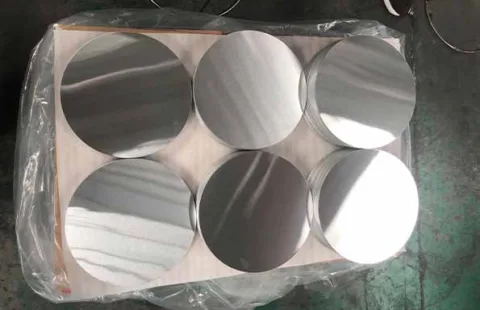
Circles stack face-to-face with interleaving paper. Heavy circles (above 3 mm thick) go on pallets with weight limits clearly marked. Containers should be loaded to avoid shifting during ocean transit.
Request packing photos before the shipment leaves the factory. Confirm all shipping documents match the purchase order.
Frequently Asked Questions
What is hot rolling aluminum?
Hot rolling aluminum is a manufacturing process where aluminum slabs pass through heavy rolling mills at temperatures above 300°C. The heat keeps the aluminum soft and workable. The rolls reduce the slab thickness in multiple passes. The result is a coil or sheet with uniform grain structure and good formability.
What is a hot rolling round aluminum circle used for?
Hot rolling round aluminum circles are used mainly for cookware (pots, pans, woks), road signs, lighting reflectors, pressure vessel heads, and metal spinning. Their formability makes them ideal for deep drawing and spinning operations.
What is the difference between hot rolled and cold rolled aluminum circles?
Hot rolled circles have better formability, lower residual stress, and uniform grain structure. Cold rolled circles have better surface finish and tighter dimensional tolerances. For thick circles (above 2 mm) used in deep drawing, hot rolled is usually preferred.
What alloy is best for hot rolling round aluminum circles?
For cookware, 3003 and 3004 are most popular. For road signs and lighting, 1050 and 1060 work well. For pressure vessels, 5052 and 5083 provide higher strength. The best alloy depends on your application requirements.
What sizes are available for aluminum round circles?
Standard sizes range from 80 mm to 1500 mm diameter and 0.5 mm to 10.0 mm thickness. Custom sizes are available from most manufacturers with minimum order quantities.
How do I choose the right temper for aluminum circles?
For severe deep drawing, choose O temper (fully annealed). For moderate drawing and spinning, H14 or H22 works well. For applications needing higher strength with moderate formability, choose H24. Your tooling design and draw ratio determine the best temper.