DC Aluminum Circle Plate for Capacitor Shell
What Is a DC Aluminum Circle Plate for Capacitor Shell?
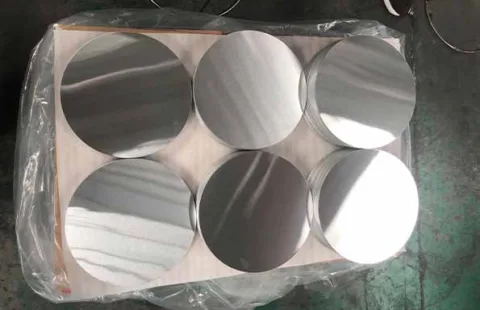
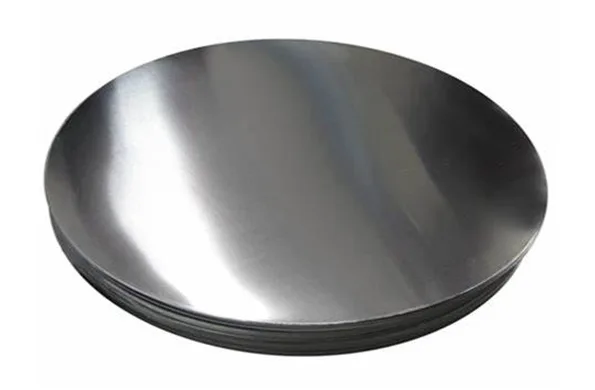
A DC aluminum circle plate for capacitor shell is a round aluminum disc produced by the direct chill (DC) casting and rolling process. Manufacturers use these discs as the primary raw material for forming aluminum capacitor shells — the cylindrical housings that protect electrolytic capacitors.
The DC process produces aluminum with exceptional purity, uniform grain structure, and consistent mechanical properties. These qualities are critical for capacitor shell production. The shells must withstand deep drawing without cracking, maintain dimensional accuracy, and meet strict electrical and chemical requirements.
DC aluminum circle plates are not standard cookware blanks. They are precision-engineered materials. Capacitor manufacturers worldwide specify DC process circles because the material performs reliably in high-speed automated drawing lines.
If you produce electrolytic capacitors or supply raw materials to capacitor manufacturers, understanding DC aluminum circle plates helps you source the right material and avoid costly production problems.


What Is the DC (Direct Chill) Process?
The DC process is the foundation of high-quality aluminum circle plate production. It differs fundamentally from continuous casting methods.
How DC Casting Works
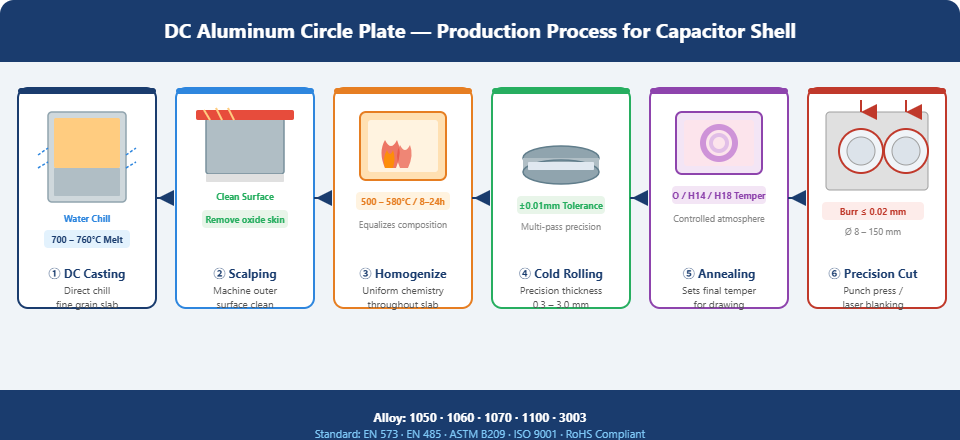
Step 1: Melting and Alloying
Aluminum ingots melt in a furnace at around 700–760°C. Alloying elements are added and mixed thoroughly. Degassing removes hydrogen gas from the melt. Filtration removes oxide inclusions.
Step 2: Direct Chill Casting
Molten aluminum flows into a water-cooled mold. As it solidifies, a mechanical ram lowers the billet or slab downward at a controlled speed. Water sprays directly onto the solidifying aluminum surface — this is the “direct chill” step.
The controlled cooling rate produces:
- Fine, uniform grain structure
- Low hydrogen content
- Minimal oxide inclusions
- Consistent chemical composition throughout the slab
Step 3: Scalping
The outer surface of the DC slab is machined away. This removes the segregation layer and any surface defects from casting. The result is a clean, defect-free slab surface before rolling.
Step 4: Homogenization
The slab heats in a furnace to 500–580°C for 8–24 hours. This equalizes the chemical composition and dissolves coarse precipitates. Homogenization is critical for consistent forming behavior.
Step 5: Hot Rolling
The homogenized slab passes through hot rolling mills. Multiple passes reduce thickness from 400–600 mm down to 3–8 mm hot band.
Step 6: Cold Rolling
The hot band goes through cold rolling mills. This achieves the final thickness with tight tolerances. Cold rolling also develops the required temper through work hardening.
Step 7: Annealing
Controlled annealing sets the final temper — O, H14, H18, or other designations based on customer requirements.
Step 8: Circle Cutting
High-precision punch presses or laser cutters produce the final DC aluminum circle plates to exact diameter specifications.
Why DC Process Matters for Capacitor Shells
| Property | DC Process | Continuous Cast |
|---|---|---|
| Grain uniformity | Excellent | Good |
| Hydrogen content | Very low | Low-medium |
| Inclusion level | Minimal | Low |
| Surface quality | Superior | Good |
| Deep drawing performance | Excellent | Good |
| Dimensional consistency | Very high | Medium-high |
| Suitability for capacitor shell | ✅ Preferred | ⚠️ Limited use |
Capacitor shell production runs at high speed — often hundreds of strokes per minute. Any inconsistency in the aluminum causes shell splitting, cracking, or dimensional variation. DC process material eliminates these problems.
Key Specifications of DC Aluminum Circle Plate for Capacitor Shell
Getting specifications right is critical when ordering DC aluminum circle plates. Capacitor shell production tolerates very little variation.
Alloy Selection
| Alloy | Purity / Composition | Key Properties | Use in Capacitor Shell |
|---|---|---|---|
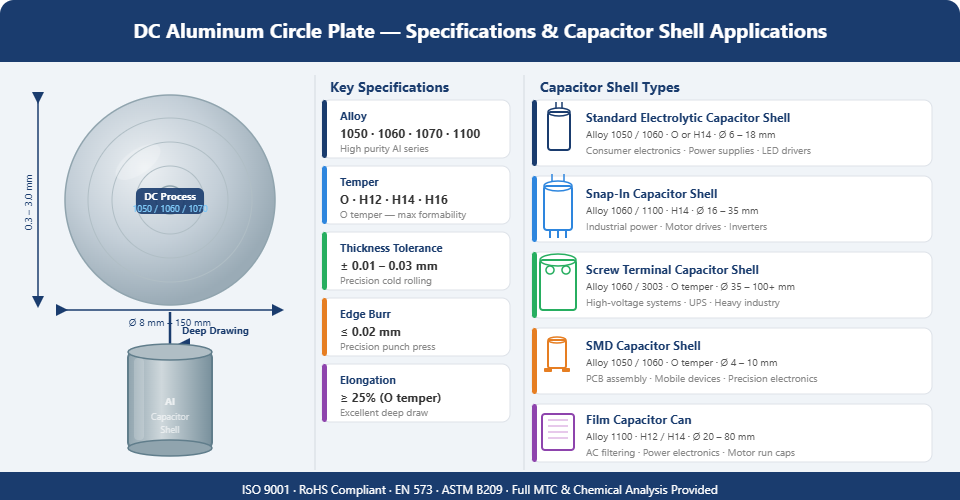
| 1050 | Al ≥ 99.5% | Excellent formability, high conductivity | Standard capacitor shells |
| 1060 | Al ≥ 99.6% | Better purity than 1050 | High-purity shell requirements |
| 1070 | Al ≥ 99.7% | Very high purity | Precision capacitor applications |
| 1100 | Al ≥ 99.0% + Cu | Good formability, slightly stronger | General electrolytic capacitor shells |
| 3003 | Al-Mn alloy | Higher strength than 1xxx | Heavy-wall capacitor shells |
For standard electrolytic capacitor shells, 1050 and 1060 are the most common choices. Their high aluminum purity ensures:
- Consistent electrical behavior
- Good corrosion resistance to electrolyte
- Reliable deep drawing without cracking
- Clean surface for anodizing
Temper Specifications
| Temper | Condition | Tensile Strength | Elongation | Application |
|---|---|---|---|---|
| O | Fully annealed | 65 – 95 MPa | ≥ 25% | Severe deep drawing |
| H12 | Quarter hard | 85 – 120 MPa | ≥ 12% | Moderate drawing |
| H14 | Half hard | 105 – 145 MPa | ≥ 7% | Standard shell drawing |
| H16 | Three-quarter hard | 120 – 160 MPa | ≥ 4% | Shallow drawing |
| H18 | Full hard | ≥ 145 MPa | ≥ 3% | Minimal forming |
Most capacitor shell manufacturers use O temper or H14 temper DC aluminum circle plates. O temper gives maximum ductility for deep drawing. H14 provides a balance of strength and formability for moderate draw ratios.
Dimensional Specifications
| Parameter | Standard Range | Tight Tolerance |
|---|---|---|
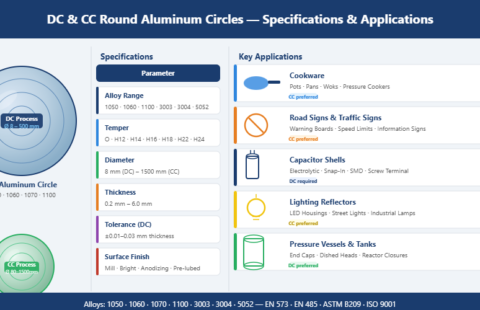
| Diameter | 8 mm – 150 mm | ± 0.1 mm |
| Thickness | 0.3 mm – 3.0 mm | ± 0.01 mm – ± 0.03 mm |
| Flatness | ≤ 1 mm per 500 mm | ≤ 0.5 mm per 500 mm |
| Edge burr height | ≤ 0.05 mm | ≤ 0.02 mm |
| Ovality (diameter variation) | ≤ 0.15 mm | ≤ 0.08 mm |
Capacitor shell tooling is precision-ground. Oversized or undersized circles cause tooling damage or shell dimensional failures. Always confirm tolerances with your tooling specifications.
Surface Quality Requirements
DC aluminum circle plates for capacitor shells require strict surface quality control:
- No pits or pinholes — subsurface defects cause shell cracking during drawing
- No scratches — surface marks create stress concentration points
- No oil stains — contamination affects anodizing and electrolyte compatibility
- Controlled roughness — Ra 0.2–0.8 μm typical for drawing operations
- No edge cracks — clean punching is essential for drawing without splitting
Why DC Aluminum Circle Plates Outperform Other Materials for Capacitor Shells
Capacitor manufacturers have specific reasons for specifying DC aluminum circle plates over other aluminum products.
Superior Purity
DC casting and subsequent processing produce aluminum with very low impurity levels. High purity means:
- Better corrosion resistance against capacitor electrolyte
- More consistent electrical properties
- Cleaner anodized surface on the finished shell
- Lower risk of electrolyte contamination
Uniform Grain Structure
The DC process produces fine, equiaxed grains throughout the slab. This uniformity means:
- The circle draws evenly in all directions
- Wall thickness is consistent around the shell circumference
- No preferential cracking direction
- Higher production yield on drawing lines
Consistent Mechanical Properties
Batch-to-batch consistency is critical for automated capacitor production. DC process circles deliver:
- Tight tensile strength variation (within ±5 MPa between batches)
- Consistent elongation values
- Predictable forming behavior
- Stable tool life on production presses
Excellent Deep Drawing Performance
Capacitor shells are deep drawn — the draw ratio (shell height to diameter) can be 2:1 or higher for some capacitor types. DC aluminum circle plates handle high draw ratios without:
- Tearing at the bottom radius
- Wrinkling at the flange
- Uneven wall thinning
- Surface cracking or orange peel
Applications: Types of Capacitor Shells Made from DC Aluminum Circle Plates
DC aluminum circle plates produce shells for several capacitor types. Each type has specific shell requirements.
1. Electrolytic Capacitor Shells
Aluminum electrolytic capacitors are the most common application. These capacitors use an aluminum oxide dielectric layer formed by anodizing the shell interior.
Shell requirements:
- High purity aluminum (1050, 1060, 1070)
- Smooth interior surface for uniform anodizing
- Consistent wall thickness after drawing
- Excellent dimensional accuracy for sealing
Electrolytic capacitors appear in:
- Consumer electronics (TVs, computers, audio equipment)
- Power supplies and converters
- Motor start and run circuits
- LED drivers and ballasts
- Automotive electronics
2. Snap-In Capacitor Shells
Larger electrolytic capacitors use snap-in mounting. Their shells are larger diameter (16–35 mm) and require:
- Higher wall strength to support lead terminals
- Precise flange dimensions for PCB mounting
- Clean surface for label adhesion
- Consistent height tolerance
3. Screw Terminal Capacitor Shells
High-voltage, high-capacitance units use screw terminal mounting. These large shells (35–100+ mm diameter) need:
- Thicker wall gauge for structural integrity
- Excellent surface quality for insulating sleeve application
- Tight dimensional control for end cap sealing
4. SMD (Surface Mount) Capacitor Shells
Small SMD aluminum electrolytic capacitors use very small shells — sometimes 4–8 mm diameter. These require:
- Ultra-precise diameter tolerance (± 0.05 mm)
- Very smooth surface
- Consistent deep drawing to small diameters
- Burr-free edges for automated assembly
5. Film Capacitor Cans
Some film capacitor types use aluminum shells for housing wound film elements. These shells need:
- Good dimensional accuracy
- Clean interior surface
- Consistent wall thickness
DC Aluminum Circle Plate vs. Standard Aluminum Circle: Key Differences
Many buyers ask why they should specify DC aluminum circle plates instead of standard aluminum circles. The differences matter for capacitor shell production.
| Feature | DC Aluminum Circle Plate | Standard Aluminum Circle |
|---|---|---|
| Production process | DC casting + precision rolling | Various casting methods |
| Grain structure | Fine, uniform, equiaxed | Variable |
| Purity control | Strict — high purity alloys | Standard alloy spec |
| Thickness tolerance | ± 0.01 – 0.03 mm | ± 0.05 – 0.15 mm |
| Surface quality | Precision controlled | Standard mill finish |
| Edge burr | ≤ 0.02 – 0.05 mm | ≤ 0.1 mm |
| Deep drawing rating | Excellent | Good |
| Batch consistency | Very high | Medium |
| Typical application | Capacitor shells, precision parts | Cookware, signs, general use |
| Price | Higher (precision product) | Lower |
For capacitor shell production, standard aluminum circles create problems:
- Higher shell rejection rate
- Inconsistent drawing behavior
- Tooling damage from hard spots or inclusions
- Surface defects after anodizing
DC aluminum circle plates solve these problems and deliver consistent production results.
Quality Control for DC Aluminum Circle Plates
A reliable supplier of DC aluminum circle plates for capacitor shells implements strict quality control at every production stage.
Incoming Material Inspection
- Spectrometer analysis — confirms alloy composition
- Hydrogen content measurement — low hydrogen prevents blistering during annealing
- Inclusion rating — ultrasonic testing detects internal defects
Rolling Process Control
- Continuous thickness measurement (laser gauges)
- Flatness monitoring across full coil width
- Surface inspection — automatic defect detection cameras
- Temperature monitoring during annealing
Circle Cutting Inspection
- Diameter measurement — every batch sampled
- Thickness check — multiple points per circle
- Edge quality — burr height measurement
- Flatness check — each bundle
Outgoing Quality Inspection
- Tensile and yield strength testing
- Elongation measurement
- Hardness testing (HB or HV)
- Surface cleanliness check
- Packaging inspection before shipment
Documentation
Request these documents with every shipment of DC aluminum circle plates:
- Mill Test Certificate (MTC) — alloy, temper, mechanical properties
- Chemical Analysis Report — full composition including trace elements
- Dimensional Inspection Report — diameter, thickness, flatness, burr height
- Certificate of Conformance — confirms compliance with agreed specification
- RoHS Compliance Certificate — required for electronics applications
How to Evaluate a DC Aluminum Circle Plate Supplier
Choosing the right supplier for DC aluminum circle plates protects your production quality and delivery schedule.
Technical Capability Checklist
| Capability | Why It Matters |
|---|---|
| In-house DC casting | Controls raw material quality from the start |
| Cold rolling to tight tolerances | Achieves ± 0.01 mm thickness |
| Precision circle cutting equipment | Ensures burr-free, accurate diameter |
| In-house laboratory | Full mechanical and chemical testing |
| Automatic surface inspection | Detects defects before shipment |
| Controlled annealing furnaces | Consistent temper across batches |
Quality System Requirements
- ISO 9001 certification — minimum requirement
- IATF 16949 — if supplying automotive capacitor manufacturers
- RoHS compliance — required for consumer electronics supply chains
- Customer-specific approvals (PPAP, First Article Inspection)
Supply Chain Stability
- Established aluminum slab supply from certified smelters
- Minimum order quantity that suits your production volume
- Lead time reliability — consistent delivery schedules
- Safety stock capability for emergency orders
Communication and Support
- Technical support for drawing process optimization
- Rapid response to quality complaints
- Willingness to conduct joint failure analysis
- Clear documentation of specification changes
Pricing Guide for DC Aluminum Circle Plates
DC aluminum circle plates carry a premium over standard aluminum circles. Understanding the pricing structure helps you budget accurately.
Price Components
LME Aluminum Base
The London Metal Exchange aluminum price is the foundation. It changes daily. Most suppliers quote on a fixed LME reference plus a conversion premium.
Alloy Premium
High-purity alloys (1060, 1070) carry higher premiums than standard alloys. The purity requirement adds cost in smelting and processing.
DC Process Premium
DC casting, scalping, homogenization, and controlled rolling add significant cost versus simpler casting methods. This premium reflects the quality benefit.
Precision Rolling Premium
Achieving ± 0.01 mm thickness tolerance requires multiple cold rolling passes and precision equipment. This adds cost versus standard tolerance rolling.
Circle Cutting Premium
High-precision punch presses with tight burr control add cost over standard blanking. Die maintenance costs are higher for precision cutting.
Surface Treatment
Pre-lubricated surfaces (drawing oil applied) add cost but reduce tooling wear and improve drawing yield.
Diameter and Thickness
Small diameters waste more material in blanking. Very thin gauges require more rolling passes. Both factors increase cost per kilogram.
Order Quantity
Larger orders reduce setup costs per unit and improve pricing. Most manufacturers offer better pricing above 1 metric ton per specification.
Typical Price Tiers
| Order Quantity | Price Level |
|---|---|
| Sample (< 50 kg) | Highest — full setup cost on small quantity |
| Trial order (50 – 500 kg) | Above standard — partial setup recovery |
| Regular order (500 kg – 3 MT) | Standard market price |
| Volume order (3 MT – 10 MT) | Competitive pricing |
| Contract order (> 10 MT/month) | Best pricing — dedicated production slot |
Packaging and Shipping for DC Aluminum Circle Plates
Precision products need precision packaging. Surface damage during shipping wastes the quality investment made during production.
Standard Packaging for Capacitor Shell Circles
| Element | Specification |
|---|---|
| Interleaving | Soft tissue paper between every circle |
| Bundle | Circles stacked face-to-face, wrapped in PE film |
| Box or pallet | Cardboard box for small circles, wooden pallet for large orders |
| Moisture protection | Silica gel desiccant inside each package |
| Labeling | Alloy, temper, diameter, thickness, quantity, lot number |
| ISPM 15 | Wooden pallets fumigated and certified |
Special Handling Requirements
- No bare hand contact — gloves required when handling circles for capacitor production
- Clean storage — keep away from dust, oil mist, and chemical vapors
- Temperature control — avoid condensation during shipping to humid climates
- Stack height limit — do not over-stack to prevent circle deformation
Frequently Asked Questions
What alloy is best for aluminum capacitor shells?
1050 and 1060 aluminum alloys are most common for standard electrolytic capacitor shells. They offer high purity, excellent formability, and good corrosion resistance against electrolyte. For very high-purity requirements, 1070 is specified.
What temper should I specify for capacitor shell drawing?
O temper gives maximum ductility for deep drawing capacitor shells with high draw ratios. H14 is suitable for moderate draw ratios where slightly higher strength is needed. Confirm with your tooling engineer based on your specific draw ratio.
What is the typical thickness for capacitor shell DC aluminum circles?
Most capacitor shells use circles between 0.3 mm and 1.5 mm thickness. The exact thickness depends on the shell diameter and wall thickness specification. Larger diameter shells typically use thicker starting material.
Why do DC aluminum circles cost more than standard circles?
DC aluminum circle plates involve more processing steps — DC casting, scalping, homogenization, precision cold rolling, controlled annealing, and precision circle cutting. Each step adds cost but delivers the consistency and quality that capacitor shell production requires.
Can you supply custom diameters for capacitor shell production?
Yes. Most manufacturers supply DC aluminum circle plates in custom diameters from 8 mm to 150 mm. Confirm minimum order quantities for custom sizes. Standard tooling exists for common capacitor shell diameters.
What surface finish is required for capacitor shell circles?
Mill finish with controlled roughness (Ra 0.2–0.8 μm) suits most capacitor shell applications. Pre-lubricated surfaces with drawing oil are available and reduce tooling wear on high-speed drawing lines. Specify your surface requirement when ordering.