DC and CC Round Aluminum Circles
What Are DC and CC Round Aluminum Circles?
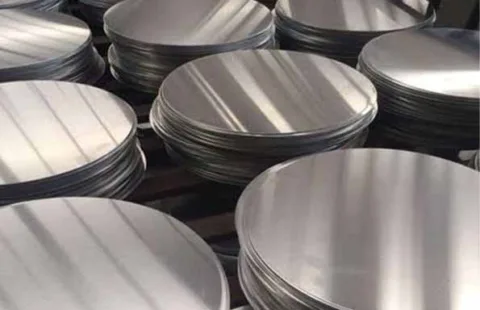
DC and CC round aluminum circles are flat, disc-shaped aluminum blanks produced by two different manufacturing processes — Direct Chill (DC) casting and Continuous Casting (CC). Both processes produce aluminum circles suitable for deep drawing, spinning, and stamping. However, the two processes deliver different quality levels, properties, and price points.
An aluminum round circle is simply a round blank cut from aluminum sheet or coil. Manufacturers use these blanks as the starting material for a wide range of products — from cookware and road signs to capacitor shells and lighting reflectors.
Understanding the difference between DC and CC process aluminum circles helps you select the right material for your production line. The wrong choice leads to higher rejection rates, tooling damage, and inconsistent product quality.
This guide covers everything you need to know — process differences, specifications, applications, quality standards, and how to choose the right supplier.
DC vs. CC Process: What Is the Difference?
The manufacturing process is the most important factor when choosing round aluminum circles. DC and CC processes produce aluminum with different internal structures and surface qualities.
What Is the DC (Direct Chill) Process?
The DC process is a batch casting method. Molten aluminum pours into a water-cooled mold. A hydraulic ram lowers the solidifying billet or slab downward at a controlled speed. Water sprays directly onto the solidifying surface — this is the direct chill step.
DC process steps:
- Melting and alloying in furnace
- Degassing and filtration
- DC casting — controlled solidification
- Scalping — surface machining to remove oxide layer
- Homogenization — furnace heating at 500–580°C
- Hot rolling — reduces slab to 3–8 mm
- Cold rolling — achieves final thickness
- Annealing — sets final temper
- Circle cutting — precision blanking
What Is the CC (Continuous Casting) Process?
The CC process casts and rolls aluminum in a continuous operation. Molten aluminum feeds between two water-cooled rollers or between a roller and a belt. The aluminum solidifies and exits as a continuous strip, which goes directly to a coiling station.
CC process steps:
- Melting and alloying in furnace
- Degassing (basic)
- Continuous casting — between cooled rollers or belt
- Direct coiling — no separate scalping step
- Cold rolling — achieves final thickness
- Annealing — sets final temper
- Circle cutting — blanking from coil
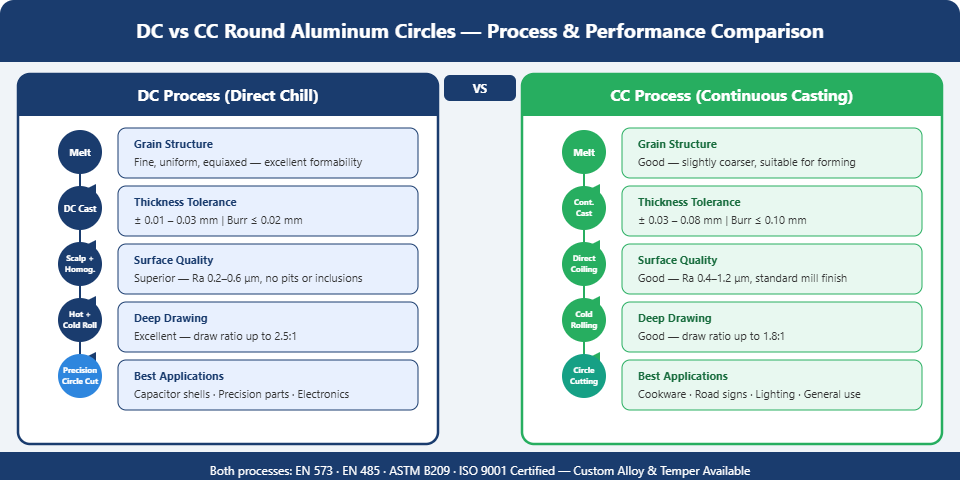
DC vs. CC: Side-by-Side Comparison
| Feature | DC Process | CC Process |
|---|---|---|
| Casting method | Batch — slab casting | Continuous — strip casting |
| Grain structure | Fine, uniform, equiaxed | Coarser, less uniform |
| Hydrogen content | Very low | Low to medium |
| Inclusion level | Minimal | Low |
| Scalping step | Yes — removes surface defects | No |
| Homogenization | Yes — 8–24 hours | Partial or none |
| Surface quality | Superior | Good |
| Thickness tolerance | ±0.01 – 0.03 mm | ±0.03 – 0.08 mm |
| Deep drawing performance | Excellent | Good |
| Batch consistency | Very high | Medium |
| Production speed | Slower — batch process | Faster — continuous |
| Cost | Higher | Lower |
| Best for | Precision parts, capacitor shells | Cookware, signs, general use |
Which Process Is Better?
Neither process is universally better. The right choice depends on your application:
Choose DC process aluminum circles when you need:
- Tight dimensional tolerances
- Excellent deep drawing performance
- High batch consistency
- Minimal surface defects
- Applications in electronics, capacitors, or precision parts
Choose CC process aluminum circles when you need:
- Cost-effective material for high-volume production
- General cookware and kitchenware
- Road signs and traffic signs
- Lighting reflectors
- Less demanding forming operations
Most cookware manufacturers use CC round aluminum circles for budget and mid-range products. Premium cookware and technical applications use DC round aluminum circles.
Aluminum Round Circle: Key Specifications
Whether you choose DC or CC process, confirm these specifications when ordering aluminum round circles.
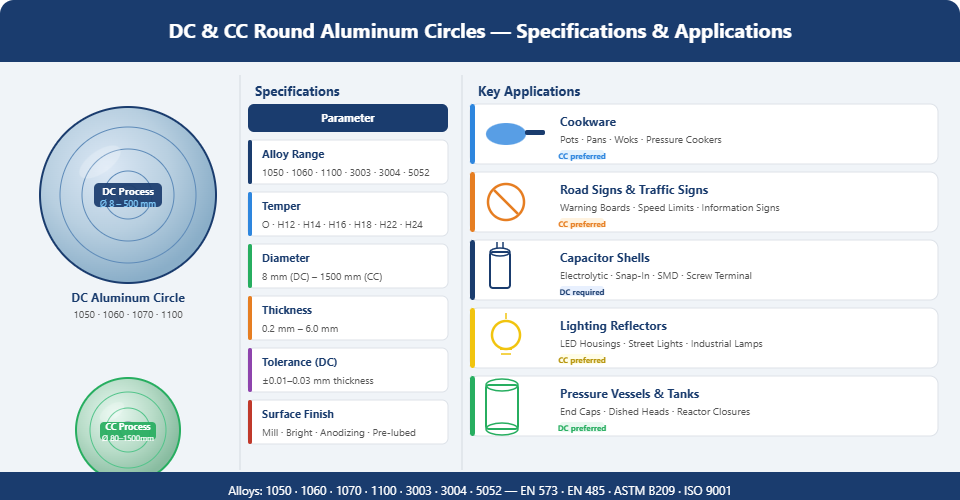
Alloy Options
| Alloy | Series | Key Properties | Typical Application |
|---|---|---|---|
| 1050 | 1xxx | High purity, excellent formability | Road signs, lighting, capacitor shells |
| 1060 | 1xxx | Higher purity than 1050 | Precision drawing, electronics |
| 1070 | 1xxx | Very high purity | Capacitor shells, technical use |
| 1100 | 1xxx | Good formability, food-safe | Cookware, food containers |
| 3003 | 3xxx | Better strength than 1xxx | Mid-range cookware, general fabrication |
| 3004 | 3xxx | Higher strength than 3003 | Premium cookware, beverage cans |
| 5052 | 5xxx | High strength, marine grade | Pressure vessels, marine parts |
Temper Options
| Temper | Condition | Tensile Strength | Elongation | Best For |
|---|---|---|---|---|
| O | Fully annealed | 65 – 130 MPa | ≥ 20% | Severe deep drawing |
| H12 | Quarter hard | 85 – 150 MPa | ≥ 12% | Moderate drawing |
| H14 | Half hard | 105 – 170 MPa | ≥ 7% | Standard forming |
| H16 | Three-quarter hard | 120 – 185 MPa | ≥ 4% | Shallow forming |
| H18 | Full hard | ≥ 145 MPa | ≥ 3% | Minimal forming |
| H22 | Strain hardened + partial anneal | Medium-low | Very good | General use |
| H24 | Strain hardened + partial anneal | Medium | Good | Cookware, circles |
Dimensional Range
| Parameter | CC Process Range | DC Process Range |
|---|---|---|
| Diameter | 80 mm – 1500 mm | 8 mm – 500 mm |
| Thickness | 0.3 mm – 6.0 mm | 0.2 mm – 4.0 mm |
| Diameter tolerance | ± 0.3 – 0.5 mm | ± 0.05 – 0.1 mm |
| Thickness tolerance | ± 0.03 – 0.08 mm | ± 0.01 – 0.03 mm |
| Edge burr | ≤ 0.1 mm | ≤ 0.02 – 0.05 mm |
| Flatness | ≤ 3 mm / 1000 mm | ≤ 1 mm / 500 mm |
Surface Finish Options
| Surface | Description | Best Application |
|---|---|---|
| Mill finish | Standard surface, slight oxide | General industrial use |
| Bright finish | Higher reflectivity | Lighting, decorative |
| Anodizing quality | Ultra-clean, controlled grain | Decorative anodizing |
| Pre-lubricated | Drawing oil applied | High-speed drawing lines |
| One side bright | One reflective, one standard | Reflectors, cookware lids |
What Is an Aluminum Circle Used For?
Aluminum circles serve a wide range of industries. Their formability, light weight, and corrosion resistance make them one of the most versatile aluminum products.
1. Cookware Manufacturing
Cookware is the largest market for circle aluminum discs. Factories deep draw or spin circles into:
- Pots and saucepans
- Frying pans and skillets
- Woks and stir-fry pans
- Pressure cookers
- Milk pans and butter warmers
- Steamer inserts
CC process circles suit most cookware production. Alloys 1100, 3003, and 3004 are most popular. Thickness ranges from 1.5 mm to 5.0 mm depending on cookware type.
After forming, manufacturers apply:
- Non-stick PTFE or ceramic coating
- Hard anodizing
- Polished or mirror finish
- Stainless steel base cladding
2. Road Signs and Traffic Signs
Traffic authorities worldwide use aluminum circles for round road signs. Aluminum offers:
- Corrosion resistance without painting the base material
- High strength-to-weight ratio
- Flat surface for reflective sheeting adhesion
- Easy fabrication — drilling, punching, and bending
Common alloys: 1050, 1100, 3003
Typical size: 400 mm – 900 mm diameter
Thickness: 2.0 mm – 3.0 mm
3. Lighting Reflectors and Lamp Components
The lighting industry uses aluminum round circles for:
- LED downlight housings and reflectors
- Street light reflector dishes
- Industrial high-bay reflectors
- Solar concentrator dishes
- Ceiling light panels
Aluminum reflects 85–95% of visible light. Bright finish or anodized circles maximize light output. Alloy 1050 and 1060 with bright surface are preferred for lighting applications.
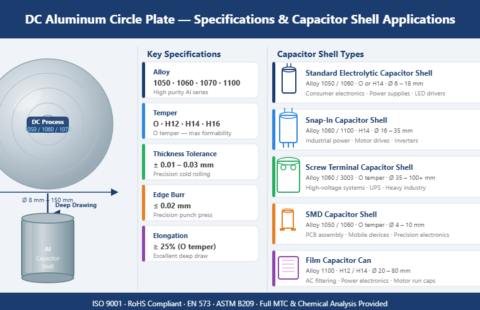
4. Capacitor Shells
Electronic capacitor manufacturers use DC process aluminum circles for capacitor shell production. The DC process is preferred because:
- Fine grain structure allows deep drawing to small diameters
- High purity protects against electrolyte corrosion
- Tight tolerance ensures consistent shell dimensions
- Low inclusion level prevents shell cracking
Alloys: 1050, 1060, 1070
Diameter: 4 mm – 150 mm
Thickness: 0.3 mm – 1.5 mm
5. Pressure Vessels and Industrial Tanks
Industrial manufacturers use thick aluminum circle discs as:
- Pressure vessel end caps
- Storage tank dished heads
- Heat exchanger components
- Chemical reactor closures
- Boiler end plates
Alloys 5052 and 5083 provide the strength needed. DC process material is preferred for pressure-rated components.
6. Food Processing Equipment
Aluminum circles in food-grade alloys serve the food industry:
- Baking pans and trays
- Pizza pans and baking sheets
- Dairy equipment components
- Food storage container lids
- Commercial kitchen equipment
Alloys 1100 and 3003 meet food contact safety requirements. Surfaces are anodized or coated for hygiene.
7. Metal Spinning Products
Metal spinning transforms flat aluminum circles into hollow shapes by rotating the blank against a mandrel. Spun products include:
- Lamp shades and reflectors
- Decorative bowls and vases
- Aerospace components
- Filter housings
- Musical instrument bells
O temper and H14 circles work best for spinning. The recrystallized grain structure flows smoothly without cracking.
8. Automotive Parts
The automotive industry uses aluminum circle discs for:
- Wheel center caps
- Heat shields
- Decorative trims
- Fuel system components
- Brake system parts
Weight reduction is the key driver. Aluminum circles deliver structural performance at a fraction of steel weight.
Circle Aluminum Disc: Quality Standards
Reliable manufacturers of DC and CC round aluminum circles comply with international quality standards.
International Standards
| Standard | Scope |
|---|---|
| EN 573-3 | Chemical composition — all alloys |
| EN 485-1 | Technical delivery conditions |
| EN 485-2 | Mechanical properties |
| EN 485-4 | Tolerances on form and dimensions |
| ASTM B209 | Aluminum sheet and plate |
| GB/T 3880 | Chinese national aluminum sheet standard |
| ISO 9001 | Quality management system |
| RoHS | Restriction of hazardous substances (electronics) |
Quality Inspection Points
A reliable supplier inspects aluminum circles at every stage:
Incoming material
- Chemical composition (spectrometer)
- Hydrogen content (low porosity requirement)
- Visual surface inspection
Rolling process
- Continuous thickness monitoring
- Flatness measurement
- Surface defect detection
Circle cutting
- Diameter measurement (every batch)
- Thickness check (multiple points)
- Burr height measurement
- Flatness check
Outgoing inspection
- Tensile strength and yield strength
- Elongation measurement
- Hardness testing
- Surface cleanliness
- Packaging inspection
Documents to Request
Always ask your supplier for:
- Mill Test Certificate (MTC) — confirms alloy, temper, mechanical properties
- Chemical Analysis Report — full composition breakdown
- Dimensional Inspection Report — diameter, thickness, flatness, burr
- Certificate of Conformance — confirms compliance with agreed standard
- RoHS Certificate — required for electronics applications
How to Choose Between DC and CC Aluminum Circles
Use this decision guide to select the right process for your application.
Choose CC Process Aluminum Circles If:
✅ You produce cookware, kitchen utensils, or bakeware
✅ Your draw ratio is moderate (below 1.5:1)
✅ You need large diameter circles (above 150 mm)
✅ Price is the primary consideration
✅ Slight batch-to-batch variation is acceptable
✅ Surface finish is mill finish or bright (not ultra-precision)
✅ You produce road signs, lighting fixtures, or general industrial parts
Choose DC Process Aluminum Circles If:
✅ You produce capacitor shells or electronic components
✅ Your draw ratio is high (above 1.5:1 or 2:1)
✅ You need very tight thickness tolerance (±0.01 – 0.03 mm)
✅ Batch consistency is critical for automated production
✅ Surface quality must be free of pits, inclusions, or hard spots
✅ You need small diameter circles (below 150 mm)
✅ Full traceability and RoHS documentation are required
Pricing Guide for DC and CC Round Aluminum Circles
Price depends on process, alloy, size, temper, surface finish, and order quantity.
Key Price Factors
Process Type
DC circles cost more than CC circles. The additional casting, scalping, homogenization, and precision rolling steps add cost. Expect DC circles to carry a 15–35% premium over equivalent CC circles.
LME Aluminum Price
All aluminum products price against the London Metal Exchange base price. It changes daily.
Alloy Premium
High-purity alloys (1060, 1070) cost more than standard alloys (1050, 3003) per kilogram.
Diameter
Larger circles waste more material in blanking. Material utilization drops significantly as diameter increases relative to coil width.
Thickness
Thinner gauges require more cold rolling passes. Very thin circles cost more per kilogram to produce.
Temper
O temper requires full annealing — an additional furnace step. H14 and H24 require partial annealing. Both add cost versus H18 (no anneal required).
Surface Finish
Bright finish, anodizing quality, and pre-lubricated surfaces all carry premiums over standard mill finish.
Order Quantity
Larger orders reduce per-unit cost. Most manufacturers offer meaningful price breaks above 3–5 metric tons.
Typical Price Tiers
| Order Size | CC Circles | DC Circles |
|---|---|---|
| Sample (< 100 kg) | Premium | Highest |
| Small (100 – 500 kg) | Above market | Above market |
| Medium (500 kg – 3 MT) | Standard | Standard + DC premium |
| Large (3 – 10 MT) | Competitive | Competitive |
| Contract (> 10 MT/month) | Best | Best available |
Request a current quotation. Prices move with LME aluminum rates.
How to Evaluate an Aluminum Circle Supplier
Choosing the right supplier for DC and CC round aluminum circles protects your production quality and supply continuity.
Technical Capability
| Capability | Why It Matters |
|---|---|
| In-house DC and CC capability | Controls both process quality tracks |
| Precision circle cutting equipment | Achieves tight diameter and burr tolerances |
| In-house laboratory | Full mechanical and chemical testing |
| Automatic surface inspection | Detects defects before shipment |
| Controlled annealing furnaces | Consistent temper across batches |
| Wide alloy range | Flexibility to meet changing requirements |
Quality System
- ISO 9001 certification — minimum requirement
- IATF 16949 — for automotive supply
- RoHS compliance — for electronics supply
- Customer-specific PPAP or FAI capability
Commercial Factors
- Minimum order quantity that suits your production volume
- Lead time reliability — consistent delivery
- Safety stock availability for urgent orders
- Competitive pricing for your volume level
- Responsive technical and commercial support
- Clear documentation provided with every shipment
Red Flags to Avoid
- No mill test certificates available
- Unable to confirm process type (DC or CC)
- No traceability from circle back to original cast
- Inconsistent delivery schedules
- No quality inspection records
- Unwilling to provide samples before bulk order
Packaging and Shipping for Aluminum Circles
Proper packaging prevents surface damage during international shipping.
Standard Export Packaging
| Element | CC Circles | DC Circles |
|---|---|---|
| Interleaving | Kraft paper between circles | Soft tissue paper between circles |
| Bundle wrap | PE film + kraft paper | PE film + moisture barrier |
| Pallet | ISPM 15 wooden pallet | ISPM 15 wooden pallet |
| Edge protection | Cardboard edge guards | Plastic or foam edge guards |
| Moisture protection | Standard wrap | Silica gel desiccant added |
| Strapping | Polyester strapping | Steel or polyester strapping |
| Labeling | Alloy, temper, size, weight | Full lot traceability label |
Shipping Options
| Method | Best For |
|---|---|
| 20ft container | Orders up to 18–20 MT |
| 40ft container | Orders up to 22–25 MT |
| LCL groupage | Small orders below full container |
| Air freight | Urgent samples or small precision orders |
Always request packing photos before shipment. Confirm all shipping documents match your purchase order.
Frequently Asked Questions About Aluminum Circles
What is an aluminum circle?
An aluminum circle is a flat, round disc cut from aluminum sheet or coil. It is the starting blank for deep drawing, spinning, and stamping operations. Manufacturers use aluminum circles to produce cookware, road signs, lighting reflectors, capacitor shells, and many other products.
What is the difference between DC and CC aluminum circles?
DC (Direct Chill) circles are produced from batch-cast slabs with fine grain structure, tight tolerances, and superior surface quality. CC (Continuous Cast) circles are produced from continuously cast strip — faster and lower cost but with slightly coarser grain structure. DC suits precision applications. CC suits general industrial and cookware production.
What alloy is best for cookware aluminum circles?
Alloys 1100, 3003, and 3004 are most popular for cookware circles. 1100 gives maximum formability. 3003 adds strength. 3004 adds more strength plus better corrosion resistance. Most cookware manufacturers use CC process circles in these alloys.
What size aluminum circles are available?
CC process circles are available from 80 mm to 1500 mm diameter and 0.3 mm to 6.0 mm thickness. DC process circles typically range from 8 mm to 500 mm diameter and 0.2 mm to 4.0 mm thickness. Custom sizes are available from most manufacturers.
What temper should I use for deep drawing aluminum circles?
O temper (fully annealed) gives maximum ductility for severe deep drawing. H14 suits moderate draw ratios. Confirm your draw ratio with your tooling engineer — the draw ratio determines the minimum elongation your material needs.
Can aluminum circles be anodized?
Yes. Aluminum circles anodize well. Specify “anodizing quality” surface finish when ordering if your application requires decorative or protective anodizing. Alloys 1050, 1060, and 3003 produce the cleanest anodized finish.
How do I calculate the right circle size for my product?
Start with your finished product diameter. Add the material that draws into the wall. A simple formula: Circle diameter = √(D² + 4Dh) where D is the base diameter and h is the wall height. Your tooling engineer can confirm the exact blank size for your specific draw ratio and material thickness.