4mm Aluminum Circles
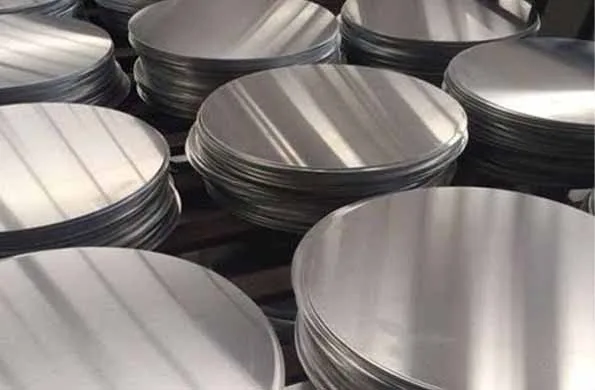
4mm aluminum circles are flat, round aluminum discs with a thickness of 4 millimeters. Manufacturers cut these circles from aluminum sheet or coil using punch presses or laser cutting equipment. The result is a precision round blank ready for deep drawing, spinning, stamping, and other forming operations.
At 4mm thickness, aluminum circles sit in the heavier gauge range. This thickness delivers significantly more strength and rigidity than thinner circles (1–2mm). It suits applications where the finished product must withstand mechanical loads, pressure, or impact without deforming.
4mm aluminum circles are widely used for heavy-duty cookware, pressure vessel heads, industrial components, road signs, and architectural elements. Their combination of structural strength and aluminum’s natural light weight makes them a preferred blank for products that need both rigidity and reduced weight compared to steel.
If you need a robust aluminum blank for demanding forming or structural applications, 4mm aluminum circles deliver the performance your production requires.


Why Choose 4mm Thickness for Aluminum Circles?
Thickness selection is one of the most important decisions when specifying aluminum circles. Understanding why 4mm suits specific applications helps you confirm it is the right choice.
Thickness vs. Application Guide
| Thickness Range | Typical Applications |
|---|---|
| 0.3 – 0.8 mm | Pharmaceutical blister, capacitor shells, foil lids |
| 0.8 – 1.5 mm | Thin cookware, road signs, lighting reflectors |
| 1.5 – 2.5 mm | Standard cookware, pots, frying pans |
| 2.5 – 3.5 mm | Heavy cookware, woks, pressure cookers |
| 4.0 mm | Heavy-duty cookware, pressure vessels, industrial parts |
| 5.0 – 6.0 mm | Thick industrial discs, structural components |
| Above 6.0 mm | Heavy plate applications, flanges, mold bases |
Advantages of 4mm Aluminum Circles
Higher structural strength
At 4mm, the circle provides significantly more resistance to bending and deformation than thinner gauges. Finished products maintain their shape under load.
Better heat retention
For cookware applications, a 4mm base retains heat longer than thinner bases. This improves cooking performance and energy efficiency.
More material for deep drawing
Thicker starting material allows deeper draws. A 4mm circle can form taller, deeper pots and vessels than a 2mm circle of the same diameter.
Pressure vessel suitability
Pressure vessels and tank heads require minimum wall thickness for safety. 4mm starting material produces components that meet pressure vessel design requirements for many applications.
Improved impact resistance
Thicker aluminum resists denting and puncturing better than thin gauges. This matters for industrial components and heavy-use cookware.
Alloy Options for 4mm Aluminum Circles
Alloy selection determines the strength, formability, and corrosion resistance of your 4mm aluminum circles. Different applications call for different alloys.
Common Alloys for 4mm Aluminum Circles
| Alloy | Series | Key Properties | Best Application |
|---|---|---|---|
| 1050 | 1xxx | High purity, excellent formability | Road signs, lighting, chemical equipment |
| 1060 | 1xxx | Higher purity, very good formability | Electrical, chemical, precision forming |
| 1100 | 1xxx | Food safe, good formability | Food processing, general cookware |
| 3003 | 3xxx | 20% stronger than 1xxx, corrosion resistant | Mid-range cookware, general fabrication |
| 3004 | 3xxx | Higher strength than 3003, good formability | Premium cookware, industrial containers |
| 5052 | 5xxx | High strength, excellent corrosion resistance | Pressure vessels, marine, structural |
| 5083 | 5xxx | Very high strength, marine grade | Heavy pressure vessels, offshore |
| 6061 | 6xxx | Heat treatable, high strength | Structural components, precision parts |
Which Alloy Is Best for 4mm Circles?
For heavy-duty cookware: 3003 or 3004 — best combination of formability and strength for pots and pans
For pressure vessel heads: 5052 or 5083 — high strength and excellent corrosion resistance for pressure-rated applications
For road signs and traffic signs: 1050 or 3003 — flat surface, good strength, excellent corrosion resistance
For industrial components: 5052 or 6061 — higher strength for structural and mechanical applications
For food processing equipment: 1100 or 3003 — food safe with good corrosion resistance
Temper Options for 4mm Aluminum Circles
Temper affects the strength, hardness, and formability of your 4mm aluminum circles. Match the temper to your forming process.
Available Tempers
| Temper | Condition | Formability | Strength | Best For |
|---|---|---|---|---|
| O | Fully annealed | Excellent | Lowest | Severe deep drawing |
| H12 | Quarter hard | Very good | Low-medium | Moderate drawing |
| H14 | Half hard | Good | Medium | General forming |
| H22 | Strain hardened + partial anneal | Very good | Medium-low | General use forming |
| H24 | Strain hardened + partial anneal | Good | Medium | Cookware, general |
| H111 | Slightly strain hardened | Very good | Low-medium | Mild forming |
Temper Recommendation for 4mm Circles
For 4mm aluminum circles used in deep drawing heavy cookware, O temper (fully annealed) is most common. The full anneal gives maximum ductility for the severe deformation that occurs when drawing a thick circle into a deep pot.
For spinning operations, H14 or H22 works well. The material is strong enough to hold its shape during the spinning process while still flowing smoothly over the mandrel.
For flat applications like road signs and architectural panels, H14 or H24 provides the right rigidity.
Key Specifications for 4mm Aluminum Circles
Standard Size Range
| Parameter | Standard Range |
|---|---|
| Thickness | 4.0 mm (fixed) |
| Diameter | 100 mm – 1500 mm |
| Diameter tolerance | ± 0.5 mm standard / ± 0.2 mm precision |
| Thickness tolerance | ± 0.05 mm – ± 0.10 mm |
| Flatness | ≤ 3 mm per 1000 mm |
| Edge condition | Clean, burr-free |
| Surface finish | Mill finish, bright, anodizing quality |
Common Diameters for 4mm Aluminum Circles
| Diameter | Typical Application |
|---|---|
| 100 – 150 mm | Small industrial components, instrument parts |
| 180 – 220 mm | Small to medium pots and pans base |
| 250 – 320 mm | Standard pot and pressure cooker base |
| 350 – 450 mm | Large cookware, wok base |
| 500 – 700 mm | Industrial components, large vessel heads |
| 800 – 1000 mm | Large vessel heads, architectural elements |
| 1000 – 1500 mm | Heavy industrial discs, large sign blanks |
Mechanical Properties at 4mm Thickness
Properties vary by alloy and temper. These values show 3003 H14 as a reference:
| Property | 3003 H14 (4mm) |
|---|---|
| Tensile Strength | 140 – 180 MPa |
| Yield Strength | ≥ 125 MPa |
| Elongation | ≥ 6% |
| Hardness (HB) | 38 – 48 |
| Density | 2.73 g/cm³ |
| Weight per circle (300mm Ø) | ≈ 770 g |
Weight Reference for 4mm Aluminum Circles
Understanding the weight helps with shipping estimates and tooling design.
Weight formula: Weight (kg) = π × (D/2)² × thickness × density
= π × (D/2)² × 0.004 × 2.73
| Diameter | Approx. Weight (3003 alloy) |
|---|---|
| 200 mm | 343 g |
| 300 mm | 770 g |
| 400 mm | 1.37 kg |
| 500 mm | 2.14 kg |
| 600 mm | 3.08 kg |
| 800 mm | 5.47 kg |
| 1000 mm | 8.55 kg |
Applications of 4mm Aluminum Circles
The 4mm thickness opens up a range of demanding applications where thinner circles are not strong enough.
1. Heavy-Duty Cookware
4mm aluminum circles are the preferred blank for premium and professional cookware. At this thickness, the finished cookware offers:
- Excellent heat distribution — thick base eliminates hot spots
- Superior heat retention — holds temperature during cooking
- High durability — resists warping and denting with regular use
- Professional grade performance — used in commercial kitchens
Products made from 4mm circles include:
- Professional woks (formed from large diameter 4mm circles)
- Heavy-duty stock pots and soup pots
- Commercial pressure cookers
- Professional frying pans and sauté pans
- Cast-style aluminum cookware
After deep drawing or spinning the circle into shape, manufacturers apply:
- Hard anodizing for durability
- Non-stick PTFE or ceramic coating
- Polished exterior finish
- Stainless steel base cladding for induction compatibility
2. Pressure Vessel Heads and Tank Ends
Industrial manufacturers use 4mm aluminum circles as starting blanks for:
- Pressure vessel dished heads
- Storage tank end caps
- Chemical reactor closures
- Heat exchanger tube plates
- Boiler components
For pressure vessel applications, alloys 5052, 5083, or 6061 provide the required strength. The 4mm thickness gives the formed head adequate wall thickness after drawing to meet pressure vessel design codes.
The aluminum circle ring profile of the flat blank becomes a dished head after hydraulic pressing or spinning. These components must pass pressure testing before installation.
3. Road Signs and Traffic Management
Large diameter 4mm aluminum circles produce thick, rigid road signs that withstand:
- High wind loads without flexing
- Impact from road debris
- Long-term outdoor exposure
- Vandalism and accidental impacts
At 4mm, round signs are significantly more rigid than standard 2mm signs. Highway authorities specify thicker signs for high-traffic locations and motorway applications.
Circles aluminum sheet at 4mm is also used for:
- Reflective traffic sign blanks
- Variable message sign panels
- Overhead gantry sign components
- Pedestrian crossing signs
4. Spinning and Metal Spinning Products
Metal spinning transforms flat 4mm aluminum circles into thick-walled hollow shapes. The thick starting material produces components with substantial wall thickness — suitable for:
- Industrial filter housings
- Pressure-rated vessel components
- Heavy-duty light fixtures
- Large decorative bowls and dishes
- Aerospace component prototypes
- Hydraulic accumulator shells
Spinning 4mm circles requires a powerful lathe and robust tooling. The thick material provides good flow characteristics but demands more force than thin gauge spinning.
5. Architectural and Decorative Elements
Architects and interior designers specify 4mm aluminum circles for:
- Architectural feature panels
- Decorative ceiling medallions
- Wall art and sculpture elements
- Furniture components
- Staircase and balustrade features
- Outdoor decorative installations
The 4mm thickness gives architectural elements the rigidity to stay flat when mounted and the substance to appear solid rather than thin and lightweight.
6. Industrial Components and Machinery Parts
4mm aluminum circles serve as blanks for many machined and formed industrial components:
- Pump impeller blanks
- Valve disc blanks
- Flange and plate components
- Gear blanks (for non-critical applications)
- Heat sink base plates
- Machine guard panels
- Fixture and jig plates
The 4mm thickness gives machinists sufficient material for facing, boring, and drilling operations without the circle flexing during machining.
7. Marine Applications
In marine environments, 4mm aluminum circles in alloy 5052 or 5083 produce:
- Porthole frames and blanks
- Marine hatch covers
- Bulkhead penetration blanks
- Boat deck hardware components
- Marine equipment housings
The combination of 4mm thickness and high-magnesium alloy delivers the strength and corrosion resistance marine applications demand.
DC vs. CC Process: Which Is Better for 4mm Aluminum Circles?
At 4mm thickness, both DC (Direct Chill) and CC (Continuous Casting) processes produce suitable material. The choice depends on your quality requirements.
Process Comparison at 4mm
| Feature | DC Process | CC Process |
|---|---|---|
| Grain structure | Fine, uniform | Good, slightly coarser |
| Surface quality | Superior | Good |
| Thickness tolerance | ± 0.03 – 0.05 mm | ± 0.05 – 0.10 mm |
| Deep drawing performance | Excellent | Very good |
| Batch consistency | Very high | Good |
| Cost | Higher | Lower |
| Availability | Good | Wide |
At 4mm thickness, CC process material performs very well for most cookware and general industrial applications. The slightly coarser grain structure has less impact at 4mm than at thin foil gauges.
DC process is preferred for:
- Pressure vessel applications requiring full traceability
- Precision components with tight dimensional requirements
- Applications requiring ultrasonic or radiographic inspection
Circles Aluminum Sheet: Cutting Methods for 4mm Circles
At 4mm thickness, the cutting method affects edge quality and production cost.
Available Cutting Methods
Punch Press Blanking
The most common method for high-volume 4mm circle production. A hardened steel punch and die cut the circle from aluminum sheet or coil. At 4mm thickness:
- Production speed: 20–80 strokes per minute
- Edge quality: good, slight burr possible
- Tooling cost: moderate
- Best for: high-volume production of standard diameters
Laser Cutting
Laser cutting suits prototype and custom diameter production:
- Precise cuts to any diameter
- No tooling cost for custom sizes
- Slower than punch press for high volume
- Slight heat-affected zone at cut edge
- Best for: custom sizes, small batches, prototypes
Water Jet Cutting
Water jet suits thick circles where heat is a concern:
- No heat-affected zone
- Very precise cuts
- Higher cost per piece than punch press
- Best for: heat-sensitive alloys, precision requirements
Plasma Cutting
Less common for aluminum circles:
- Fast for thick material
- Less precise than laser or water jet
- Oxidized edge requires cleanup
- Best for: very large diameter, thick circles where precision is secondary
Edge Finishing Options
After cutting, edges can be:
- As-cut — standard, slight burr
- Deburred — burr removed mechanically
- Chamfered — edge beveled for safety
- Milled — precision edge for close-tolerance applications
Quality Standards for 4mm Aluminum Circles
International Standards
| Standard | Scope |
|---|---|
| EN 573-3 | Chemical composition |
| EN 485-2 | Mechanical properties |
| EN 485-4 | Tolerances on form and dimensions |
| ASTM B209 | Aluminum sheet and plate |
| GB/T 3880 | Chinese national standard |
| ISO 9001 | Quality management system |
Quality Checks for 4mm Circles
Dimensional inspection
- Diameter measurement (every batch)
- Thickness check (multiple points per circle — center and edges)
- Flatness measurement
- Edge burr height
Mechanical testing
- Tensile strength and yield strength (per batch)
- Elongation (confirms temper)
- Hardness (HB or HV)
Surface inspection
- Visual inspection under controlled lighting
- Surface roughness (Ra) measurement
- Cleanliness check (oil residue, oxide staining)
Documents to Request
- Mill Test Certificate (MTC) — alloy, temper, mechanical properties
- Chemical Analysis Report — composition confirmation
- Dimensional Inspection Report — diameter, thickness, flatness
- Certificate of Conformance — standard compliance confirmation
Pricing Guide for 4mm Aluminum Circles
Pricing Factors
LME Aluminum Base Price
All aluminum products price against the London Metal Exchange spot price. It changes daily.
Alloy Premium
Higher-alloy grades (5052, 6061) carry larger premiums than 1xxx and 3xxx series alloys.
Diameter
Larger diameters waste more material during blanking. A 1000mm circle leaves significantly more scrap than a 300mm circle from the same sheet. Large diameters carry a higher material utilization premium.
Cutting Method
Laser-cut circles cost more per piece than punch-press blanked circles for the same diameter. The premium reflects slower production speed and higher equipment cost.
Surface Finish
Mill finish is the lowest cost. Bright finish, anodizing quality, and pre-painted surfaces add processing cost.
Edge Condition
Deburred or chamfered edges add cost over standard as-cut edges.
Order Quantity
Larger orders reduce per-kilogram and per-piece cost. Most manufacturers offer significant discounts above 1–3 metric tons.
Typical Price Tiers
| Order Quantity | Price Level |
|---|---|
| Sample (< 50 kg) | Highest — setup costs on small quantity |
| Small (50 – 300 kg) | Above market price |
| Medium (300 kg – 2 MT) | Standard market price |
| Large (2 MT – 8 MT) | Competitive pricing |
| Contract (> 8 MT/month) | Best available price |
Packaging and Shipping for 4mm Aluminum Circles
4mm aluminum circles are significantly heavier than thin gauge circles. Packaging must handle the weight safely.
Standard Export Packaging
| Element | Specification |
|---|---|
| Interleaving | Kraft paper or soft tissue between circles |
| Bundle wrap | PE film + kraft paper outer wrap |
| Pallet | Heavy-duty ISPM 15 wooden pallet |
| Weight limit | Max 1500 – 2000 kg per pallet (confirm with shipper) |
| Edge protection | Foam or cardboard edge guards |
| Strapping | Steel strapping for heavy bundles |
| Labels | Alloy, temper, diameter, thickness, quantity, lot number |
Shipping Considerations
At 4mm thickness, circles are heavy. A stack of 300mm diameter circles:
- 10 circles ≈ 7.7 kg
- 100 circles ≈ 77 kg
- 1000 circles ≈ 770 kg
Plan pallet weights carefully. Confirm container weight limits with your freight forwarder before booking shipment.
Frequently Asked Questions
What are 4mm aluminum circles used for?
4mm aluminum circles are used for heavy-duty cookware (woks, stock pots, pressure cookers), pressure vessel heads, road signs, industrial components, metal spinning products, architectural elements, and marine hardware. The 4mm thickness provides extra strength, heat retention, and rigidity compared to thinner circles.
What alloy is best for 4mm aluminum circles for cookware?
3003 and 3004 are the most popular alloys for cookware circles at 4mm thickness. 3003 offers good formability and corrosion resistance. 3004 provides higher strength. Both alloys are food safe and produce excellent deep-drawn cookware.
What temper should I specify for 4mm aluminum circles for deep drawing?
O temper (fully annealed) is recommended for severe deep drawing of 4mm circles into deep pots and vessels. The full anneal maximizes ductility and allows the thick material to draw without cracking. For spinning, H14 or H22 may suit better depending on your specific process.
Can 4mm aluminum circles be used for pressure vessels?
Yes. 4mm aluminum circles in alloys 5052, 5083, or 6061 can be formed into pressure vessel heads. The 4mm starting thickness produces adequate wall thickness after forming for many pressure vessel applications. Always confirm the design meets applicable pressure vessel codes and have the design reviewed by a qualified engineer.
What is the maximum diameter available for 4mm aluminum circles?
Most manufacturers produce 4mm aluminum circles up to 1500mm diameter. Very large diameter circles (above 1200mm) may require laser or water jet cutting rather than punch press blanking. Confirm maximum available diameter with your supplier.
How much do 4mm aluminum circles weigh?
Weight depends on diameter. For 3003 alloy (density 2.73 g/cm³) at 4mm thickness: a 300mm diameter circle weighs approximately 770g, a 500mm circle weighs about 2.14kg, and a 800mm circle weighs about 5.47kg. Use the formula: Weight = π × (D/2)² × 0.004 × density.
What is the difference between 4mm aluminum circles and aluminum circle rings?
4mm aluminum circles are solid flat discs. Aluminum circle rings are annular (donut-shaped) discs with a hole in the center. Rings are used for different applications — flanges, gasket blanks, and decorative elements. Both are cut from aluminum sheet but have different profiles.