
What Is an Aluminium Disc for Cookware?
An aluminium disc for cookware is a flat, circular aluminum blank cut and processed from aluminum coil or sheet stock. It serves as the primary raw material for manufacturing pots, pans, pressure cookers, frying pans, woks, and other household and commercial cookware.
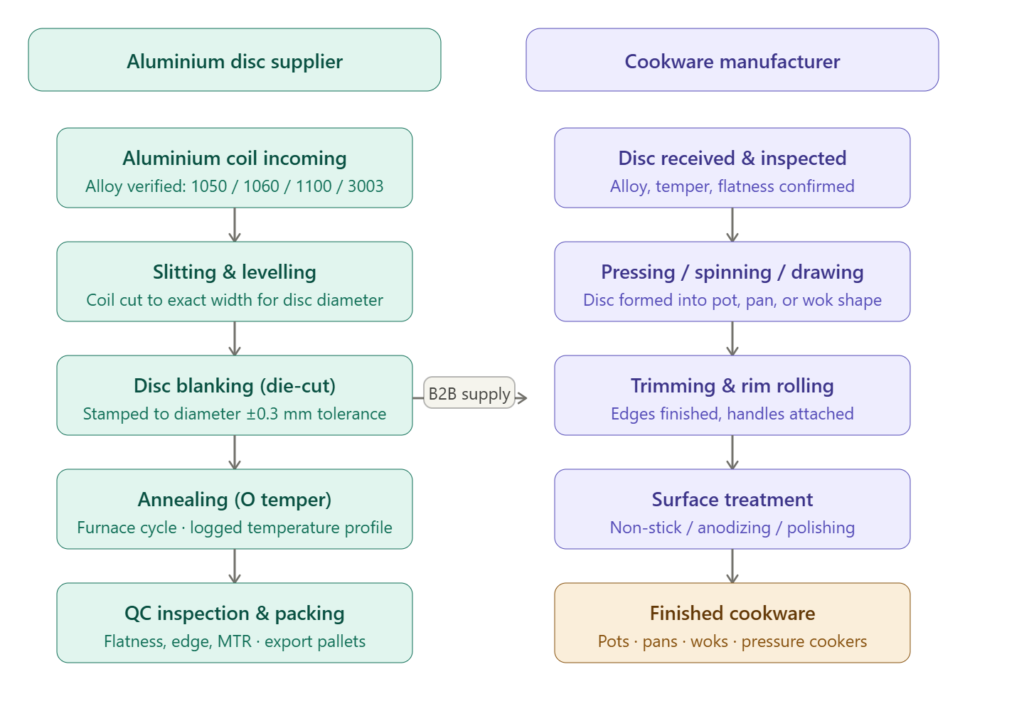
Cookware manufacturers — especially those producing stamped, spun, or deep-drawn utensils — rely on aluminum discs as their starting material. The disc is loaded into a press or spinning lathe, then formed into the final shape. The quality of the aluminum disc directly determines the dimensional accuracy, surface finish, and durability of the finished cookware product.
As a material supplier, we provide aluminum disc blanks in precise specifications. We do not manufacture the cookware itself. Our role is to supply the raw disc material that your production line needs.
Why Aluminum Is the Preferred Material for Cookware Discs
Aluminum is the dominant choice for cookware manufacturing worldwide. Here is why:
Excellent thermal conductivity. Aluminum conducts heat approximately 5× faster than stainless steel. This translates to even heat distribution across the pan base, reducing hot spots.
Low density. Aluminum weighs roughly one-third as much as steel. Lighter cookware is easier for end users to handle and reduces shipping costs for cookware brands.
Corrosion resistance. Aluminum naturally forms a thin oxide layer that resists corrosion under normal cooking conditions.
Formability. Aluminum disc blanks can be deep-drawn, spun, and stamped without cracking, especially in the H14 or O temper commonly used for cookware.
Cost efficiency. Compared to copper or stainless steel, aluminum offers strong thermal performance at significantly lower cost per kilogram.
For manufacturers sourcing an aluminum cooking disc, these properties make aluminum the material of choice across mass-market and premium cookware segments alike.
Key Technical Specifications of Aluminium Discs for Cookware
The following table summarizes the standard and custom specifications we supply:
| Parameter | Standard Range | Typical Cookware Spec |
|---|---|---|
| Alloy | 1050, 1060, 1100, 3003 | 1050 / 1060 / 3003 |
| Temper | O, H12, H14, H18, H24 | O (fully annealed) or H14 |
| Thickness | 0.5 mm – 6.0 mm | 1.5 mm – 4.0 mm |
| Diameter | 50 mm – 800 mm | 160 mm – 360 mm (common pot sizes) |
| Flatness tolerance | ±0.1 mm | ±0.05 mm (precision grade) |
| Surface finish | Mill finish, bright finish, one-side bright | Mill finish (standard) |
| Edge condition | Slit edge, deburred edge | Deburred (smooth edge, safe for pressing) |
| Diameter tolerance | ±0.5 mm standard | ±0.3 mm precision |
Aluminum Disc Bottom Specifications
For aluminum disc bottom applications — where the disc forms the base layer of a clad or encapsulated cookware bottom — the following specs are most relevant:
| Parameter | Specification |
|---|---|
| Alloy | 1100 or 3003 |
| Temper | O temper (fully soft, for cladding adhesion) |
| Thickness | 1.0 mm – 3.0 mm |
| Surface | Degreased, oxide-free, bright finish |
| Flatness | ±0.05 mm |
A flat, clean surface is critical for aluminum disc bottom use. Any oxide contamination or warping will cause delamination in bonded tri-ply or disc-bottom cookware construction.
Alloy Selection Guide: Which Grade Should You Order?
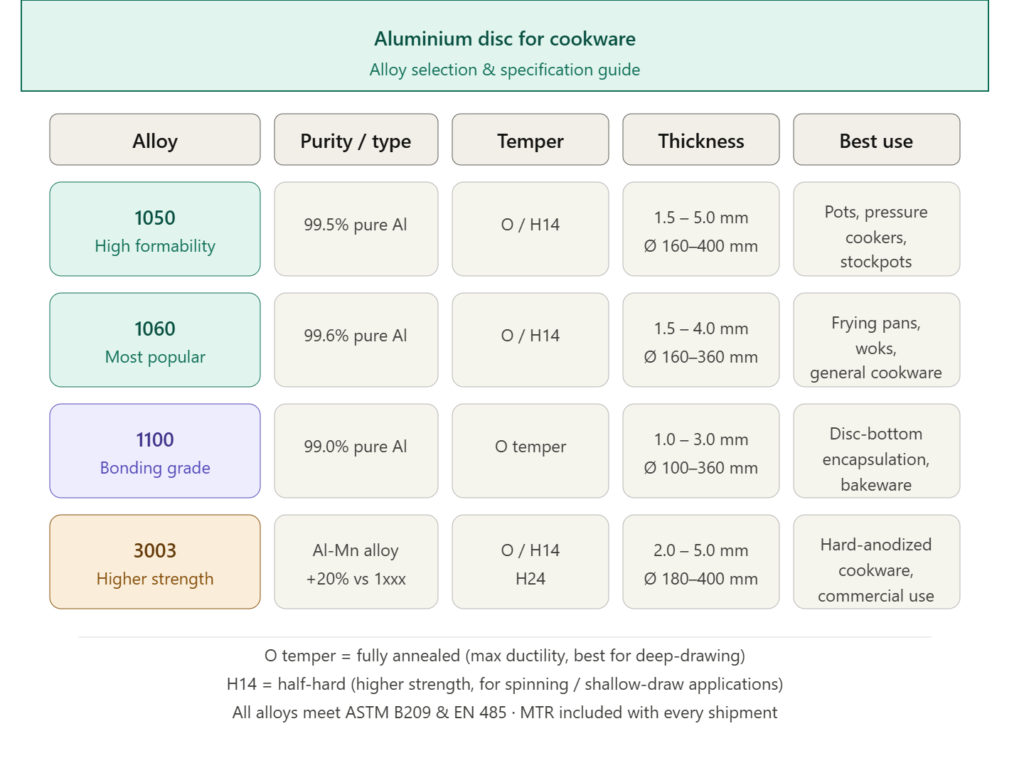
Choosing the right alloy for your aluminum cooking disc depends on your forming process and the cookware type.
| Alloy | Key Properties | Best Application |
|---|---|---|
| 1050 | 99.5% pure Al, excellent formability, soft | Deep-drawn pots, stockpots, pressure cooker bodies |
| 1060 | 99.6% pure Al, slightly higher strength than 1050 | Frying pans, woks, general cookware |
| 1100 | 99.0% pure Al, good corrosion resistance | Disc-bottom encapsulation, bakeware |
| 3003 | Al-Mn alloy, 20% stronger than 1xxx series | Hard-anodized cookware blanks, commercial kitchen use |
1050 and 1060 are the most commonly ordered alloys for aluminium disc for cookware applications. Both offer the deep-drawability required for pots and pans without cracking during stamping.
3003 is preferred when the finished cookware will undergo hard anodizing, as the alloy’s composition produces a more uniform anodized layer.
Temper Selection: O Temper vs. H14 for Cookware Discs
Temper has a direct impact on your production output and scrap rate.
O temper (fully annealed): Maximum ductility. The disc can be drawn to deep depths without intermediate annealing steps. This is the standard choice for deep-drawn pots, pressure cookers, and milk pots. Most aluminum cooking disc orders use O temper.
H14 (half-hard): Higher yield strength, less ductile. Suitable for shallow-drawn or spun applications where the forming depth is limited. Reduces springback in spinning operations.
H24: Work-hardened and partially annealed. Balances formability and strength. Used for frying pans where moderate drawing depth is needed alongside a harder final surface.
If you are unsure which temper suits your production line, our technical team can advise based on your tool geometry and press capacity.
Surface Finish Options for Aluminum Cookware Discs
| Finish Type | Description | Application |
|---|---|---|
| Mill finish | Standard as-rolled surface, slight roughness | Interior-coated cookware (non-stick PTFE, ceramic) |
| Bright/mirror finish | Reflective surface, Ra ≤ 0.2 μm | Exposed exterior of polished cookware |
| One-side bright | Bright on one face, mill on reverse | Disc-bottom bonding (bond side is mill, cooking side is bright) |
| Degreased + oxide-free | Chemically cleaned | Cladding, bonding, hard anodizing prep |
For cookware that will receive a non-stick coating, mill finish is sufficient and preferred — the slight surface texture improves coating adhesion. For polished stainless-clad exterior cookware, the outer aluminum face should be ordered as bright finish.
Common Cookware Products Made from Aluminum Disc Blanks
Aluminum discs are the starting material for a wide range of cookware products:
Frying pans and skillets. Typically 1060-O temper, 2.0–3.0 mm thick, diameter 200–300 mm. Pressed into a shallow-draw shape on hydraulic or mechanical presses.
Stockpots and saucepans. Typically 1050-O temper, 2.0–4.0 mm thick. Deep-drawn in multiple stages for taller sidewalls.
Pressure cooker bodies. Require thicker discs (3.0–5.0 mm) in 1050-O or 3003-O for structural integrity under pressure.
Woks. Typically 1.5–2.5 mm, large diameter (360–400 mm), O temper for spinning or pressing into the curved wok profile.
Milk pots and small saucepans. 1.0–2.0 mm, small diameters (120–180 mm), 1050-O or 1060-O.
Bakeware (cake tins, muffin trays). Thinner gauge (0.6–1.2 mm), 1100-O or 3003-O, bright finish.
Disc-bottom cookware. Stainless steel pots with an aluminum disc bottom encapsulated at the base. The aluminum disc in these products is typically 1100-O or pure aluminum alloy, optimized for thermal bonding.
Aluminum Disc for Cookware: Key Quality Standards
| Standard | Scope | Relevance to Cookware Discs |
|---|---|---|
| ASTM B209 | Aluminum alloy sheet and plate | Governs alloy composition, mechanical properties, dimensional tolerances |
| EN 485 | European aluminum sheet standard | Required for export to EU cookware manufacturers |
| GB/T 3880 | Chinese national standard | Applicable for domestically audited supply chains |
| FDA 21 CFR | US food contact safety | Confirms alloy is safe for food-contact cookware applications |
| REACH / RoHS | EU chemical regulations | Confirms no restricted substances in alloy or surface treatment |
Our aluminium disc for cookware supply meets ASTM B209 and EN 485 standards. Material Test Reports (MTRs) are available with every shipment. Third-party inspection by SGS, TÜV, or BV is available on request.
Ordering Information and Customization
We supply aluminum discs for cookware on a B2B basis, with the following flexibility:
| Item | Details |
|---|---|
| MOQ | 1 metric ton (approximately 500–3,000 pcs depending on spec) |
| Lead time | 7–15 business days for standard specs; 15–25 days for custom |
| Packaging | Stacked on pallets with interleaving paper; export carton option available |
| Diameter range | 50 mm – 800 mm (custom die-cut to your drawing) |
| Thickness tolerance | ±0.05 mm (precision grade on request) |
| Coil-to-disc conversion | We convert from our aluminum coil stock; no minimum coil order required |
| Custom alloy + temper | Available for repeat orders ≥3 MT |
We accept orders in imperial and metric dimensions. Custom diameters outside the standard range are available with a tooling fee.
Why Source Aluminium Discs from a Dedicated Aluminum Supplier?
Cookware manufacturers have two sourcing options: buy aluminum discs from a local metal service center, or source directly from a primary aluminum supplier like us.
Direct supplier advantages:
The aluminum originates from verified ingot sources with full alloy traceability. We maintain consistent chemical composition batch-to-batch, which is critical for cookware manufacturers running automated stamping lines calibrated to specific material properties.
Service centers buy from multiple mills and may mix batches. For high-volume cookware production, this introduces variability in hardness and formability — increasing scrap rates.
Our specific advantages as a supplier:
- Alloy consistency: same ingot chemistry per order, confirmed by MTR
- Annealing control: O temper discs are furnace-annealed with logged temperature profiles
- Custom dimensions: we cut to your exact diameter and thickness from coil stock
- ISO 9001 certified quality management system
- Export experience: regular shipments to cookware manufacturers in Turkey, Egypt, Vietnam, Indonesia, Mexico, Brazil, and the Middle East
Export Markets: Where We Supply Aluminum Cookware Discs
We currently supply aluminum discs for cookware to manufacturers in the following regions:
| Region | Key Countries |
|---|---|
| Middle East | Turkey, Iran, Saudi Arabia, Egypt |
| Southeast Asia | Vietnam, Indonesia, Thailand, Malaysia |
| South Asia | Bangladesh, Pakistan |
| Africa | Ethiopia, Nigeria, Kenya |
| Latin America | Mexico, Brazil, Colombia |
| Europe | Poland, Ukraine, Spain |
Our export documentation includes commercial invoice, packing list, certificate of origin, material test report, and SGS inspection certificate where required. All shipments comply with HS Code 7606 (aluminum plates, sheets, strip) or 7616 (other aluminum articles) depending on customs classification in the destination country.
Frequently Asked Questions
What is the difference between an aluminum disc and an aluminum circle? They are the same product. “Aluminum disc” and “aluminum circle” (or “aluminium circle blank”) are used interchangeably in the industry. Both refer to a flat, circular aluminum blank intended for forming.
What alloy is best for hard-anodized cookware? 3003 alloy is recommended. The manganese content in 3003 produces a harder, more uniform anodized layer compared to 1050 or 1060. The O temper is still used for forming before anodizing.
Can you supply discs with a non-stick coating pre-applied? No. We supply bare aluminum discs only. Non-stick coating (PTFE, ceramic, granite) is applied by the cookware manufacturer after forming. We are a material supplier, not a coating service provider.
What is the minimum order quantity? Our standard MOQ is 1 metric ton. For mixed specifications (multiple diameters or alloys), the combined total should reach 1 MT.
Do you offer free samples? Yes. Sample discs (up to 5 pcs per specification) are available for qualified cookware manufacturers to test in their production process before placing a bulk order.
Request a Quote
We supply aluminium disc for cookware to manufacturers and importers worldwide. To receive a quotation, please provide:
- Alloy and temper required (e.g., 1050-O, 1060-O, 3003-O)
- Diameter (mm or inches)
- Thickness (mm)
- Quantity (kg or metric tons)
- Destination port