
An aluminum circle 1050 disc is a flat, round blank punched or cut from 1050-alloy aluminum sheet. It is one of the most widely sourced aluminum circle products in global B2B markets. Cookware manufacturers, utensil factories, road-sign producers, and lighting hardware suppliers all rely on 1050 aluminum circle discs for their consistent formability, high conductivity, and clean surface finish.
This guide covers everything procurement teams need to know: alloy properties, temper options, dimensional specs, surface treatments, pricing factors, and how to evaluate a qualified aluminum circle disc supplier.
What Is an Aluminum Circle 1050 Disc?
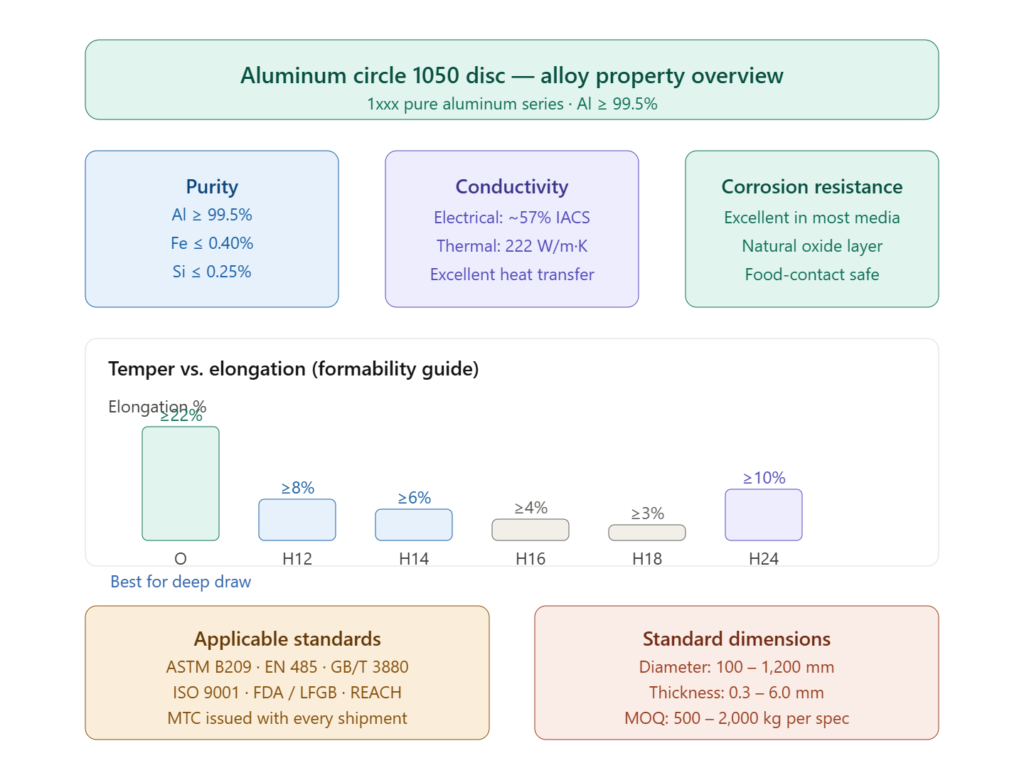
The 1050 designation belongs to the 1xxx pure-aluminum series. It contains a minimum of 99.5% aluminum with trace amounts of iron, silicon, and copper. Because the alloy is nearly pure aluminum, it offers excellent electrical conductivity, outstanding corrosion resistance, and very high elongation — all critical for deep-drawing processes used in cookware and utensil production.
The term aluminum circle disc and aluminum circle sheet both refer to the same product family — circular aluminum blanks produced from rolled sheet. “Disc” typically implies a thicker, more rigid blank, while “circle sheet” sometimes denotes thinner gauges used for spinning or light stamping. In practice, suppliers use both terms interchangeably.


1050 Aluminum Circle Disc: Key Specifications
When requesting a quotation, buyers must specify alloy, temper, diameter, thickness, and surface condition. The table below covers standard parameters for 1050 aluminum disc products.
| Parameter | Standard Range | Notes |
|---|---|---|
| Alloy | 1050 (Al ≥ 99.5%) | Pure aluminum series; also available in 1060, 1100, 3003 |
| Temper | O, H12, H14, H16, H18, H24 | O temper most common for deep drawing |
| Diameter | 100 mm – 1,200 mm | Custom diameters available on request |
| Thickness | 0.3 mm – 6.0 mm | Most cookware blanks: 1.0 mm – 3.5 mm |
| Surface Finish | Mill finish, anodized, polished, coated | Mill finish standard; anodized for premium cookware |
| Edge Condition | Deburred, smooth edge | Clean edge required for forming safety |
| Flatness Tolerance | ≤ 3 mm/m | Per ASTM B209 / EN 485-2 |
| Applicable Standards | ASTM B209, EN 485, GB/T 3880 | ISO 9001-certified mills preferred |
Temper Selection Guide for 1050 Aluminum Circle Disc
Temper is the most critical variable when sourcing an aluminum circle 1050 disc for manufacturing. The wrong temper causes cracking during forming or excessive springback in stamping.
| Temper | Tensile Strength (MPa) | Elongation (%) | Best Application |
|---|---|---|---|
| O (Annealed) | 60 – 95 | ≥ 22 | Deep drawing, spin forming, cookware blanks |
| H12 | 85 – 115 | ≥ 8 | Light stamping, shallow drawing |
| H14 | 95 – 125 | ≥ 6 | Road signs, reflectors, general fabrication |
| H16 | 110 – 140 | ≥ 4 | Stiffened discs, cover plates |
| H18 | 125 – 155 | ≥ 3 | Rigid discs, electrical components |
| H24 | 85 – 120 | ≥ 10 | General use, moderate forming |
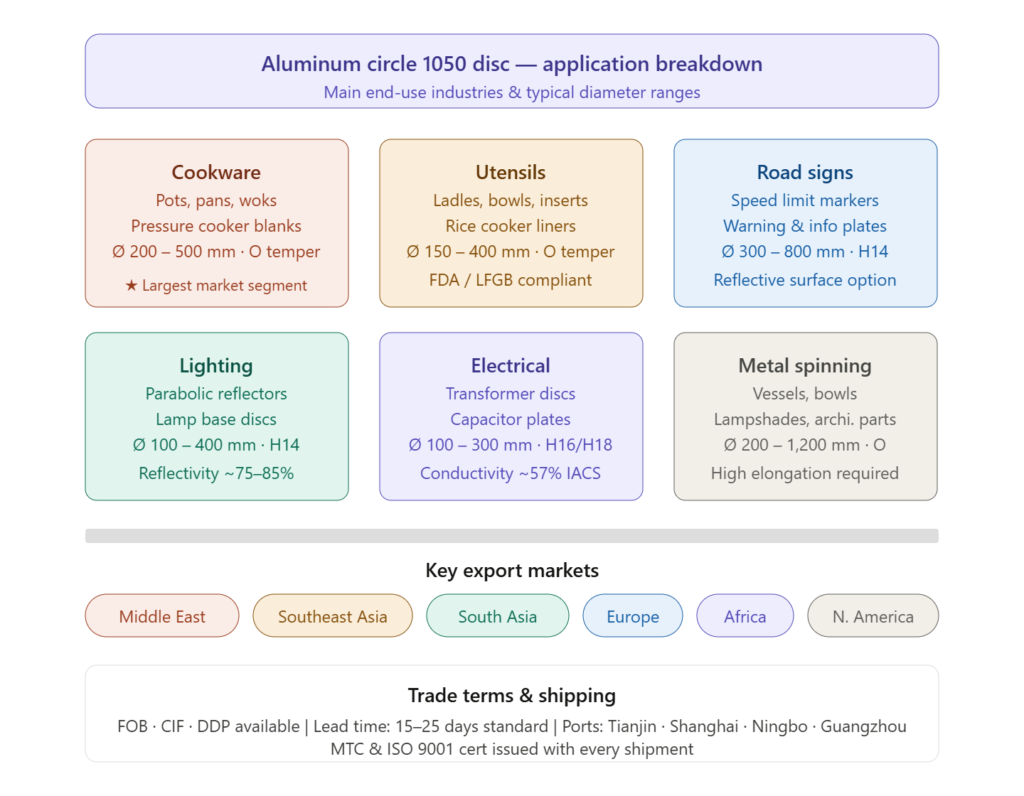
For cookware and utensil manufacturing, O temper is the standard choice. It provides maximum ductility for multi-pass deep drawing without intermediate annealing. H14 temper is preferred for aluminum circle plate applications such as traffic signs and lighting reflectors, where some rigidity is needed after forming.
Applications of Aluminum Circle Disc 1050
The 1050 aluminum disc serves a broad range of industries. Its combination of formability, corrosion resistance, and thermal conductivity makes it one of the most versatile aluminum circle products on the market.
Cookware and Kitchenware
Cookware manufacturers are the largest buyers of 1050 aluminum disc blanks. Deep-drawn pots, pans, pressure cookers, and woks all start as flat aluminum circle discs. The O-temper 1050 alloy draws cleanly in progressive dies without cracking. For premium non-stick cookware, the disc surface receives an anodizing or PTFE coating step after forming.
Utensils and Household Items
Factories producing ladles, rice cooker inserts, bowls, and storage containers use aluminium circle for utensil blanks in diameters from 150 mm to 500 mm. The high aluminum purity of 1050 meets FDA and LFGB food-contact standards, making it a safe choice for food-touching surfaces.
Road Signs and Traffic Equipment
Highway sign producers use aluminum circle sheet and disc formats as blanks for circular road signs, speed limit markers, and warning plates. H14 temper provides the right balance of formability and stiffness after bending.
Lighting Reflectors and Lamp Bases
High-purity 1050 aluminum has a natural reflectivity of about 75–85%. Polished or bright-rolled aluminum circle discs are used as parabolic reflector blanks in industrial and commercial lighting fixtures.
Electrical and Electronic Components
Transformer discs, capacitor plates, and heat spreaders use 1050 alloy for its superior electrical conductivity — approximately 57% IACS. The aluminum circle disc format allows efficient stamping of circular electrical components.
Spinning and Metalworking
Metal spinning shops use aluminum circle discs as starting blanks for spinning vessels, bowls, lampshades, and architectural elements. The O-temper 1050 disc spins smoothly without work-hardening too quickly.
1050 vs. Other Alloys: Which Aluminum Circle Disc Should You Choose?
Different aluminum alloys serve different performance needs. The table below compares 1050 against commonly used alternatives for aluminum circle plate and disc applications.
| Alloy | Al Purity / Composition | Formability | Strength | Corrosion Resistance | Typical Use |
|---|---|---|---|---|---|
| 1050 | ≥ 99.5% Al | Excellent | Low | Excellent | Cookware, utensils, reflectors |
| 1060 | ≥ 99.6% Al | Excellent | Low | Excellent | Electrical, chemical equipment |
| 1100 | ≥ 99.0% Al | Very Good | Low–Medium | Excellent | General cookware, food packaging |
| 3003 | Al-Mn alloy | Good | Medium | Very Good | Pressure cookers, water tanks |
| 5052 | Al-Mg alloy | Moderate | Medium-High | Very Good | Marine, structural parts |
For pure deep-drawing applications, 1050 and 1060 are the top choices. When additional strength is needed — for example, in pressure cooker bodies — 3003 or 1100 alloy discs are a better fit.
How Aluminum Circle 1050 Discs Are Manufactured
Understanding the production process helps buyers assess quality and set accurate lead-time expectations.
Step 1: Hot Rolling and Cold Rolling
Aluminum ingot is first hot-rolled into thick coil, then cold-rolled to the target gauge. Cold rolling increases hardness (work hardening), which is why annealing is required to reach O temper.
Step 2: Annealing
For O-temper aluminum circle 1050 discs, the rolled sheet passes through a continuous annealing furnace. Temperature and time are tightly controlled to achieve full recrystallization and maximum elongation.
Step 3: Blanking / Disc Cutting
The annealed sheet is fed into a blanking press or circle-shearing machine. Dies punch out circular blanks at high speed. Tolerance on diameter is typically ±0.5 mm for standard tooling, tighter on precision dies.
Step 4: Edge Deburring
Freshly punched aluminum circle discs have sharp blanked edges. Deburring machines tumble or belt-grind the edges to a smooth, safe finish required for downstream forming.
Step 5: Surface Treatment (Optional)
Mill-finish discs ship as-cut. Value-added options include: bright rolling for reflective surfaces, anodizing for corrosion protection, PVDF/polyester coating for colored discs, and polishing for mirror finish.
Step 6: Inspection and Packing
Each production batch undergoes dimensional inspection, visual inspection for surface defects, and mechanical testing per ASTM B209 or EN 485. Mill Test Certificates (MTC) are issued with each shipment.
Surface Finish Options for Aluminum Circle Discs
| Surface Finish | Description | Application |
|---|---|---|
| Mill Finish | As-rolled, no additional treatment | Cookware blanks, general forming |
| Bright Rolling | High-polish rolls produce reflective surface | Lighting reflectors, cosmetic packaging |
| Anodized | Electrochemical oxide layer, 5–25 µm | Premium cookware, decorative parts |
| Polished (Mirror) | Mechanical + chemical polishing, Ra ≤ 0.1 µm | Reflectors, high-end kitchenware |
| PVDF / Polyester Coated | Color coating, 15–35 µm dry film | Colored aluminum disc, signage |
Aluminum Circle 1050 Disc Pricing Factors
The price of an aluminum circle disc depends on several variables. Understanding each factor helps buyers negotiate effectively and plan procurement budgets.
- LME Aluminum Price: Base metal cost follows the London Metal Exchange (LME) aluminum price, which fluctuates daily. Most suppliers quote a fabrication premium over the LME base.
- Alloy and Temper: Higher-purity alloys and annealed (O) tempers require additional processing steps, adding to cost.
- Diameter and Thickness: Larger and thicker discs consume more material and create more scrap during blanking. Both increase unit cost.
- Surface Treatment: Mill finish is the lowest cost. Anodized, polished, or coated discs carry a significant premium.
- Order Quantity (MOQ): Standard MOQ for aluminum circle 1050 disc orders ranges from 500 kg to 2,000 kg per specification. Higher volumes bring lower unit pricing.
- Trade Terms: FOB pricing is the most common export quotation basis. CIF and DDP pricing are available for buyers who prefer freight-inclusive quotations.
Quality Standards and Certifications
When sourcing aluminum circle discs for food-contact or industrial applications, buyers should verify compliance with the following:
| Standard / Certification | Scope | Required For |
|---|---|---|
| ASTM B209 | Aluminum sheet and plate dimensional and mechanical tolerance | North American markets |
| EN 485 | European standard for aluminum sheet products | EU buyers |
| GB/T 3880 | Chinese national standard for aluminum alloy sheet | China-origin supply verification |
| ISO 9001 | Quality management system | All export orders |
| FDA / LFGB | Food-contact safety certification | Cookware and utensil discs |
| REACH / RoHS | Hazardous substance compliance | EU market entry |
| MTC (Mill Test Certificate) | Per-batch chemical and mechanical test results | All shipments |
Packaging and Shipping for Aluminum Circle Disc Export
Proper packaging prevents surface scratches and deformation in transit. Standard export packaging for aluminum circle discs includes:
- Interleaved with plastic film or kraft paper between each disc
- Stacked vertically in wooden pallets or horizontal in wooden crates
- Steel strapping with corner protectors
- Moisture-barrier outer wrapping for sea freight
Shipment terms: FOB major Chinese ports (Tianjin, Shanghai, Ningbo, Guangzhou). Lead time for standard specifications: 15–25 days. Custom alloy or surface-treated discs: 25–35 days.
Export Markets: Where Are Aluminum Circle 1050 Discs Used Most?
Demand for aluminum circle disc and aluminum circle plate products is highest in the following regions:
- Middle East (UAE, Saudi Arabia, Egypt): Large-scale cookware and utensil manufacturing hubs with strong demand for O-temper 1050 discs.
- Southeast Asia (Vietnam, Indonesia, Thailand): Fast-growing cookware export manufacturers sourcing aluminum circle blanks in high volumes.
- South Asia (Pakistan, Bangladesh): Active markets for aluminum utensil production, especially rice cooker inserts and pressure cooker blanks.
- Africa (Nigeria, Kenya, South Africa): Growing domestic cookware manufacturing sectors requiring competitively priced aluminium circle for utensil production.
- Europe (Germany, Turkey, Italy): High-specification markets requiring EN 485-compliant aluminum circle disc with full MTC documentation.
- North America: Buyers sourcing aluminum round plate and disc blanks for specialty cookware and lighting components.
FAQ: Aluminum Circle 1050 Disc
What is the difference between an aluminum circle disc and an aluminum circle plate?
The terms are often used interchangeably. In common industry usage, “aluminum circle plate” tends to refer to thicker blanks (above 3 mm), while “aluminum circle disc” typically describes thinner circular blanks used in drawing and spinning. Both are sourced from the same 1050-alloy sheet material.
What is the standard MOQ for aluminum circle 1050 disc orders?
Most suppliers set a minimum order quantity (MOQ) of 500 kg to 2,000 kg per SKU (diameter + thickness + temper combination). Mixed-specification orders may be available above a total order weight of 3,000–5,000 kg.
Can aluminum circle discs be anodized after forming?
Yes. Cookware manufacturers typically form the disc first, then anodize the shaped body. However, pre-anodized disc blanks are also available for applications where the anodized surface must remain on the outer face after shallow forming.
Is 1050 aluminum food-safe?
Yes. 1050 alloy contains no hazardous alloying elements. It complies with FDA food-contact regulations and European LFGB standards. It is widely used in direct food-contact cookware and utensil manufacturing globally.
What is the lead time for custom-size aluminum circle discs?
Standard diameters (150 mm, 200 mm, 250 mm, 300 mm, 360 mm, 400 mm, 500 mm) are typically in stock or carry a 15–20 day production lead time. Non-standard diameters require new tooling and carry a 25–35 day lead time.
How is the price of aluminum circle 1050 disc calculated?
Price = LME aluminum price + processing/fabrication premium + surface treatment surcharge (if any). The fabrication premium varies by specification complexity, order quantity, and market conditions. Always request a formal quotation referencing the current LME price basis date.
What alloy should I choose for deep-drawn cookware — 1050 or 3003?
For most cookware, 1050 O-temper is the preferred choice due to its higher formability and better food-safety profile. 3003 alloy is chosen when additional strength is needed — for example, in pressure cooker bodies or multi-clad cookware constructions where the blank undergoes multiple deep draws.
Why Source Aluminum Circle 1050 Disc from a Direct Manufacturer
Buying directly from an aluminum circle manufacturer — rather than a trading company — delivers clear advantages:
- Consistent Quality: Direct mill supply means full traceability from ingot to finished disc, with per-batch MTC documentation.
- Custom Specifications: Diameter, thickness, temper, and surface treatment are configurable without trading company markups or communication delays.
- Competitive Pricing: No intermediary margins. Price is based directly on LME aluminum cost plus factory fabrication premium.
- Faster Response: Technical questions about alloy properties, drawing ratios, or surface treatment options are answered directly by engineers.
- Flexible Trade Terms: FOB, CIF, and DDP options available. Sample orders supported for new product development.
Request a Quote for Aluminum Circle 1050 Disc
We supply aluminum circle 1050 discs and aluminum circle plates to cookware manufacturers, utensil factories, sign producers, and industrial buyers in over 30 countries. Standard and custom specifications are available with short lead times.
To receive a competitive quotation, please contact us with the following details:
- Alloy: 1050 (or alternative: 1060, 1100, 3003)
- Temper: O / H12 / H14 / H16 / H18 / H24
- Diameter (mm) and Thickness (mm)
- Surface finish requirement
- Estimated monthly quantity (kg or pieces)
- Destination port and preferred trade terms (FOB / CIF / DDP)