
An aluminum circle plate is a flat, disc-shaped aluminum product cut or rolled directly into a circular form. It serves as the primary raw material for cookware, road signs, lighting reflectors, bottle caps, and many industrial components. Whether you are sourcing a 4 inch aluminum disc for a small hardware project or a full pallet of aluminum plate circular blanks for mass production, understanding the key specifications will help you choose the right product and get the best price.
This guide covers alloy grades, standard sizes, technical parameters, applications, cutting methods, and pricing. It is written for engineers, procurement managers, and buyers who want factory-direct information.


1. What Is an Aluminum Circle Plate?
An aluminum circle is a round aluminum blank produced by stamping or slitting aluminum coil or sheet into a disc shape. The terms “aluminum circle plate,” “aluminum disc,” and “aluminum plate circular” are used interchangeably in the market. The product is distinguished by its diameter (ranging from 50 mm to over 1,500 mm), alloy series, temper, and thickness.
Compared with rectangular aluminum sheet, an aluminum circle plate reduces material waste in downstream forming processes such as deep drawing, spinning, and impact extrusion. This makes it the preferred starting form for round finished parts.
Key advantage: Buying pre-cut aluminum circle plates instead of cutting circles from sheet can reduce material waste by 15–30% and lower per-part cost significantly in high-volume production.
2. Common Alloy Grades for Aluminum Circle Plates
The alloy determines corrosion resistance, formability, strength, and surface finish. The table below covers the most widely used grades for aluminum circle plate and aluminum circle applications.
| Alloy | Temper | Tensile Strength (MPa) | Main Characteristics | Typical Applications |
|---|---|---|---|---|
| 1050 | O / H14 / H24 | 65 – 110 | 99.5% pure Al, excellent forming, high conductivity | Cookware, traffic signs, nameplates |
| 1060 | O / H12 / H14 | 75 – 120 | 99.6% pure Al, soft, easy to deep-draw | Pots, pans, kitchenware, lamp covers |
| 1100 | O / H14 / H18 | 90 – 130 | Good workability, weldable, widely available | Food containers, decorative parts, reflectors |
| 3003 | O / H14 / H24 | 110 – 165 | Mn-added, better strength than 1xxx, still formable | Pressure vessels, deep-drawn pots, pizza pans |
| 3004 | O / H32 / H34 | 170 – 215 | Higher strength, good corrosion resistance | Beverage cans, storage containers |
| 5052 | O / H32 | 170 – 230 | Excellent marine corrosion resistance, moderate strength | Marine components, automotive parts |
| 6061 | T4 / T6 | 260 – 310 | Heat-treatable, high strength, machinable | Structural discs, flanges, mechanical parts |
For cookware and the aluminum circle pan market, alloys 1050, 1060, 1100, and 3003 are the most popular because they offer deep-draw formability without cracking. For structural or machined parts, 6061-T6 is the standard choice.
3. Standard Sizes and Technical Specifications
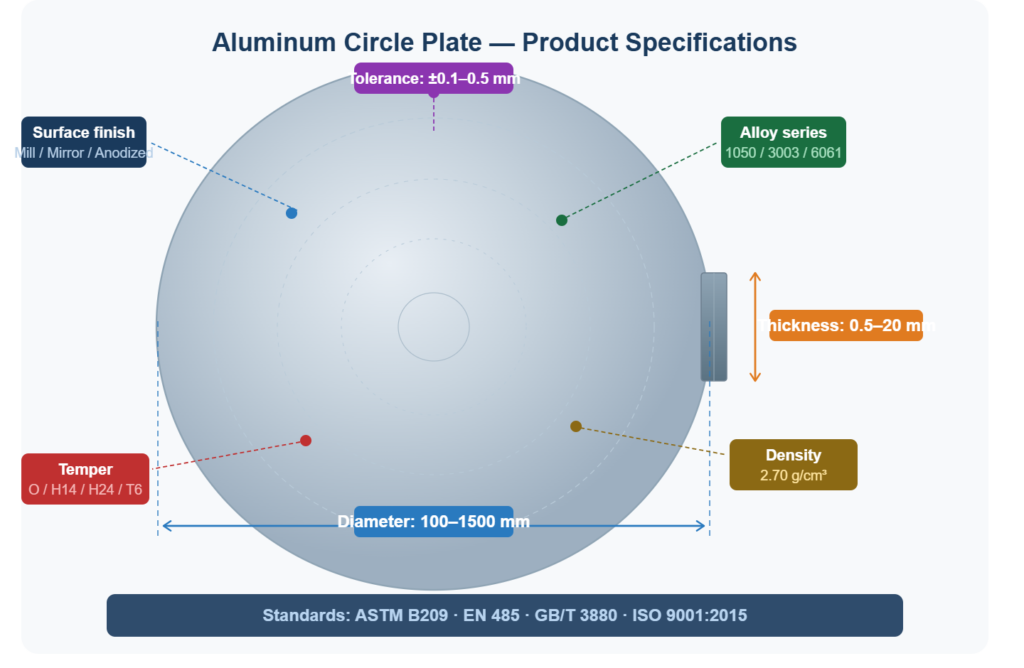
Aluminum circle plates are available in a wide range of diameters and thicknesses. Below is a reference table for the most common standard sizes. Custom sizes are available from most manufacturers with a minimum order quantity.
| Diameter (mm) | Diameter (inch) | Common Thickness (mm) | Weight per pc (kg) — 1mm thick | Common Alloy |
|---|---|---|---|---|
| 100 | ~4 inch | 0.5 – 3.0 | 0.021 | 1050 / 1100 / 3003 |
| 150 | ~6 inch | 0.5 – 4.0 | 0.048 | 1050 / 1060 / 3003 |
| 200 | ~8 inch | 0.8 – 5.0 | 0.085 | 1050 / 3003 / 5052 |
| 300 | ~12 inch | 1.0 – 6.0 | 0.191 | 1060 / 3003 / 5052 |
| 400 | ~16 inch | 1.5 – 8.0 | 0.340 | 1060 / 3003 / 6061 |
| 500 | ~20 inch | 2.0 – 10.0 | 0.530 | 3003 / 5052 / 6061 |
| 600 | ~24 inch | 2.0 – 12.0 | 0.762 | 3003 / 5052 / 6061 |
| 800 – 1200 | 32 – 48 inch | 3.0 – 20.0 | 1.356 – 3.051 | 5052 / 6061 / 7075 |
Full Parameter Reference
| Parameter | Standard Range | Notes |
|---|---|---|
| Diameter tolerance | ±0.5 mm (standard), ±0.1 mm (precision) | CNC trimming available for tighter tolerance |
| Thickness tolerance | ±0.02 – ±0.05 mm | Per EN 485 / ASTM B209 |
| Flatness | ≤ 1 mm/m | Leveled after stamping |
| Surface finish | Mill finish, bright/mirror, anodized, painted | Mill finish is default |
| Edge condition | Trimmed, deburred | Burr height ≤ 0.1 mm standard |
| Density (aluminum) | 2.70 g/cm³ | Used for weight calculation |
| Melting point | 600 – 660 °C | Varies slightly by alloy |
| Conductivity (1100) | 57% IACS | High conductivity series |
| Packing | Wooden pallet + plastic film | Interleaved with paper to protect surface |
4. Main Applications of Aluminum Circle Plates
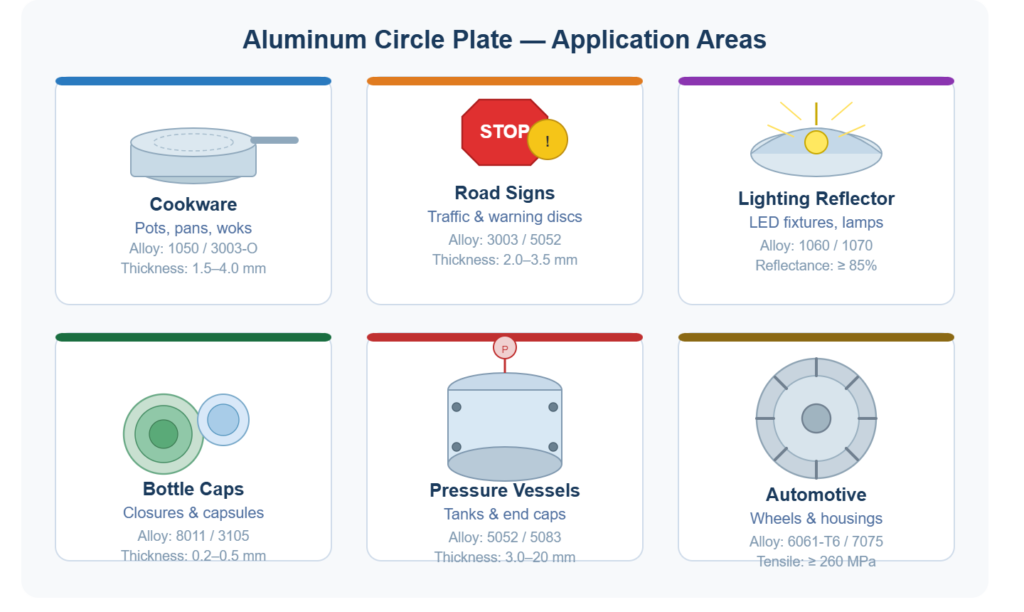
The aluminum circle plate is one of the most versatile aluminum semi-finished products. Its applications span consumer goods, transportation, construction, and industrial equipment.
Cookware and Kitchenware
This is the largest single market for aluminum circle plates. The aluminum circle pan blank starts as a flat disc—typically 1050-O or 3003-O alloy—and is deep-drawn or spun into shape. Alloys in the 1xxx and 3xxx series offer excellent annealing and forming properties with no cracking at deep-draw ratios up to 2.5:1. Non-stick coatings, hard anodizing, and polishing are applied after forming.
Road Signs and Traffic Equipment
Circular road signs use aluminum plate circular blanks of 3003 or 5052 alloy, typically 2–3 mm thick. Aluminum is preferred over steel because it is lighter, does not rust, and is easier to mount on posts. Retroreflective sheeting is applied to the face after punching mounting holes.
Lighting and Reflectors
High-purity 1060 and 1070 aluminum circles are used for lampshades, downlight housings, and solar reflector discs. Mirror-finish or bright-rolled surfaces achieve reflectance values above 85%. The lightweight and formability of aluminum make it the dominant material for LED fixture components.
Bottle Caps and Closures
Thin aluminum circles (0.2–0.5 mm) in 8011 and 3105 alloys are stamped into bottle caps, wine capsules, and pharmaceutical closures. The soft temper allows tight sealing without cracking.
Pressure Vessels and Industrial Equipment
Thicker aluminum circle plates in 5052, 5083, and 6061 alloys serve as end caps or flanges for tanks and pressure vessels. Their corrosion resistance in marine and chemical environments extends service life.
Automotive and Aerospace
Circular aluminum blanks are spun or formed into wheels, brake drums, structural housings, and spacecraft bulkhead sections. High-strength 6061-T6 and 7075-T6 are used where strength-to-weight ratio is critical.
5. Aluminium Circle Price – What Affects Cost?
The aluminium circle price depends on several factors. Understanding these helps buyers negotiate better and compare quotes accurately.
| Cost Factor | Impact | Typical Range |
|---|---|---|
| Aluminum LME price | High – base metal is the largest cost component | $2,200 – $2,700 / MT (2024–2025 average) |
| Alloy series | Medium – 6xxx costs more than 1xxx | 1xxx cheapest; 7xxx most expensive |
| Temper / heat treatment | Medium – O temper is cheapest; T6 adds heat-treat cost | +$50 – $300/MT for T6 |
| Thickness and diameter | Medium – non-standard sizes have higher tooling/scrap cost | Standard sizes are ~5–10% cheaper |
| Surface finish | Medium – mirror / anodized adds processing cost | Mill finish cheapest; mirror +$0.15–0.30/kg |
| Order quantity (MOQ) | High – larger orders reduce per-unit cost | MOQ usually 1–5 MT; price breaks at 5, 10, 20 MT |
| Shipping and Incoterms | High – sea freight vs. air freight is a major factor | FOB, CIF, DDP quotations vary widely |
As a general reference, FOB factory prices for standard 1050/1060 aluminum circle plates (mill finish, O temper) typically range from $2,400 to $3,200 per metric ton depending on the factors above. 3003 alloy runs about 5–10% higher, and 6061-T6 discs can be $4,000–$6,000/MT depending on thickness and quantity. Always request a quote with a specific alloy, temper, thickness, diameter, and quantity to get an accurate price.
6. How to Cut a Circle in an Aluminum Plate or Sheet
For buyers who need to cut custom-sized aluminum circles on site, or engineers specifying the process, here are the main methods used to cut a circle in aluminum plate and aluminum sheet.
Plasma Cutting
Plasma cutting is the fastest method for aluminum plate circular cuts on thick material (3 mm and above). A CNC plasma table with a circle-cutting attachment or programmed arc path produces clean edges with minimal heat distortion. Edge finishing with a deburring wheel is recommended.
Waterjet Cutting
Waterjet is the preferred method for precision circles in aluminum sheet and plate because it produces no heat-affected zone (HAZ). It handles thicknesses from 0.5 mm to 200 mm. It is the best answer to “how to cut a circle in aluminum plate” when tight tolerances (±0.1 mm) are required.
CNC Router / Milling
A CNC router with a carbide end mill cuts aluminum sheet circles cleanly at speeds of 15,000–25,000 RPM using a climb-milling strategy. A circle-cutting jig (pivot pin + router) works well for hobbyists cutting one or two pieces from aluminum sheet up to 6 mm thick.
Laser Cutting
Fiber laser cutting handles aluminum up to about 25 mm. It delivers excellent edge quality and works with CNC nesting software to minimize material waste. Reflectivity of aluminum requires a fiber laser (not CO₂) to cut efficiently.
Stamping / Blanking (Factory Method)
At production scale, the most cost-effective way to produce aluminum circles is stamping from coil. A round blanking die punches the disc in a single stroke. This is the process used by aluminum circle plate manufacturers and results in the lowest per-piece cost at volumes above a few thousand pieces.
Hole Saw (DIY / Low Volume)
For small diameters up to about 150 mm and thin sheet (≤ 3 mm), a bi-metal hole saw in a drill press cuts acceptable aluminum circles. Use cutting fluid, keep RPM low, and clamp the workpiece securely.
7. Aluminum Circle Ring vs. Full Disc – Key Differences
An aluminum circle ring is an annular (donut-shaped) blank with a center hole, while a full aluminum circle plate has no hole. Rings are used where weight reduction is important or where a hole is needed by design, such as flanges, gaskets, and bearing housings. Key differences:
| Feature | Aluminum Circle Plate (Full Disc) | Aluminum Circle Ring (Annular) |
|---|---|---|
| Center | Solid | Open hole (inner diameter specified) |
| Weight | Higher (full material) | Lower for same OD |
| Applications | Cookware, signs, caps, reflectors | Flanges, gaskets, frames, wheels |
| Specification | OD + thickness | OD + ID + thickness |
| Production | Single-stage stamping | Two-stage punch (OD then ID) or waterjet |
8. Surface Treatments for Aluminum Circle Plates
Surface treatment affects corrosion resistance, appearance, hardness, and end-use suitability. Common options for aluminum circle plates include:
- Mill finish – As-rolled surface. Most economical. Suitable for parts that will be further processed or coated.
- Bright / mirror finish – Mechanically or chemically polished to achieve reflectance above 80%. Used in lighting reflectors and decorative products.
- Anodizing – Electrochemical process that builds a hard oxide layer 10–25 µm thick. Improves corrosion resistance and allows dyeing in multiple colors.
- Hard anodizing – Layer thickness of 25–50 µm, surface hardness up to HV 400. Used for cookware and industrial wear parts.
- PVDF / polyester coating – Organic coating applied by coil coating for outdoor signs and architectural products. 20–25 years weathering life.
- Non-stick coating (PTFE / ceramic) – Applied after forming for cookware. Requires clean mill-finish or anodized substrate.
9. Quality Standards and Certifications
Reputable aluminum circle plate manufacturers comply with internationally recognized standards. When evaluating suppliers, ask for documentation of the following:
| Standard / Certification | Scope |
|---|---|
| ASTM B209 | Standard specification for aluminum sheet and plate (US market) |
| EN 485-1/2 | European standard for aluminum sheet, strip, and plate |
| GB/T 3880 | Chinese national standard for aluminum alloy plate and sheet |
| ISO 9001:2015 | Quality management system certification |
| ISO 14001 | Environmental management |
| FDA / LFGB | Food-contact safety certification for cookware-grade circles |
| SGS / BV Material Test Report | Third-party chemical composition and mechanical property verification |
10. Why Source Aluminum Circle Plates from a Factory?
Buying direct from an aluminum circle plate manufacturer offers several advantages over purchasing through a distributor or trader:
- Competitive price: No middleman margin. Factory prices are 8–15% lower than trader prices on equivalent specifications.
- Custom specifications: Factories can produce non-standard diameters, alloys, tempers, and surface finishes with flexible MOQ.
- Consistent quality: In-house rolling, stamping, annealing, and inspection under one roof eliminates inter-supplier variation.
- Mill test reports: Chemical composition and mechanical property certificates issued with every batch.
- Large production capacity: 500–3,000 MT/month capacity means faster delivery and ability to scale with your order growth.
- Export experience: Established factories handle export documentation, Letter of Credit, and sea freight logistics routinely.
Major Export Destinations
Aluminum circle plates manufactured in China are widely exported to Southeast Asia (Vietnam, Indonesia, Thailand), the Middle East (UAE, Saudi Arabia, Turkey), Africa (Nigeria, Kenya, South Africa), South America (Brazil, Mexico), and Europe. Standard shipping terms include FOB Qingdao/Shanghai, CIF destination port, and DDP for door-to-door delivery.
Request a Quote for Aluminum Circle Plates
Tell us your alloy, temper, diameter, thickness, and monthly quantity. Our engineers will respond within 24 hours with a competitive factory price and sample options.
📧 inquiry@yourcompany.com | 📞 +86-XXX-XXXX-XXXX
11. Frequently Asked Questions
What is the minimum order quantity for aluminum circle plates?
Most factories accept a minimum order of 1–2 metric tons per alloy/size combination. For trial orders, some suppliers accept 500 kg with a slightly higher unit price. Large orders of 10 MT or more typically get the best per-unit pricing.
What is the difference between a 4 inch aluminum disc and a 12 inch aluminum disc?
The only difference is diameter. A 4 inch aluminum disc (approx. 100 mm) is used for smaller components like lamp bases, small lids, or hardware fittings. A 12 inch aluminum disc (approx. 300 mm) suits larger cookware, medium road signs, or industrial flanges. Both can be produced in the same alloys and thicknesses.
How do I specify an aluminum circle plate order?
Provide: alloy (e.g., 1050), temper (e.g., O or H14), diameter in mm or inches, thickness in mm, surface finish (mill finish, bright, anodized), quantity in kg or MT, and any special requirements (tolerance class, certification, packaging). The more detail you provide, the faster and more accurate the quotation.
Can aluminum circle plates be anodized after delivery?
Yes. Mill-finish aluminum circle plates in 1xxx and 3xxx series can be anodized by a local anodizing shop after delivery. If you require a specific anodizing color or hard-anodize layer, it is usually more cost-effective to have the factory apply the treatment before shipping.
What alloy is best for deep-drawn cookware?
1050-O, 1060-O, and 3003-O are the top choices for deep-drawn pots and pans. They offer the high elongation (≥25%) and low yield strength needed to form deeply without cracking. 3003 is preferred when slightly more strength is needed in the finished product, such as for pressure cookers.