
An aluminum circle (also called aluminum disc or round aluminum plate) is a flat, circular piece cut from aluminum sheet metal. It is one of the most widely used aluminum products in the world — valued for its lightweight nature, excellent corrosion resistance, and superior formability. Our aluminum circles are produced from high-quality alloys including 1050, 1060, 1100, 3003, and 5052.
Whether you need an aluminum circle ring for lighting fixtures, an aluminum circle pan blank for cookware, or a large round aluminum plate for industrial equipment, we manufacture them all under one roof. This guide covers everything buyers need to know — from alloy selection and standard sizes to pricing and applications.

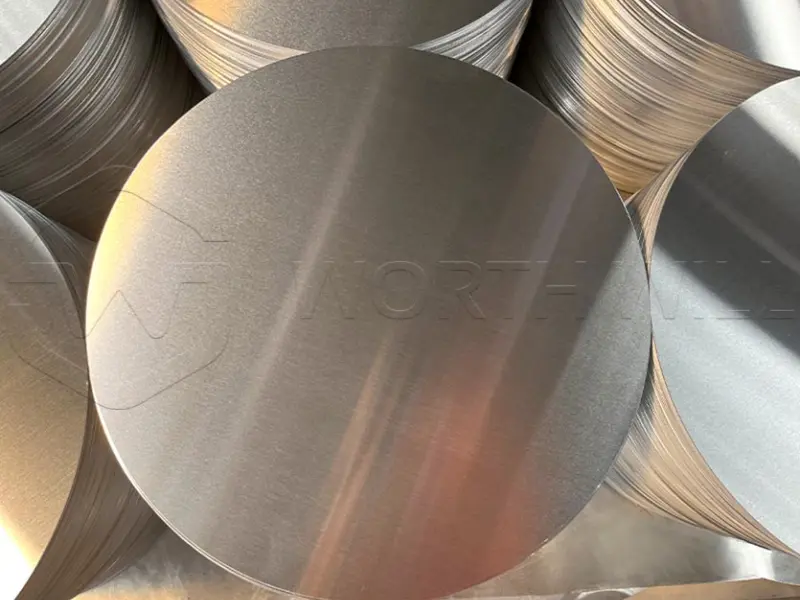

What Is an Aluminum Circle?
An aluminum circle is a disc-shaped product stamped or cut from an aluminum sheet. The production process starts with a high-quality aluminum sheet metal coil. The sheet passes through a blanking press that punches out circles of a specified diameter. The result is a smooth, burr-free disc ready for deep drawing, spinning, or stamping into final products.
Aluminum circles differ from simple sheet offcuts because they are manufactured to tight dimensional tolerances. Flatness, surface finish, and edge quality are all tightly controlled. These qualities make the aluminum circle the preferred starting material for cookware, lighting reflectors, traffic signs, and capacitor housings.
⚖️
Lightweight
Density of only 2.7 g/cm³ — about one-third the weight of steel, ideal for transport and portable applications.
🔧
High Formability
Excellent deep-drawing and spinning properties, enabling complex cookware and reflector shapes without cracking.
🛡️
Corrosion Resistant
Natural oxide layer provides strong resistance to moisture, chemicals, and oxidation in everyday environments.
♻️
100% Recyclable
Aluminum can be recycled indefinitely without loss of quality, supporting sustainable manufacturing goals.
Aluminum Circle Specifications & Parameters
We supply aluminum circles across a wide range of alloys, tempers, and dimensions. The table below summarizes our standard product parameters. Custom sizes and alloys are available on request.
| Parameter | Standard Range | Common Options |
|---|---|---|
| Alloy | 1xxx, 3xxx, 5xxx series | 1050, 1060, 1100, 3003, 5052, 8011 |
| Temper | O, H12, H14, H16, H18, H24 | O (fully annealed) most common for cookware |
| Diameter | 80 mm – 1,500 mm | 100, 150, 200, 250, 300, 400, 500 mm |
| Thickness | 0.3 mm – 6.0 mm | 0.5, 0.8, 1.0, 1.2, 1.5, 2.0, 3.0 mm |
| Surface Finish | Mill finish, bright, anodized | Mill finish standard; mirror finish available |
| Edge Type | Blanked edge (trimmed clean) | Deburred, polished edge on request |
| Flatness | ≤ 2 mm/m | Tighter tolerance available for precision use |
| MOQ | 1 metric ton | Sample orders accepted |
| Packing | Interleaved with paper, wooden pallets | Export seaworthy packing standard |
Alloy Comparison for Aluminum Circles
| Alloy | Tensile Strength | Elongation | Key Property | Typical Use |
|---|---|---|---|---|
| 1050 | 60–95 MPa | ≥20% | Highest purity, softest | Cookware, road signs |
| 1060 | 60–100 MPa | ≥18% | Excellent deep-drawing | Pressure cookers, pots |
| 1100 | 75–130 MPa | ≥15% | Good corrosion resistance | Food packaging, utensils |
| 3003 | 95–185 MPa | ≥12% | Mn-added, stronger | Cookware lids, traffic signs |
| 5052 | 170–245 MPa | ≥10% | High strength, marine grade | Pressure vessels, tanks |
| 8011 | 80–120 MPa | ≥15% | Foil-grade, food safe | Bottle caps, closures |
Aluminum Circle Ring – Features & Uses
An aluminum circle ring is a variant of the standard aluminum disc with a center hole punched out, creating a ring or donut shape. This form is used when a hollow center is required — common in lighting components, pipe flanges, motor parts, and decorative elements.
The ring is produced in the same blanking process as a solid aluminum circle, with an additional punch for the inner diameter. This ensures the inner and outer edges are concentric. Wall thickness (the difference between outer and inner radius) can be held to ±0.1 mm for precision applications.
Common Aluminum Circle Ring Specifications
- Outer diameter: 80 mm to 600 mm
- Inner diameter: 20 mm to 500 mm (must be smaller than OD)
- Thickness: 0.5 mm to 4.0 mm
- Alloys: 1050, 1060, 1100, 3003
- Surface: Mill finish or anodized
Aluminum Circle Pan – Cookware Blanks
The aluminum circle pan blank is the starting point for most aluminum cookware production. A flat aluminum circle is deep-drawn or spun on a lathe to form the finished pan shape — a process that stretches and thins the material evenly without tearing it.
The quality of the aluminum circle pan blank directly determines the quality of the final cookware. Critical requirements include:
- Temper O (fully annealed) — Maximum softness for deep drawing without cracking.
- Uniform thickness — Variation of ≤ ±0.02 mm prevents uneven walls in the finished pan.
- Clean surface — Free of inclusions, oil spots, and scratches that would appear in the final product.
- Alloy 1050 or 1060 — Highest formability and food-safe composition.
Our aluminum circle pan blanks pass a three-stage surface inspection before dispatch. We supply over 200 cookware manufacturers across Asia, Europe, and the Americas each year.
| Pan Type | Blank Diameter | Blank Thickness | Recommended Alloy |
|---|---|---|---|
| Small fry pan (18 cm) | 240–260 mm | 1.2–1.5 mm | 1050-O / 1060-O |
| Medium fry pan (24 cm) | 310–330 mm | 1.5–2.0 mm | 1060-O / 3003-O |
| Large fry pan (30 cm) | 380–400 mm | 2.0–2.5 mm | 3003-O |
| Pressure cooker (4 L) | 260–280 mm | 2.5–3.0 mm | 3003-O / 5052-O |
| Stock pot (8 L) | 320–360 mm | 2.5–3.5 mm | 3003-H14 |
Round Aluminum Plate – Industrial Applications
A round aluminum plate refers to a thicker aluminum disc — typically 3 mm or above — used in structural and industrial applications rather than cookware. Round aluminum plates are machined, welded, or bolted into assemblies where flatness, strength, and machinability are all important.
Common alloys for round aluminum plates include 6061-T6 for machined parts and 5052-H32 for marine and chemical equipment. Our round aluminum plates are produced to ASTM B209 or EN 573 standards and can be supplied with mill test certificates.
Machinery End Caps
Round aluminum plates serve as end covers for cylinders, housings, and bearing assemblies in mechanical engineering.
Traffic Signs & Road Plates
High-visibility signage boards cut as round aluminum plates. 5052 alloy resists outdoor weathering.
Flanges & Covers
Pipe flanges, inspection covers, and manholes use round aluminum plates for their corrosion resistance.
LED Lighting Bases
Heat-dissipating base plates for high-power LED fixtures, taking advantage of aluminum’s thermal conductivity.
Aerospace Components
Bulkhead plates and structural discs in aircraft frames, typically from 2024 or 7075 series alloys.
Capacitor Housings
Thin, precise round aluminum plates form the casings of electrolytic capacitors in electronics.
4 Inch Aluminum Disc – Small Format Precision Blanks
The 4 inch aluminum disc (approximately 100 mm diameter) is one of our most popular small-format products. At this size, dimensional accuracy is especially important. A 4 inch aluminum disc is commonly used in:
- LED PCB heat spreader bases
- Valve covers and instrument blanking plates
- Sublimation printing blanks for custom photo discs
- Small cookware lids and trivets
- Medal and award blanks
| Specification | 4 Inch Aluminum Disc |
|---|---|
| Diameter | 100 mm ± 0.5 mm (4 inches = 101.6 mm, standard 100 mm) |
| Thickness range | 0.5 mm – 5.0 mm |
| Common alloys | 1050, 1060, 1100, 3003, 5052, 6061 |
| Surface options | Mill finish, bright annealed, anodized, sublimation-coated |
| MOQ | 500 pcs (small-batch orders accepted) |
| Lead time | 7–15 business days |
| Packaging | Interleaved with protective film, carton or pallet |
12 Inch Aluminum Disc – Large Format & Industrial Use
The 12 inch aluminum disc (approximately 300 mm diameter) covers a wide range of medium-to-large industrial applications. At 300 mm, the disc is large enough for woks, pressure cooker bodies, large lighting reflectors, and industrial flanges — yet still light enough to handle easily.
Deep drawing a 12 inch aluminum disc into cookware requires careful material selection. We recommend 1060-O or 3003-O for cookware applications at this size. For structural or machined parts, 5052-H32 or 6061-T6 provides higher strength.
4″
~100 mm
8″
~200 mm
12″
~300 mm
20″
~500 mm
| Specification | 12 Inch Aluminum Disc |
|---|---|
| Diameter | 300 mm ± 0.5 mm (12 inches = 304.8 mm) |
| Thickness range | 0.8 mm – 6.0 mm |
| Common alloys | 1050, 1060, 3003, 5052, 6061 |
| Weight (2 mm thick) | ~480 g per disc (1060 alloy) |
| Surface options | Mill finish, mirror polished, anodized |
| MOQ | 200 pcs or 1 metric ton |
| Lead time | 10–20 business days |
Aluminum Sheet Metal – The Source Material
Every aluminum circle starts as aluminum sheet metal. Understanding the parent sheet helps buyers choose the right circle specification. Our aluminum sheet metal is produced on a continuous casting and rolling line, then cold-rolled to final thickness. The sheet is then slit into strips and fed into the blanking press to produce aluminum circles.
Key properties of our aluminum sheet metal used for circle production:
| Property | 1050 / 1060 Sheet | 3003 Sheet | 5052 Sheet |
|---|---|---|---|
| Al content | ≥99.5% / ≥99.6% | ≥97.0% | ≥94.7% |
| Yield strength (O) | 15–25 MPa | 35–55 MPa | 65–90 MPa |
| Elongation (O) | 23–28% | 18–22% | 14–18% |
| Thermal conductivity | 229 W/m·K | 163 W/m·K | 138 W/m·K |
| Thickness tolerance | ±0.02 mm | ±0.03 mm | ±0.03 mm |
| Width available | Up to 2,000 mm | Up to 2,000 mm | Up to 1,600 mm |
| Coil weight | 3–7 MT | 3–7 MT | 3–6 MT |
We can supply aluminum sheet metal separately for customers who run their own blanking operations. Minimum order quantity for coil is 3 metric tons. Cut-to-length sheets are available from 0.5 MT.
Aluminum Circle Applications Across Industries
The aluminum circle is a universal input material. Across the world, manufacturers rely on it as the starting point for dozens of product categories. Below are the main industries we serve:
| Industry | Product | Recommended Alloy | Typical Size |
|---|---|---|---|
| Cookware | Pots, pans, woks, lids | 1050-O, 1060-O, 3003-O | 150–400 mm |
| Lighting | Reflectors, lamp bases, LED housings | 1060-H18, 1100-H18 | 80–300 mm |
| Traffic & Signage | Round road signs, warning plates | 5052-H32, 3003-H14 | 200–800 mm |
| Electronics | Capacitor cases, heat sinks | 1050-O, 8011-O | 10–80 mm |
| Packaging | Bottle caps, can ends, closures | 8011-O, 3003-O | 20–120 mm |
| Sublimation | Photo blanks, award medals, nameplates | 1100-H18 | 75–300 mm |
| Machinery | Flanges, end caps, spacers | 6061-T6, 5052-H32 | 100–600 mm |
| Automotive | Wheel covers, sensor housings | 3003-H14, 5052-H32 | 100–400 mm |
Aluminum Circle Price – What Affects Your Cost?
The price of an aluminum circle depends on four main factors. Understanding each helps you get accurate quotes and negotiate better terms.
1. Aluminum LME Price
Aluminum circles are priced as a fabrication premium over the London Metal Exchange (LME) aluminum price. When LME prices rise, so does the base material cost. Our quotes lock in the processing premium; the aluminum component adjusts with the market.
2. Alloy & Temper
Higher-alloy products cost more. A 5052 aluminum circle costs roughly 15–25% more than a 1060 circle of the same size and weight. Annealed (O temper) is typically cheaper than work-hardened tempers because less post-rolling processing is needed.
3. Diameter & Thickness
Material yield loss increases with circle diameter and is higher for thicker gauges. A 12 inch aluminum disc requires more material per piece than a 4 inch aluminum disc. Very thin gauges (below 0.5 mm) also carry a premium due to rolling difficulty.
4. Surface Finish & Quantity
Mill finish is the most economical option. Mirror finish, anodized, or sublimation-coated surfaces add 8–30% depending on the process. Larger quantities reduce the per-piece cost significantly — bulk orders above 5 MT receive the best pricing.
For a current price, please contact our sales team with your diameter, thickness, alloy, temper, and quantity. We respond within 12 hours.
Why Choose Us as Your Aluminum Circle Manufacturer?
🏭
Factory Direct
We are the manufacturer, not a trading company. No middlemen means lower prices and faster lead times.
📐
Custom Sizes
Any diameter from 80 mm to 1,500 mm. Any thickness from 0.3 mm to 6 mm. Custom alloys and tempers on request.
✅
Quality Certified
ISO 9001:2015 certified. Mill test certificates provided for every order. Third-party inspection accepted.
🚢
Export Experience
Over 15 years of export experience. We handle customs documentation, packing, and freight coordination.
🔬
In-House Lab
Mechanical testing, chemical composition analysis, and surface inspection performed on-site before shipment.
📦
Sample Available
Free samples available for standard sizes. Custom sample orders (1–50 pcs) can be arranged within 5 days.
Export Countries & Global Reach
We export aluminum circles and aluminum sheet metal to over 60 countries. Our main markets include:
🇺🇸 United States🇩🇪 Germany🇬🇧 United Kingdom🇫🇷 France🇮🇹 Italy🇪🇸 Spain🇧🇷 Brazil🇲🇽 Mexico🇸🇦 Saudi Arabia🇦🇪 UAE🇹🇷 Turkey🇮🇩 Indonesia🇻🇳 Vietnam🇿🇦 South Africa🇦🇺 Australia🇨🇦 Canada
We ship via sea freight (FCL & LCL), air freight, and express courier. Port of loading: Tianjin, Shanghai, Guangzhou. Average sea transit time to Europe: 25–30 days; to the US West Coast: 20–25 days.
Frequently Asked Questions
What is the difference between an aluminum circle and an aluminum disc?
They are the same product. “Aluminum circle” is the more common trade term in Asia, while “aluminum disc” is often used in North America and Europe. Both describe a flat, round piece of aluminum cut from sheet metal.
Which alloy should I choose for cookware aluminum circle pan blanks?
For most cookware applications, we recommend 1060-O or 1050-O. These alloys offer the best formability for deep drawing and are food-safe. For thicker-walled or higher-pressure cookware such as pressure cookers, 3003-O provides additional strength.
Can you supply both 4 inch aluminum disc and 12 inch aluminum disc in the same order?
Yes. We can mix sizes within the same shipment. Different sizes may have separate minimum quantity requirements, but we work with customers to consolidate orders wherever possible.
What is the lead time for a standard order?
Standard sizes in 1050, 1060, and 3003 are usually available from stock or can be produced within 7–15 business days. Custom sizes, special alloys, or anodized surfaces require 15–25 business days.
Do you provide material test reports?
Yes. We provide a Mill Test Certificate (MTC) with every order. The MTC includes chemical composition, mechanical properties, and dimensional measurements. Third-party inspection by SGS, BV, or Intertek is accepted at buyer’s cost.
Is your round aluminum plate suitable for anodizing?
Yes. Alloys 1050, 1060, 1100, and 5052 all anodize well. We can supply the round aluminum plate in pre-anodize condition (degreased, bright finish) so your anodizing line gets the best results. We also offer in-house anodizing for small and medium quantities.