
An anodized aluminum circle is a round aluminum disc that has been treated through an electrochemical process called anodization. This process creates a durable oxide layer on the surface of the aluminum. The result is a product that is stronger, more corrosion-resistant, and more visually appealing than standard aluminum.
Manufacturers, fabricators, and buyers around the world choose anodized aluminum circles for a wide range of applications. Whether you need them for cookware, signage, lighting, or industrial use, these discs offer excellent performance and long service life.
This guide covers everything you need to know — from what anodized aluminum circles are, to their applications, advantages, specifications, and how to buy them at the best price.


What Is an Anodized Aluminum Circle?
An aluminum circle (also called an aluminum disc or aluminum round blank) is a flat, round piece of aluminum cut from an aluminum sheet or coil. When this disc goes through the anodizing process, it becomes an anodized aluminum circle.
Anodizing is an electrochemical process. It converts the outer layer of aluminum into aluminum oxide. This oxide layer bonds directly to the metal. It does not peel or flake like paint or coatings. The layer is hard, dense, and protective.
Key facts about anodized aluminum circles:
- Base material: Pure aluminum or aluminum alloy (1050, 1060, 1100, 3003, 5052, etc.)
- Shape: Perfectly round disc
- Surface: Smooth, matte, or brushed, depending on pre-treatment
- Thickness range: 0.3mm – 6.0mm
- Diameter range: 100mm – 1500mm
- Anodized layer thickness: 5 – 25 microns (standard); up to 50 microns (hard anodize)
Anodized Aluminum Circles vs. Regular Aluminum Circles
Many buyers ask: Is anodized aluminum better than aluminum? The answer is yes — in most cases.
Here is a simple comparison:
| Feature | Regular Aluminum Circle | Anodized Aluminum Circle |
|---|---|---|
| Corrosion resistance | Moderate | Excellent |
| Surface hardness | Low to moderate | High |
| Appearance | Shiny silver | Matte or colored |
| Paint adhesion | Good | Excellent |
| Durability | Standard | Superior |
| Food safety | Not always | Yes (when properly done) |
| Cost | Lower | Slightly higher |
Anodized aluminum circles last longer. They handle heat, moisture, and wear better. For applications like cookware, lighting reflectors, and outdoor signage, anodized aluminum circles are the clear choice.
What Are the Downsides of Anodized Aluminum?
No product is perfect. Here are the main downsides of anodized aluminum circles:
- Higher cost: Anodizing adds a step to production. This increases the price compared to plain aluminum circles.
- Color limitations: The anodized layer limits the range of colors available. Deep reds and bright yellows can be harder to achieve.
- Not easily re-anodized: Once scratched deeply, you cannot simply re-anodize a small area. You need to strip and redo the entire piece.
- Brittle oxide layer: The anodized surface is harder but more brittle than the base metal. Heavy impacts can crack the surface.
- Size limitations: Very large pieces may not fit in standard anodizing tanks.
Despite these downsides, the benefits far outweigh the negatives for most applications.
Anodized Aluminum Circle Applications
Anodized aluminum circles are used in dozens of industries worldwide. Here are the most common applications:
Cookware and Kitchen Products
This is one of the biggest markets for anodized aluminum circles. Manufacturers use them to make:
- Pots and pans
- Pizza pans
- Pressure cooker lids
- Baking trays
- Woks and frying pans
Hard-anodized aluminum circles are especially popular for cookware. The surface is non-reactive. It does not leach metals into food. It is also easy to clean.
Lighting and Reflectors
Anodized aluminum circles reflect light very well. Manufacturers use them to make:
- LED light reflectors
- Lamp shades
- Spotlight housings
- Solar reflector panels
The anodized surface maintains its reflectivity over time. It does not tarnish or oxidize further.
Road Signs and Nameplates
Aluminum circle tags and round aluminum signs use anodized surfaces. The anodized layer accepts dye sublimation printing and laser engraving very well. This makes them ideal for:
- Road signs
- Parking signs
- Nameplates
- Memorial plaques
- Award medallions
The anodized surface holds text and images clearly for many years outdoors.
Industrial and Engineering Uses
In engineering and manufacturing, anodized aluminum circles appear in:
- Machine parts
- Flanges and spacers
- Valve discs
- Electronic enclosure parts
- Heat sinks
The hardness of the anodized layer reduces wear in moving parts.
Decorative and Consumer Products
Anodized aluminum circles also appear in everyday consumer products:
- Watch faces
- Phone cases
- Bicycle parts
- Sporting equipment
- Jewelry blanks
The ability to color anodized aluminum makes it attractive for decorative applications.
Anodized Aluminum Circle Specifications
When ordering anodized aluminum circles, you need to specify the right parameters. Here are the key specifications to consider:
Alloy Grade
The most common alloys for anodized aluminum circles are:
- 1050 / 1060 / 1100: High purity aluminum. Best for cookware and reflectors. Excellent anodizing results.
- 3003: Good formability and corrosion resistance. Popular for cookware and general use.
- 5052: Higher strength. Good for structural applications.
- 6061: High strength. Good for engineering parts.
Note: Higher purity alloys (1xxx series) produce the clearest and most uniform anodized finish.
Temper
- O (Annealed): Soft and formable. Good for deep drawing.
- H12 / H14 / H16: Work-hardened. Used when some stiffness is needed.
- H18: Fully hardened.
Thickness
Standard thicknesses for anodized aluminum circles range from 0.3mm to 6.0mm. The most common thicknesses are:
- 0.5mm, 0.8mm, 1.0mm — for lightweight applications
- 1.5mm, 2.0mm, 2.5mm — for cookware and signs
- 3.0mm, 4.0mm, 5.0mm — for industrial and structural use
Diameter
Custom diameters are available. Common sizes range from 100mm to 1500mm. We cut circles to your exact specifications.
Anodized Layer Thickness
- Type II (Standard Anodize): 5 – 25 microns. Good for decorative and general use.
- Type III (Hard Anodize): 25 – 75 microns. For industrial and high-wear applications.
Surface Finish
- Mill finish: Natural aluminum appearance after anodizing
- Brushed finish: Satin, directional grain texture
- Polished finish: Mirror-like before anodizing
- Matte finish: Non-reflective surface
Anodized Aluminum Circle Colors
One major advantage of anodized aluminum is that you can add color. The anodizing process creates pores in the oxide layer. These pores absorb dye. After dyeing, the pores are sealed. The color becomes part of the metal.
Common colors available for anodized aluminum circles include:
- Silver / Clear: Natural aluminum appearance
- Black: Most popular. Very durable.
- Gold / Champagne: Elegant, decorative look
- Red: Bright and eye-catching
- Blue: Popular for consumer products
- Bronze / Brown: Natural, architectural appearance
- Green: Used in outdoor and environmental applications
Custom colors are available with minimum order quantities. Please contact our sales team for color matching services.
Color durability depends on the application. Indoor anodized colors last decades. Outdoor colors may fade slowly over 10-20 years under direct sunlight.
How Are Anodized Aluminum Circles Made?
Understanding the production process helps you choose the right product and supplier.
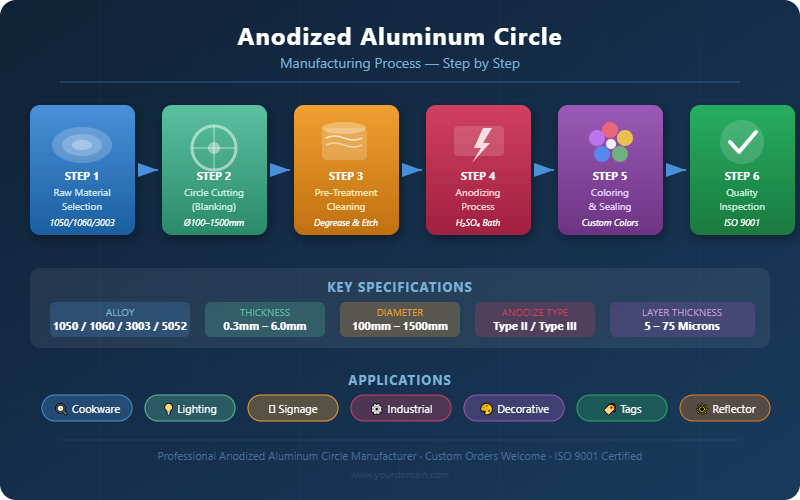
Step 1: Raw Material Selection
We start with high-quality aluminum coils or sheets. The alloy grade and temper are selected based on the end application.
Step 2: Circle Cutting (Blanking)
Round blanks are cut from the aluminum sheet using a stamping press or laser cutter. This creates the basic aluminum circle shape. Edges are deburred and smoothed.
Step 3: Pre-Treatment
Before anodizing, the surface is cleaned and prepared:
- Degreasing: Removes oils and contaminants
- Etching: Creates a uniform matte appearance (optional)
- Desmutting: Removes smut left by etching
Step 4: Anodizing
The circles are submerged in a sulfuric acid bath. An electric current passes through the bath. This oxidizes the aluminum surface and creates the hard oxide layer.
- Temperature: 18–22°C (standard anodize)
- Current density: 1.2 – 1.5 A/dm²
- Time: 20 – 60 minutes depending on desired thickness
Step 5: Coloring (Optional)
If color is needed, circles are placed in a dye bath after anodizing. The dye fills the open pores in the oxide layer.
Step 6: Sealing
The anodized and colored circles go into a sealing bath (hot water or nickel acetate). Sealing closes the pores. This locks in the color and improves corrosion resistance.
Step 7: Quality Inspection
Each batch is inspected for:
- Layer thickness (using eddy current tester)
- Color consistency
- Surface defects
- Dimensional accuracy
Step 8: Packaging and Shipping
We package anodized aluminum circles carefully to prevent scratching. Interleaf paper, plastic film, and sturdy cartons protect the surface during transport.
Is It Possible to Anodize Aluminum? (FAQ)
Yes, absolutely. Aluminum is one of the easiest metals to anodize. In fact, aluminum anodizing is a well-established industrial process used worldwide. Almost all aluminum alloys can be anodized. Some alloys produce better results than others.
Here are common questions buyers ask:
Q: What is the circle of aluminium?
An aluminum circle (or aluminum disc) is a flat, round piece of aluminum. Manufacturers produce it by stamping or cutting from aluminum sheet or coil. Aluminum circles are the starting material for many products like pots, pans, signs, and reflectors.
Q: Is anodized aluminum better than aluminum?
In most cases, yes. Anodized aluminum has a harder surface, better corrosion resistance, improved appearance, and longer lifespan. The trade-off is a slightly higher cost and some color limitations.
Q: What are the downsides of anodized aluminum?
The main downsides are higher cost, limited color range, the difficulty of repairing scratched areas, and a brittle surface layer that can crack under heavy impact.
Q: How long does anodized aluminum last?
With proper care, anodized aluminum can last 20 to 30 years or more. Hard-anodized surfaces in industrial applications often last even longer.
Q: Can I get custom sizes for anodized aluminum circles?
Yes. We supply custom diameter and thickness combinations. Minimum order quantities apply for custom sizes.
Anodized Aluminum Circle Price Factors
The price of anodized aluminum circles depends on several factors:
- Alloy grade: Higher purity alloys may cost more
- Thickness and diameter: Larger and thicker circles use more material
- Anodizing type: Hard anodize costs more than standard anodize
- Color: Clear/silver is the most economical. Custom colors add cost
- Surface finish: Mirror polish or brushed finish adds processing cost
- Order quantity: Larger orders get better unit prices
- Current aluminum market price: LME aluminum prices affect raw material costs
For an accurate price, please contact us with your specifications:
- Alloy grade
- Thickness (mm)
- Diameter (mm)
- Anodizing type and color
- Quantity (kg or pieces)
- Destination port
Why Choose Our Anodized Aluminum Circles?
We are a professional manufacturer of aluminum circles and anodized aluminum products. Here is why customers worldwide trust us:
Strict Quality Control
We test every batch. Our in-house lab checks chemical composition, mechanical properties, surface quality, and anodized layer thickness. We hold ISO 9001 certification.
Wide Product Range
We stock and produce anodized aluminum circles in:
- Multiple alloy grades (1050, 1060, 1100, 3003, 5052, 6061)
- Thickness: 0.3mm – 6.0mm
- Diameter: 100mm – 1500mm
- Multiple colors and finishes
Custom Production
We accept custom orders. You can specify any size, alloy, temper, anodizing type, color, and finish. Our engineering team will work with you to meet your exact requirements.
Competitive Pricing
As a direct manufacturer, we eliminate middlemen. You get factory prices. We offer volume discounts for large orders.
Fast Delivery
We maintain large inventory of standard sizes. Custom orders typically ship within 15-25 days after order confirmation.
Global Export Experience
We export anodized aluminum circles to the United States, Germany, Australia, Canada, Mexico, the Middle East, Southeast Asia, and many other markets. We handle all export documentation and can arrange shipping by sea or air.
Excellent Customer Service
Our sales team responds within 24 hours. We provide:
- Free samples (standard sizes)
- Technical support
- Material certifications and test reports
- Third-party inspection support
How to Order Anodized Aluminum Circles
Ordering is simple. Follow these steps:
- Send us your specifications — alloy, thickness, diameter, quantity, anodizing requirements
- Receive our quotation — we respond within 24 hours
- Confirm the order — sign the sales contract
- Pay the deposit — usually 30% T/T in advance
- Production begins — we keep you updated with production photos
- Final inspection — QC check before shipment
- Shipment — we arrange shipping and send you tracking details
- Pay the balance — before or after shipment, as agreed
Conclusion
Anodized aluminum circles are one of the most versatile and durable aluminum products available. They combine the lightweight and formability of aluminum with the strength and beauty of an anodized surface. From cookware to signage, lighting to industrial parts, these discs serve countless applications worldwide.
Choosing the right alloy, thickness, diameter, and anodizing type is important. A reliable supplier makes the process easy.
If you are looking for high-quality anodized aluminum circles at competitive prices, contact us today. We are ready to provide samples, technical advice, and the best pricing for your project.
Contact us now for a free quote on anodized aluminum circles. Tell us your specifications and we will respond within 24 hours.