Alloy 3003 Round Aluminum Circle
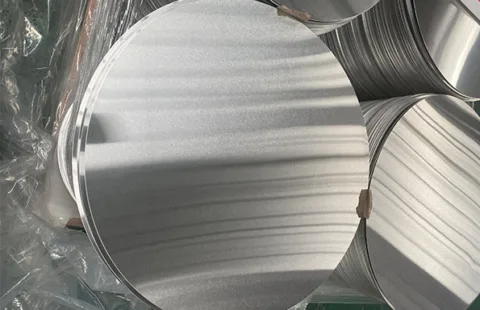
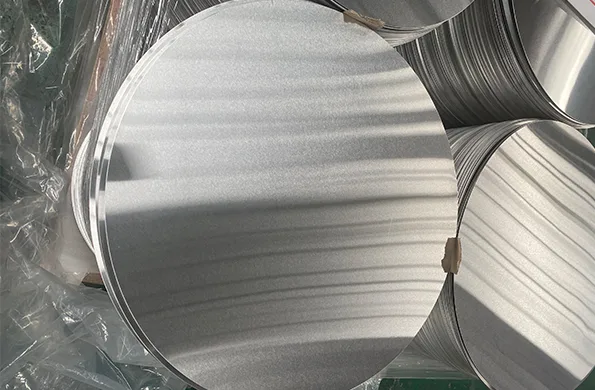
Alloy 3003 round aluminum circle is a flat, circular aluminum blank made from 3003 aluminum alloy. Manufacturers cut or blank these circles from rolled aluminum sheet or coil. The result is a precise round disc ready for forming into cookware, containers, and other products.
The term “round aluminum circle” describes the shape clearly. It is round. It is flat. It is made from aluminum alloy 3003. These circles serve as raw material blanks for stamping, spinning, and deep drawing operations.
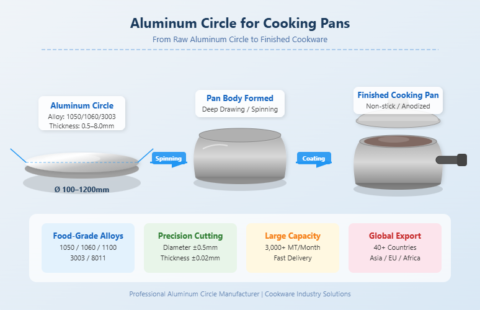
3003 aluminum circle is the most popular alloy choice for cookware manufacturing worldwide. The manganese content in 3003 gives it better strength than pure aluminum alloys. At the same time, it keeps the excellent formability needed for deep drawing operations.
Factories in Asia, Europe, the Middle East, and Africa use alloy 3003 round aluminum circles every day to produce millions of pots, pans, rice cookers, and pressure cookers.

What Is Alloy 3003?
Alloy 3003 is a wrought aluminum alloy in the 3000 series. The 3000 series uses manganese as the primary alloying element. Among all 3000 series alloys, 3003 is the most widely produced and used.
Key Facts About Alloy 3003
- Series: 3000 (Al-Mn alloy system)
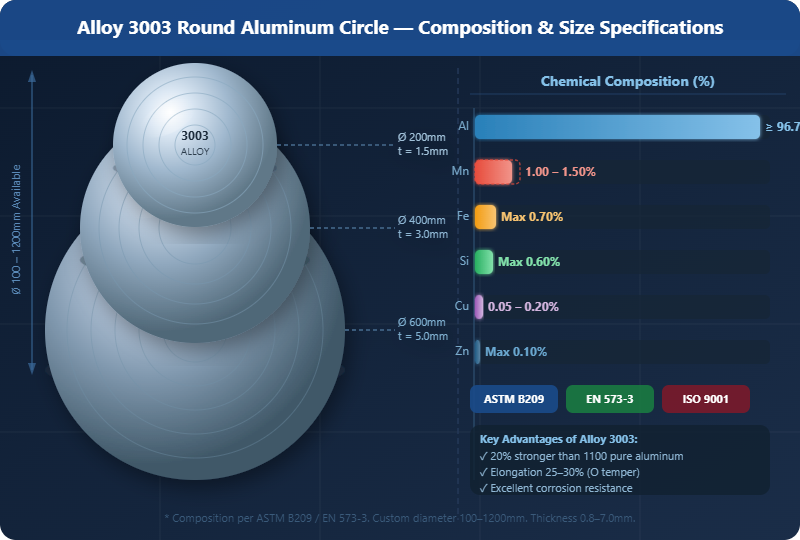
- Primary alloying element: Manganese (1.0–1.5%)
- Temper options: O, H12, H14, H16, H18, H22, H24
- Strength: About 20% stronger than 1100 pure aluminum
- Non-heat-treatable: Strength comes from work hardening only
- Excellent corrosion resistance: Resists food acids, water, and chemicals
- Good weldability: Welds easily with all standard methods
- Food safe: Approved for direct food contact worldwide
Alloy 3003 aluminum strikes the perfect balance between strength, formability, and cost. This is why cookware manufacturers worldwide choose it over other alloys.
Alloy 3003 Chemical Composition
The chemical composition of alloy 3003 follows strict international standards.
Chemical Composition Table
| Element | Content (%) |
|---|---|
| Aluminum (Al) | Balance ≥96.7% |
| Manganese (Mn) | 1.00 – 1.50 |
| Copper (Cu) | 0.05 – 0.20 |
| Iron (Fe) | Max 0.70 |
| Silicon (Si) | Max 0.60 |
| Zinc (Zn) | Max 0.10 |
| Titanium (Ti) | Max 0.10 |
| Other (each) | Max 0.05 |
| Other (total) | Max 0.15 |
Why Manganese Matters
Manganese is what makes alloy 3003 different from pure aluminum (1000 series). Here is what manganese does:
Increases strength
Manganese dissolves into the aluminum matrix and increases tensile strength by solid solution strengthening. This gives 3003 about 20% more strength than 1100 aluminum without sacrificing ductility.
Maintains formability
Unlike copper or zinc additions, manganese does not significantly reduce ductility. The alloy remains highly formable even with manganese additions.
Improves corrosion resistance
Manganese improves resistance to corrosion, especially in food and water environments. This makes 3003 ideal for cookware and food containers.
No heat treatment needed
Manganese strengthening works through solid solution effects. No heat treatment is required to achieve the baseline strength of 3003.
Aluminum Alloy 3003 Rolled — How Circles Are Made
Aluminum alloy 3003 rolled products form the starting point for circle production. Understanding the rolling process helps buyers evaluate material quality.
The Rolling and Circle Production Process
Step 1: Ingot Production
Raw aluminum is melted and alloyed with manganese, copper, and other elements. The molten alloy is cast into large rectangular ingots typically 500–600mm thick.
Step 2: Homogenization
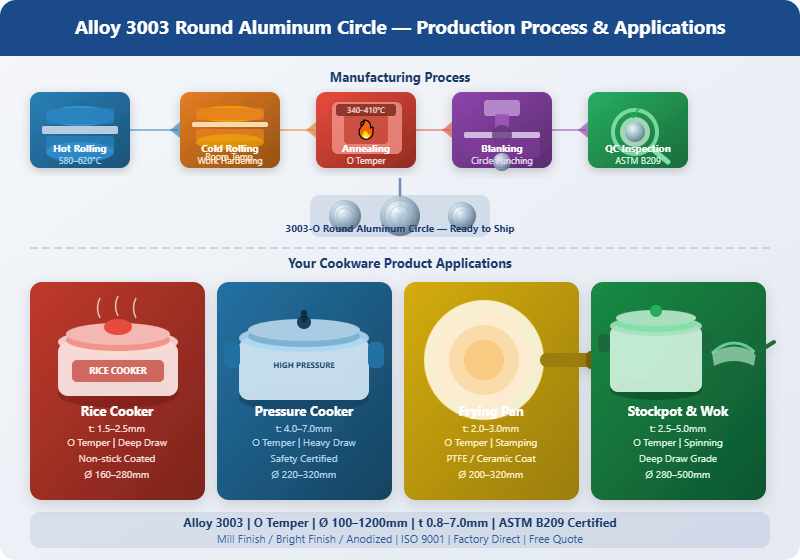
Ingots are heated to approximately 580–620°C and held for several hours. This homogenizes the microstructure and dissolves segregated elements.
Step 3: Hot Rolling
Heated ingots pass through large hot rolling mills. Multiple passes reduce thickness from ~500mm down to 6–8mm. Hot rolling also breaks up the cast structure and creates a uniform wrought microstructure.
Step 4: Cold Rolling
Hot-rolled coils go through cold rolling mills at room temperature. Multiple passes reduce thickness to the target gauge. Cold rolling work-hardens the metal and improves surface finish.
Step 5: Annealing (for O Temper)
For O temper circles, cold-rolled coils are annealed in controlled atmosphere furnaces at 340–410°C. This fully softens the metal and maximizes ductility for deep drawing.
Step 6: Slitting
Wide coils are slit to the correct width for circle blanking.
Step 7: Circle Blanking
Aluminum sheet or coil feeds into blanking presses. Circular dies punch out round discs at high speed. Modern blanking lines run at hundreds of strokes per minute.
Step 8: Edge Deburring
Blanked circles pass through deburring equipment. Clean, smooth edges prevent tearing during subsequent forming.
Step 9: Inspection and Packaging
Finished circles undergo quality inspection. Approved circles are stacked with protective interleaving paper and packed on pallets.
Why Rolled Aluminum Makes Better Circles
Aluminum alloy 3003 rolled sheet and coil offers advantages over cast material for circle production:
- More uniform thickness across the entire circle
- Better surface finish with fewer defects
- More consistent mechanical properties
- Superior formability due to wrought microstructure
- Better dimensional control and tighter tolerances
3003 Aluminum Round Circle — Specifications
Buyers need complete specifications when ordering 3003 aluminum round circles. Here are all the key parameters.
Diameter Specifications
| Size Category | Diameter Range | Typical Applications |
|---|---|---|
| Small | 100mm – 250mm | Small pots, cups, lids |
| Medium | 250mm – 500mm | Standard cookware |
| Large | 500mm – 800mm | Large pots, woks |
| Extra Large | 800mm – 1200mm | Commercial cookware |
Custom diameters are available. Provide your exact diameter requirement.
Thickness Specifications
| Thickness Range | Application |
|---|---|
| 0.8mm – 1.5mm | Thin pans, lids, shallow containers |
| 1.5mm – 3.0mm | Rice cookers, soup pots, frying pans |
| 3.0mm – 5.0mm | Heavy-duty pots, stockpots |
| 5.0mm – 7.0mm | Pressure cookers, commercial cookware |
Available Tempers
| Temper | Condition | Elongation | Best Use |
|---|---|---|---|
| O | Fully annealed | 25–30% | Deep drawing, spinning |
| H12 | Quarter hard | 10–12% | Moderate forming |
| H14 | Half hard | 7–9% | Light forming, flat parts |
| H16 | Three-quarter hard | 5–7% | Minimal forming |
| H18 | Full hard | 4–6% | No forming required |
| H24 | Partially annealed | 8–11% | Balanced strength/formability |
For deep drawing cookware, always specify O temper. Other tempers risk cracking during forming operations.
Surface Finish Options
| Surface | Description | Application |
|---|---|---|
| Mill finish | Standard, as-rolled | General cookware production |
| Bright finish | Polished, reflective | Premium visible surfaces |
| One-side bright | Bright top, mill bottom | Economy premium option |
| Anodized | Hard oxide layer | Scratch-resistant surfaces |
Mechanical Properties of Alloy 3003 Round Aluminum Circle
Properties by Temper
| Property | O Temper | H14 Temper | H18 Temper |
|---|---|---|---|
| Tensile Strength | 110–145 MPa | 150–185 MPa | 195–230 MPa |
| Yield Strength | 40–75 MPa | 130–165 MPa | 185–220 MPa |
| Elongation | 25–30% | 7–9% | 4–6% |
| Hardness (HB) | 28–35 | 40–50 | 55–65 |
| Shear Strength | 75–95 MPa | 97–115 MPa | 125–140 MPa |
Physical Properties (All Tempers)
| Property | Value |
|---|---|
| Density | 2.73 g/cm³ |
| Melting Range | 643 – 654°C |
| Thermal Conductivity | 193 W/m·K |
| Electrical Conductivity | 41% IACS |
| Thermal Expansion | 23.2 µm/m·°C |
| Elastic Modulus | 68.9 GPa |
What These Properties Mean for Cookware
High thermal conductivity (193 W/m·K)
Heat spreads quickly and evenly across the cooking surface. Food cooks uniformly without hot spots. This is why aluminum cookware heats faster than stainless steel.
Low density (2.73 g/cm³)
Finished cookware is lightweight. Consumers prefer lighter pots and pans. Aluminum is about three times lighter than steel.
High elongation in O temper (25–30%)
The metal can stretch significantly before breaking. Deep pots and bowls form without cracking. This is the most critical property for cookware manufacturers.
Good corrosion resistance
Aluminum forms a natural oxide layer. This layer protects against food acids, water, and most cleaning agents. Cookware lasts for years in demanding kitchen environments.
Applications of Alloy 3003 Round Aluminum Circle
Alloy 3003 aluminum circles serve many manufacturing applications. Here is a detailed breakdown.
Cookware Manufacturing
Cookware is by far the largest market for 3003 aluminum circle.
Rice Cookers
Rice cooker inner pots require clean, deep drawing. 3003 O circles in 1.5–2.5mm thickness form perfect pot shapes. The smooth surface accepts non-stick coating well. Non-stick and ceramic coatings bond reliably to 3003 aluminum surfaces.
Soup Pots and Stockpots
Taller pots need more material elongation. 3003 O temper handles the demanding draw ratios needed for deep soup pots. Typical thickness is 2.0–3.5mm.
Frying Pans and Skillets
Frying pans need a flat base and gently curved sides. 3003 O circles in 2.0–3.0mm stamp easily into pan shapes. The base can be impact-bonded with stainless steel for induction compatibility.
Pressure Cookers
Pressure cooker bodies need the most material. Thickness runs from 4.0mm to 7.0mm. 3003 provides the strength needed to contain cooking pressure safely. Wall thickness after drawing must meet safety standards.
Woks
Wok shapes require complex curved forming. The wide, shallow bowl with steep sides demands good metal flow. 3003 O circles handle this forming challenge.
Steamer Pots
Multi-tier steamers use several circles of different diameters. The perforated inserts use thinner circles with punched holes.
Milk Pots and Saucepans
Small household pots for sauces and milk use smaller circles in 1.0–2.0mm thickness. High production volumes need consistent quality.
Food Containers and Packaging
Beyond cookware, 3003 aluminum circles produce:
- Aluminum food trays for airlines and catering
- Disposable baking pans and cake tins
- Pizza pans and round baking molds
- Food container lids and closures
- Takeaway food containers
Industrial Applications
3003 aluminum round circles also serve industrial markets:
- Chemical storage vessel heads
- Tank end caps and closures
- Heat exchanger components
- Filter housing discs
- Lighting reflector blanks
Decorative and Other Uses
- Circular sign blanks
- Spinning blanks for custom shapes
- Decorative discs and medallions
- Musical instrument parts
3003 Aluminum Circle vs Other Alloys
Buyers often compare alloy 3003 against other alloys for circle applications. Here is a detailed comparison.
3003 vs 1060 Aluminum Circle
| Property | 3003 O | 1060 O |
|---|---|---|
| Tensile Strength | 110–145 MPa | 70–95 MPa |
| Elongation | 25–30% | 23–28% |
| Manganese Content | 1.0–1.5% | None |
| Corrosion Resistance | Excellent | Excellent |
| Cost | Slightly higher | Lower |
| Formability | Excellent | Excellent |
When to choose 3003:
Need stronger finished cookware. Making pressure cookers or heavy pots. Want better dent resistance in the finished product.
When to choose 1060:
Cost is the primary concern. Making lightweight rice cooker inner pots. Standard household cookware with thin walls.
3003 vs 1100 Aluminum Circle
| Property | 3003 O | 1100 O |
|---|---|---|
| Tensile Strength | 110–145 MPa | 75–105 MPa |
| Elongation | 25–30% | 25–35% |
| Strength Advantage | Higher | Lower |
| Food Safety | Yes | Yes |
| Cost | Medium | Low |
When to choose 3003:
Need stronger cookware. Want better resistance to denting and deformation during use.
When to choose 1100:
Maximum softness needed. Extremely thin gauges required. Lowest possible material cost is the priority.
3003 vs 5052 Aluminum Circle
| Property | 3003 O | 5052 O |
|---|---|---|
| Tensile Strength | 110–145 MPa | 170–215 MPa |
| Elongation | 25–30% | 22–25% |
| Corrosion Resistance | Excellent | Superior |
| Marine Resistance | Good | Excellent |
| Cost | Lower | Higher |
When to choose 3003:
Standard household cookware. Cost-sensitive markets. General food container production.
When to choose 5052:
Marine environments. Commercial kitchen equipment needing superior corrosion resistance. High-strength cookware for professional use.
3003 vs 8011 Aluminum Circle
| Property | 3003 | 8011 |
|---|---|---|
| Primary Use | Cookware, thick circles | Foil, thin packaging |
| Thickness Range | 0.8mm – 7.0mm | 0.006mm – 0.5mm |
| Main Alloy Element | Manganese | Iron + Silicon |
| Strength | Medium | Lower |
| Formability | Excellent | Excellent |
These two alloys serve very different markets. 3003 suits cookware and containers. 8011 suits foil and thin packaging. They rarely compete directly.
How to Calculate the Blank Diameter for Your Cookware
Buying the right size 3003 aluminum round circle requires knowing your blank diameter. Here is a practical guide.
Basic Formula for Cylindrical Products
For a simple cylindrical pot or cup:
D = √(d² + 4dh)
Where:
- D = blank diameter needed
- d = finished inner diameter of the pot
- h = finished depth of the pot
Example Calculation
You need a soup pot with:
- Inner diameter: 200mm
- Depth: 150mm
D = √(200² + 4 × 200 × 150)
D = √(40,000 + 120,000)
D = √160,000
D = 400mm
Add 10–15% for trimming: 400mm × 1.12 = 448mm
Order circles with diameter: 450mm
Adjustment Factors
| Factor | Adjustment |
|---|---|
| Trimming allowance | Add 10–15% |
| Thick material (>3mm) | Add extra 5% |
| Complex shapes | Consult with supplier |
| Flanged products | Add flange width |
Our technical team can calculate the exact blank diameter for any cookware shape. Contact us with your product dimensions.
Quality Standards for 3003 Round Aluminum Circles
Professional buyers require certified quality. Here are the key standards.
International Standards
| Standard | Region | Scope |
|---|---|---|
| ASTM B209 | USA | Aluminum sheet and plate |
| EN 573-3 | Europe | Chemical composition |
| EN 485-2 | Europe | Mechanical properties |
| GB/T 3880 | China | Aluminum sheet standard |
| JIS H4000 | Japan | Aluminum sheet standard |
Quality Check Points
Chemical Composition Testing
Spectrometer analysis confirms manganese content falls between 1.00% and 1.50%. Wrong composition affects forming performance directly.
Mechanical Property Testing
Tensile testing confirms strength and elongation meet O temper requirements. Elongation below 25% means inadequate annealing.
Dimensional Inspection
- Diameter: ±0.5mm to ±1.0mm
- Thickness: ±4% to ±6% of nominal value
- Flatness: Max 1mm deviation per 1000mm length
Surface Quality Inspection
Visual and tactile inspection checks for:
- Scratches and roll marks
- Oxidation spots
- Oil contamination
- Edge cracks or tears
- Uneven surface brightness
Edge Quality
Smooth, burr-free edges are critical. Burrs cause tearing during high-speed stamping operations.
Pinhole and Void Testing
For thin gauges, ultrasonic testing can detect internal voids or delamination.
Packaging and Delivery of 3003 Aluminum Circles
Proper packaging protects circle quality from factory to your production line.
Standard Packaging
- Circles stacked vertically or horizontally on wooden pallets
- Protective interleaving paper between each circle
- Outer wrap: waterproof kraft paper or stretch film
- Steel strapping bands secure the load
- Corner protectors prevent edge damage
Special Packaging Options
- Wooden crates for bright-finish circles
- Individual plastic bag wrapping for premium surfaces
- Custom pallet heights for specific warehouse requirements
- Sea-worthy crating for long ocean voyages
Labeling
Each pallet or bundle carries a label showing:
- Alloy: 3003
- Temper: O (or other specified temper)
- Diameter and thickness
- Quantity (pieces and weight)
- Batch/heat number
- Production date
- Mill test certificate reference number
Shipping Options
| Method | Transit Time | Best For |
|---|---|---|
| Sea freight (FCL) | 15–40 days | Large orders, cost priority |
| Sea freight (LCL) | 20–45 days | Medium orders |
| Air freight | 3–7 days | Urgent samples, small orders |
| Rail (Europe/Asia) | 15–25 days | Europe-bound shipments |
Container Loading
- 20-foot container: 18–22 tons
- 40-foot container: 22–26 tons
- 40-foot high cube: Up to 28 tons
We provide complete export documentation: commercial invoice, packing list, bill of lading, certificate of origin, mill test certificates, and fumigation certificate for wooden packaging.
Why Choose Our Alloy 3003 Round Aluminum Circles?
Direct Factory Supply
We manufacture alloy 3003 round aluminum circles in our own production facility. No middlemen. No trading company markup. You buy directly from the source at factory prices.
Consistent Quality
Our production uses strict quality control at every stage:
- Incoming raw material testing
- In-process thickness and property monitoring
- Final inspection before shipment
- Third-party inspection available on request
Custom Sizes on Request
Standard sizes ship from stock. Custom diameters from 100mm to 1200mm and custom thickness from 0.8mm to 7.0mm are available with normal lead times.
Full Certification Support
We provide:
- Mill Test Certificates (MTC) with chemical composition and mechanical properties
- ASTM B209 compliance documentation
- EN 573-3 and EN 485 compliance for European markets
- SGS, BV, or TUV third-party inspection coordination
- Food safety and RoHS documentation
Technical Support Team
Our engineering team helps you:
- Calculate the correct blank diameter for your product
- Select the right thickness and temper
- Troubleshoot forming problems
- Optimize material specifications to reduce cost
Fast Sample Service
Sample orders of 50–200 kg ship within 3–7 business days. Test our material quality before committing to large production orders.
Global Export Experience
We export 3003 aluminum circles to over 50 countries. Our logistics team handles all export requirements efficiently.
Global Markets We Serve
Southeast Asia
Vietnam, Thailand, Indonesia, Malaysia, Philippines — major cookware manufacturing hubs. We are an established supplier to factories in all these countries.
South Asia
Bangladesh, Pakistan, India, Sri Lanka — large and growing cookware markets with strong demand for affordable quality circles.
Middle East and Turkey
Turkey, Iran, Egypt, UAE, Saudi Arabia — significant cookware production and distribution activity. We understand the quality and price requirements of these markets.
Africa
Nigeria, Ethiopia, Kenya, Ghana, Tanzania, South Africa — fast-developing cookware markets. Local manufacturers need reliable supply of quality aluminum circles.
Europe
Germany, Poland, Italy, Spain, Netherlands, Czech Republic — premium cookware manufacturers requiring ASTM or EN certified material with full documentation.
Americas
Brazil, Mexico, Colombia, Peru, Argentina — active cookware production markets with growing demand.
Frequently Asked Questions
What is alloy 3003 round aluminum circle?
It is a flat, round aluminum blank made from 3003 alloy. Manufacturers use it as raw material for stamping and deep drawing cookware, containers, and other round products.
What temper is best for deep drawing cookware?
O temper (fully annealed) is the best choice. It provides the highest elongation (25–30%) needed for deep drawing without cracking.
What is the difference between 3003 and 1060 aluminum circle?
3003 is stronger due to its manganese content. It resists denting better in finished cookware. 1060 is softer and cheaper. Choose 3003 for heavier cookware and pressure cookers. Choose 1060 for lightweight rice cooker inner pots where cost matters most.
How do I calculate the right blank diameter?
Use the formula: D = √(d² + 4dh), where d is the finished inner diameter and h is the finished depth. Add 10–15% for trimming. Contact our technical team for precise calculations for your specific product.
What sizes are available?
Standard diameters range from 100mm to 1200mm. Standard thickness ranges from 0.8mm to 7.0mm. Custom sizes are available.
Is 3003 aluminum food safe?
Yes. 3003 aluminum meets FDA and EU food contact material regulations. It is safe for cookware, food containers, and food processing equipment.
What is the minimum order quantity?
Minimum order is typically 1–3 tons per specification. Contact us to discuss your specific requirements.
Can I get ASTM certified material?
Yes. We provide ASTM B209 mill test certificates with every shipment. European EN standard documentation is also available.
Request a Quote for Alloy 3003 Round Aluminum Circles
We are ready to supply alloy 3003 round aluminum circles for your production needs. Contact our sales team today.
Product Summary
| Parameter | Details |
|---|---|
| Alloy | 3003 |
| Temper | O, H12, H14, H16, H18, H24 |
| Diameter | 100mm – 1200mm |
| Thickness | 0.8mm – 7.0mm |
| Surface | Mill finish, bright finish, anodized |
| Standard | ASTM B209, EN 573-3, EN 485 |
| Certifications | ISO 9001, SGS, MTC available |
| MOQ | 1–3 tons per specification |
| Lead Time | 15–25 days production |
| Packaging | Pallets with interleaving paper |
| Payment | T/T, L/C |
What to Include in Your Inquiry
Send us these details for a fast, accurate quote:
- Required diameter (mm)
- Required thickness (mm)
- Temper needed (O temper for most cookware)
- Surface finish requirement
- Quantity per order (kg or tons)
- Annual volume estimate
- Certification requirements
- Destination country and port
Our team responds within 24 hours with pricing, lead time, and technical confirmation.