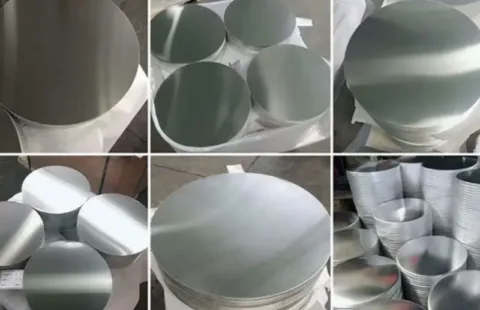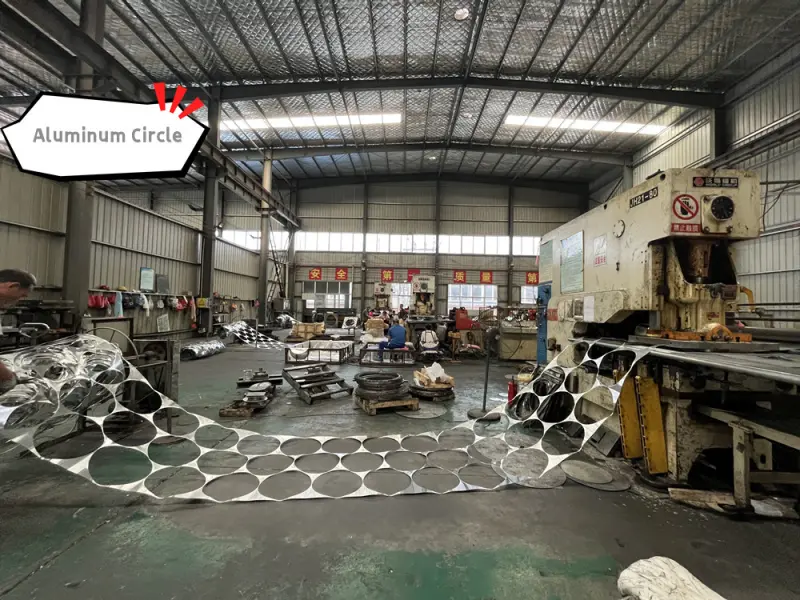
Aluminium Circle Plate for Real Production Needs
In aluminium cookware production, many buyers don’t start with complex specifications. They usually ask a simple question first: “Can your aluminium circle plate run smoothly on deep drawing machines?”


That is actually the key point.
Aluminium circle plate (or aluminium disc) is not just a raw material. For cookware factories, it directly affects stamping speed, waste rate, and final surface quality. If the material is not stable, production problems will appear very quickly—especially during high-speed punching.
Most of our customers come from cookware plants, trading companies, and stamping factories. Over time, we found that different markets really have different expectations. For example, South Asian buyers often focus more on cost control, while European customers care more about surface and thickness tolerance.
Common Aluminium Grades We Supply
In real production, we usually recommend the following alloys:
- 1050 aluminium circle plate – very soft, good for deep drawing cookware
- 1060 aluminium disc – similar to 1050, slightly better strength
- 3003 aluminium circle – better hardness, used when product requires durability
- 5052 aluminium circle plate – for higher strength applications (less common for cookware)
Thickness usually ranges from 0.3mm to 6.0mm, depending on end product.
Diameter can be customized from small kitchen lids to large industrial discs (up to around 1200mm in most cases).
Why Cookware Factories Prefer Aluminium Circle Plate
If you visit cookware factories in India, Egypt, or Southeast Asia, you will notice most frying pans and pots still start from aluminium circle plate.
The reason is very practical:
- It reduces forming cost compared to cutting from sheet
- It improves material utilization (less waste)
- It speeds up stamping process
- It performs well in polishing and coating later
Some customers also told us that switching suppliers is not about price only. Even a small difference in hardness can cause cracking during deep drawing, which leads to production delay.
So in many cases, stability is more important than anything else.
Production and Quality Control
From our experience, overseas buyers usually care about a few key points:
1. Surface condition
No oil stains, no black spots, clean surface is required for cookware use.
2. Thickness tolerance
For most cookware customers, tolerance must be controlled strictly. Even ±0.05mm difference can matter in mass production.
3. Edge quality
Smooth edges help avoid machine damage during stamping.
4. Coil origin and consistency
Stable coil source means stable final performance. This is why long-term buyers often stick with one supplier once quality is confirmed.
Application Areas
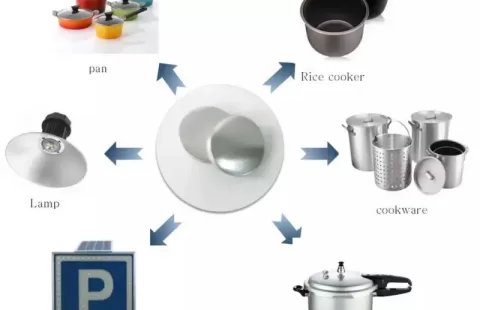
Although cookware is the main market, aluminium circle plate is also used in other areas:
- LED lighting reflectors
- Road signs and traffic boards
- Decorative metal parts
- Industrial stamping parts
- Kitchenware accessories
But in reality, cookware still takes the largest share of global demand.
Export Experience and Packaging
For export shipments, packaging is often underestimated.
We usually use:
- Wooden pallets or fumigated wooden cases
- Moisture-proof wrapping
- Proper labeling for size, alloy, and batch number
Because in long-distance shipping (especially sea freight), humidity can affect surface condition if packaging is not correct.
Many customers in Middle East and South America care about this point a lot.
Final Thoughts
Aluminium circle plate looks like a simple product, but in real production it is very sensitive to material stability and processing details.
That is also why buyers usually prefer suppliers with stable production experience rather than just low price offers.
We focus on stable quality, consistent thickness control, and export-friendly packaging. Most importantly, we try to reduce problems during our customers’ production process—because in real business, that is what matters most.