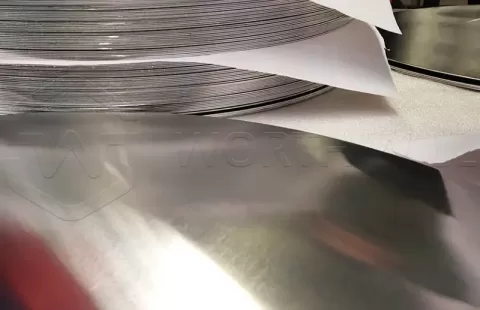
CC Aluminum Circle Plate
A CC aluminum circle plate — where “CC” stands for continuously cast — is a round aluminum blank produced from continuously cast and rolled aluminum coil. It is one of the most widely used semi-finished aluminum products in the world, serving as the starting material for cookware, utensils, lighting reflectors, road signs, and countless industrial components. This guide covers what makes CC aluminum circles different, key alloy grades, full dimensional specifications, surface options, and sourcing guidance for procurement teams and manufacturers.
What Is a CC Aluminum Circle Plate?
A circle aluminum plate is a flat, round disk punched or sheared from an aluminum coil or sheet. The “CC” designation refers to the casting process used to produce the original coil: continuous casting and rolling (CC&R), as opposed to the older DC (direct chill) casting method.
CC casting produces coil with a fine, uniform grain structure at lower production cost. This makes CC-grade aluminum circle blanks the preferred choice for most standard cookware, utensil, and general-purpose industrial applications. Where ultra-high purity or aerospace-grade consistency is required, DC-cast coil is used — but for the vast majority of circle aluminum applications, CC material performs equally well at a more competitive price.


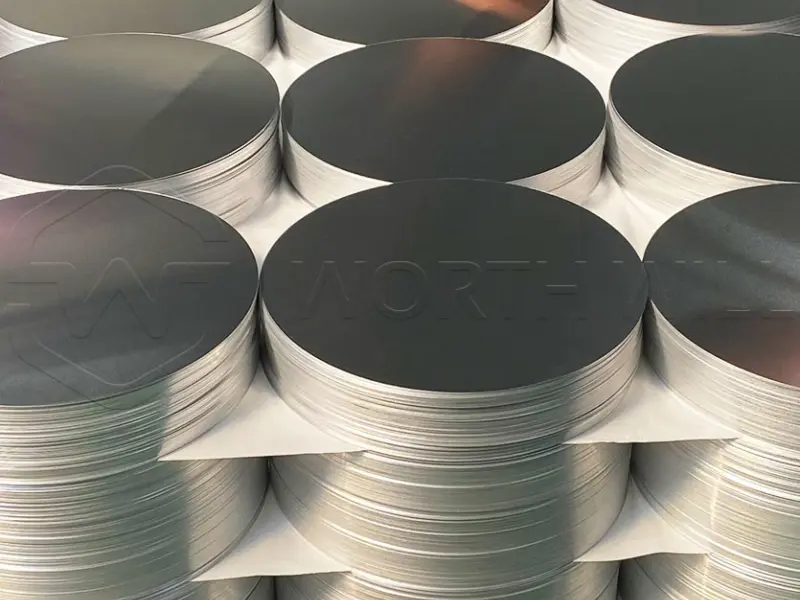
CC vs DC aluminum circle: key differences
| Property | CC aluminum circle plate | DC aluminum circle plate |
|---|---|---|
| Casting method | Continuous cast & rolled | Direct chill cast, hot rolled |
| Grain structure | Fine, uniform | Very fine, tightly controlled |
| Typical alloys | 1050, 1060, 1100, 3003, 8011 | 3003, 5052, 5083, 6061 |
| Formability | Excellent for deep drawing | Excellent; wider alloy range |
| Cost | Lower (continuous process) | Higher (batch process) |
| Main applications | Cookware, utensils, lighting, signs | Aerospace, marine, structural |
| Availability | Wide; fast lead time | Longer lead time |
For cookware manufacturers, sign fabricators, and lighting component producers, CC aluminum circle plates deliver the right combination of formability, surface quality, and price. Most standard aluminum plate circular blanks shipped internationally are CC-grade material.
Alloy Grades for CC Aluminum Circle Plates
Choosing the right alloy is critical for both forming performance and end-product quality. The following alloys are available in CC-grade circle aluminum plate form.
| Alloy | Al Purity / Main Element | Tensile Strength (MPa) | Elongation (%) O temper | Key Characteristics | Primary Applications |
|---|---|---|---|---|---|
| 1050 | ≥99.5% Al | 60–95 | ≥23 | Highest purity; excellent corrosion resistance | Pots, kettles, rice cookers, utensils |
| 1060 | ≥99.6% Al | 60–95 | ≥25 | Slightly purer than 1050; best deep-drawing elongation | Deep-drawn pots, pressure cooker bodies |
| 1100 | ≥99.0% Al | 75–110 | ≥20 | Good strength-formability balance | Frying pans, bakeware, sublimation blanks |
| 3003 | Al + 1.0–1.5% Mn | 95–145 | ≥16 | Higher strength; excellent corrosion resistance | Pressure cookers, hard-anodized cookware, woks |
| 3004 | Al + Mn + Mg | 170–215 | ≥8 | High strength; moderate formability | Thick-wall commercial cookware |
| 8011 | Al + Fe + Si | 95–135 | ≥16 | Good formability; cost-effective | Lid blanks, thin-wall cookware, packaging discs |
Chemical Composition of CC Aluminum Circle Plates
| Element | 1050 (%) | 1060 (%) | 1100 (%) | 3003 (%) | 8011 (%) |
|---|---|---|---|---|---|
| Al (min) | 99.50 | 99.60 | 99.00 | Rem. | Rem. |
| Si | ≤0.25 | ≤0.25 | ≤0.95* | ≤0.60 | 0.50–0.90 |
| Fe | ≤0.40 | ≤0.35 | ≤0.95* | ≤0.70 | 0.60–1.00 |
| Cu | ≤0.05 | ≤0.05 | 0.05–0.20 | 0.05–0.20 | ≤0.10 |
| Mn | ≤0.05 | ≤0.03 | ≤0.05 | 1.00–1.50 | ≤0.20 |
| Mg | ≤0.05 | ≤0.03 | — | — | ≤0.10 |
| Zn | ≤0.05 | ≤0.05 | ≤0.10 | ≤0.10 | ≤0.10 |
| Ti | ≤0.03 | ≤0.03 | — | — | ≤0.08 |
| Other (each) | ≤0.03 | ≤0.03 | ≤0.05 | ≤0.05 | ≤0.05 |
* 1100: Si + Fe combined ≤ 0.95%. Compositions per ASTM B209 / EN 485-2 / GB/T 3880.
Mechanical Properties by Temper
The temper controls the hardness and formability of the CC aluminum circle plate at the time of processing. O (annealed) temper is standard for deep drawing and spin forming.
| Alloy | Temper | Yield Strength (MPa) | UTS (MPa) | Elongation A50 (%) | Hardness (HB) |
|---|---|---|---|---|---|
| 1050 | O | ≥20 | 60–95 | ≥23 | ≈19 |
| 1050 | H14 | ≥85 | 105–135 | ≥3 | ≈30 |
| 1060 | O | ≥15 | 60–95 | ≥25 | ≈19 |
| 1060 | H18 | ≥130 | ≥150 | ≥3 | ≈35 |
| 1100 | O | ≥30 | 75–110 | ≥20 | ≈23 |
| 1100 | H14 | ≥100 | 115–145 | ≥3 | ≈32 |
| 3003 | O | ≥40 | 95–135 | ≥22 | ≈28 |
| 3003 | H14 | ≥145 | 170–215 | ≥1 | ≈40 |
| 8011 | O | ≥25 | 95–135 | ≥16 | ≈25 |
Standard Dimensions: CC Aluminum Circle Plate Size Range
We supply circle aluminum plates in a wide range of diameters and thicknesses. Standard stock sizes ship within 7–15 days. Custom dimensions are produced to order.
| Parameter | Standard Stock Range | Custom Range | Tolerance Class |
|---|---|---|---|
| Diameter | 100 mm – 1,200 mm | 50 mm – 1,500 mm | ±0.5 mm / ±0.2 mm precision |
| Thickness | 0.5 mm – 8.0 mm | 0.3 mm – 15.0 mm | ±0.05 mm / ±0.02 mm precision |
| Flatness | ≤1 mm per 1,000 mm | Per ASTM B209 / EN 485 | Standard / precision |
| Edge condition | Sheared / deburred | Machined edge available | — |
| Surface | Mill finish / bright / annealed | Polished, brushed, colored | Per Ra specification |
Common size combinations by application
| Application | Diameter (mm) | Thickness (mm) | Alloy / Temper |
|---|---|---|---|
| Small pot / saucepan (14–16 cm) | 200–240 | 1.5–2.5 | 1050-O / 1060-O |
| Medium pot (18–22 cm) | 260–320 | 2.0–3.0 | 1060-O / 1100-O |
| Large stockpot (24–28 cm) | 340–400 | 2.5–4.0 | 1100-O / 3003-O |
| Pressure cooker body | 260–360 | 3.0–5.0 | 3003-O |
| Wok / frying pan | 380–500 | 2.0–3.5 | 1060-O / 3003-O |
| Rice cooker inner pot | 180–280 | 1.2–2.0 | 1050-O / 1060-O |
| Lighting reflector disc | 80–400 | 0.5–1.5 | 1060 polished / 1100 |
| Round road sign blank | 300–900 | 2.0–3.0 | 5052-H32 / 3003-H14 |
| Sublimation / printing blank | 100–300 | 0.8–1.5 | 1100 polished |
| Lid / cover blank | 160–320 | 0.8–1.5 | 1100-O / 8011-O |
Surface Finish Options
Surface quality affects coating adhesion, appearance, and performance in the finished product. We offer the following finishes on all CC aluminum circle plate products.
| Finish | Description | Ra (µm) | Best For |
|---|---|---|---|
| Mill finish | As-rolled; slight natural oxidation | 0.4–1.0 | General cookware, industrial discs |
| Bright / mirror polished | Reflective surface; uniform appearance | ≤0.2 | Lighting reflectors, premium cookware, sublimation blanks |
| Satin / brushed | Unidirectional grain; matte sheen | 0.4–0.8 | Decorative cookware, signage |
| Annealed (O temper) | Stress-relieved; maximum softness | 0.4–0.8 | All deep-drawing / spin-forming applications |
| Anodizing-ready | Ultra-clean; degreased; no surface defects | ≤0.4 | Hard-anodized cookware, colored circles |
| Colored (pre-anodized) | Gold, black, grey, champagne, bronze | ≤0.4 | Branded colored cookware, decorative blanks |
| Non-stick coating ready | Mechanically textured; adhesion-optimized | 1.0–2.5 | PTFE / ceramic-coated cookware bodies |
Quality Standards and Certifications
All CC aluminum circle plates are produced and tested to internationally recognized standards. Full documentation is provided with every shipment.
| Standard / Certificate | Scope | Markets |
|---|---|---|
| ASTM B209 | Aluminum sheet, plate & circle tolerances and composition | North America, global B2B |
| EN 485-1/2/3/4 | European standard for aluminum wrought products | EU, Middle East, Africa |
| GB/T 3880 | Chinese national standard for aluminum sheet & plate | China domestic |
| ISO 9001:2015 | Quality management system | All export markets |
| FDA CFR 21 | Food contact material safety | USA cookware market |
| LFGB | Food contact safety (Germany / EU) | EU cookware brands |
| REACH / RoHS | Restricted substances compliance | EU, electronics sectors |
| Mill Test Certificate (MTC) | Lot-specific composition and mechanical data | All orders, standard |
| SGS / BV / TÜV inspection | Third-party material verification | On request |
Applications of CC Aluminum Circle Plates
The circle aluminum blank is one of the most versatile semi-finished aluminum products. The same production process — adjusted for alloy, temper, and size — supplies a wide range of industries.
Cookware and kitchenware
This is the largest application for CC aluminum circle plates. Deep-drawing grade 1050-O, 1060-O, and 1100-O circles are formed into pots, pans, pressure cookers, woks, and rice cooker inner pots. Alloy 3003-O is used for premium hard-anodized lines. The aluminium disc for cookware market spans household brands, OEM manufacturers, and commercial catering equipment producers worldwide.
Utensils and flatware
Aluminium circle for utensil production covers ladles, spoons, plates, trays, and serving dishes. High-purity 1050 and 1060 circles with polished surface finish are standard for this segment. Lightweight and food-safe, they are exported in large volumes to South Asia and Africa.
Lighting reflectors
Polished 1060 and 1100 aluminum round plates with mirror finish (Ra ≤ 0.2 µm) are spin-formed into parabolic reflectors for streetlights, stadium floodlights, and industrial luminaires. High reflectivity (≥85%) makes aluminum the preferred material over steel or plastic.
Road signs and traffic plates
Round sign blanks cut from 3003-H14 or 5052-H32 aluminum plate circular stock are used for stop signs, speed limit discs, and regulatory road signs. Aluminum’s corrosion resistance and light weight make it the standard material for outdoor signage globally.
Sublimation and photo printing blanks
Polished 1100 aluminum circle sheet blanks are used as substrates for dye-sublimation printing — medals, promotional discs, photo prints, and branded items. The bright surface accepts sublimation ink with excellent color reproduction and scratch resistance.
Industrial and engineering discs
Chemical reactor lids, tank closures, filter bases, automotive stamped components, and electronic heat-spreader discs all use CC aluminum circle plates in alloys selected for the specific mechanical or thermal requirement of the application.
Colored Aluminum Circle Plates
Colored aluminum discs — pre-anodized in gold, black, grey, champagne, bronze, or blue — are supplied ready for forming without additional surface treatment. These are used by cookware brands that want a distinctive colored finish on their product line, and by promotional item manufacturers producing colored medal or plaque blanks.
| Color | Anodizing Type | Thickness (µm) | Alloy Base | Applications |
|---|---|---|---|---|
| Natural / silver | Clear anodize | 10–25 | 1060 / 1100 | Cookware, utensils |
| Hard anodize (grey/black) | Hard anodize | 25–50 | 3003 / 1100 | Premium cookware, industrial |
| Champagne / gold | Decorative anodize | 10–20 | 1100 / 3003 | Branded cookware, decor |
| Black | Decorative anodize | 10–20 | 1100 / 3003 | Premium pans, medals |
| Bronze / rose gold | Decorative anodize | 10–20 | 1100 | Promotional items, awards |
CC Aluminum Circle Plate Pricing Factors
The price of a CC aluminum circle plate depends on several variables. Understanding these helps buyers evaluate quotes accurately and negotiate effectively.
| Factor | Price Impact | Notes |
|---|---|---|
| LME aluminum price | High | Base metal cost; changes daily. Price = LME + processing premium |
| Alloy grade | Medium | 3003 > 1100 > 1060 ≈ 1050 in material cost |
| Thickness | Medium | Thicker = more material; very thin requires precision rolling |
| Diameter | Low–Medium | Larger discs have lower yield rate from coil; affects price per piece |
| Surface finish | Medium–High | Mirror polish and colored anodize add significant cost vs mill finish |
| Temper | Low–Medium | O temper (annealed) adds processing cost; H temper is as-rolled |
| Order quantity (MOQ) | High | Orders ≥5 MT unlock best unit prices |
| Certification | Low | SGS / BV inspection adds a small per-order fee |
| Trade terms | Medium | CIF destination costs more than FOB port; affects landed cost |
Indicative price range: USD 2.00–3.60/kg (FOB China) for standard CC 1050/1060-O aluminum circle plates, depending on thickness, diameter, and volume. Contact us for a formal quotation with current LME-linked pricing.
Supplier Advantages: Why Source CC Aluminum Circle Plates from Us
| Advantage | Details |
|---|---|
| Factory-direct supply | No trading company markup; LME-transparent pricing |
| Full alloy coverage | 1050, 1060, 1100, 3003, 3004, 5052, 8011 in CC grade |
| Flexible dimensions | Any diameter 50–1,500 mm; any thickness 0.3–15 mm |
| ISO 9001:2015 certified | MTC issued with every production lot |
| Low MOQ | Sample orders accepted; standard MOQ 1–3 MT for production |
| Fast lead time | Standard sizes: 7–15 days; custom: 20–30 days |
| Global shipping | FOB, CFR, CIF to all major ports worldwide |
| Third-party inspection | SGS, BV, TÜV available on request |
| Technical support | Blank diameter calculation; alloy selection consultation |
| Export documentation | CO, MTC, packing list, BL, form E / GSP available |
Export Markets
Our CC aluminum circle plates and aluminum round plates are exported to more than 40 countries. Key destination markets include:
- Southeast Asia — Vietnam, Thailand, Indonesia, Malaysia (high-volume cookware manufacturing)
- South Asia — Bangladesh, Pakistan, Sri Lanka (aluminium utensil production clusters)
- Middle East — Saudi Arabia, UAE, Egypt (cookware manufacturing and re-export)
- Africa — Nigeria, Ethiopia, Kenya, Ghana (local cookware production)
- South America — Brazil, Colombia, Peru (domestic manufacturers)
- Europe — Turkey, Poland, Italy (OEM cookware and lighting brands)
- North America — USA, Mexico (cookware component importers and sign fabricators)
Frequently Asked Questions
Q1: What does “CC” mean in CC aluminum circle plate?
“CC” stands for continuously cast. It refers to the manufacturing process where molten aluminum is cast and rolled into coil in a continuous process, rather than the batch-based DC (direct chill) method. CC-grade material is widely used for cookware, utensils, and general-purpose circle blanks because it offers consistent quality at a competitive price.
Q2: What is the difference between a CC aluminum circle and a DC aluminum circle?
Both are round aluminum blanks. The difference is in the upstream coil production process. CC coil is produced at lower cost and is the standard for most cookware and utensil applications. DC coil is used for alloys requiring tighter composition control or for demanding structural applications (marine, aerospace). For standard deep-drawing applications, CC and DC circles perform equally well.
Q3: Which alloy and temper should I specify for deep drawing?
For most cookware forming, specify 1060-O or 1050-O for pots and small vessels, and 3003-O for pressure cookers or hard-anodized products. O temper (fully annealed) provides the maximum elongation (≥23–25%) needed for clean deep draws without cracking.
Q4: Can you supply 1050 aluminum disc in small quantities for sampling?
Yes. We accept sample orders for 1050 aluminum disc and other grades. Sample orders typically involve a small quantity surcharge. Contact us with your required diameter, thickness, and surface finish for a sample quotation.
Q5: Do you offer colored aluminum circle plates?
Yes. We supply colored aluminum discs in pre-anodized finishes including black, gold, champagne, grey, and bronze. These are supplied in flat circle form ready for your forming process, or post-anodized on request after forming.
Q6: What is the minimum order quantity (MOQ)?
Our standard MOQ is 1 metric ton (MT) for common alloys and standard diameters. For custom alloys, precision tolerances, or colored finishes, higher MOQs may apply. Contact us to discuss your specific requirements.
Q7: What trade terms do you offer?
We ship on FOB (from major Chinese ports including Tianjin, Shanghai, Qingdao, and Guangzhou), CFR, and CIF to ports worldwide. DDP (Delivered Duty Paid) is available for select countries. Standard payment terms: 30% TT deposit, 70% TT before shipment, or LC at sight.
Q8: How do I calculate the correct blank diameter for my cookware product?
Use the standard deep-drawing blank diameter formula: Blank Ø = √(d² + 4dh), where d = finished inside diameter and h = cup height. Our technical team can assist with blank size calculation for your specific product design at no charge.
Request a Quote for CC Aluminum Circle Plates
Send us your specifications — alloy, temper, diameter, thickness, surface finish, and quantity — and we will respond with a competitive, LME-based quotation within 24 hours. Sample orders are welcome. We supply CC aluminum circle plates, circle aluminum plates, aluminum round plates, and the full range of aluminium disc products for manufacturers worldwide.