Deep Drawing Aluminium Circle 3003
What Is Deep Drawing Aluminium Circle 3003?
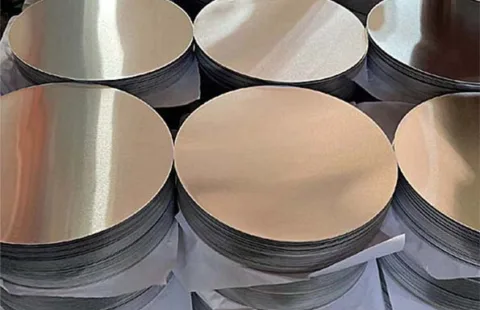
Deep drawing aluminium circle 3003 is a round aluminum disc specifically made for deep drawing processes. It uses 3003 alloy, which contains manganese (Mn) as the primary alloying element. This alloy is one of the best choices for deep drawing applications worldwide.
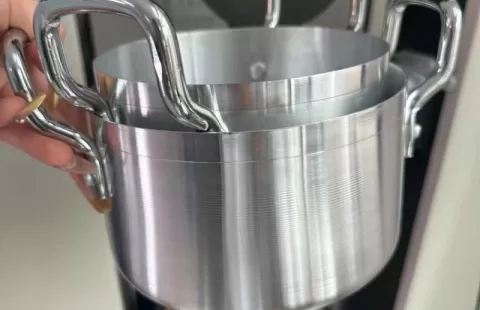
The term “deep drawing” refers to a metal forming process. A flat aluminium circle is pressed into a die to form a hollow shape — such as a pot, pan, cylinder, or enclosure. The material must stretch and flow without cracking.
3003 aluminium circle handles this process very well. It offers excellent formability, good corrosion resistance, and reliable surface quality.
If you need aluminium circles for cookware, containers, or industrial parts, 3003 is the most popular and trusted alloy.


What Is Deep Drawing? (Simple Explanation)
Deep drawing is a sheet metal forming process. A punch pushes a flat metal blank into a die cavity. The metal stretches and takes the shape of the die.
The process is called “deep” drawing when the depth of the finished part is greater than its diameter.
Key Requirements for Deep Drawing Material:
- High elongation (the metal must stretch without breaking)
- Low yield strength (easy to form)
- Good surface finish (no scratches or defects)
- Consistent thickness and flatness
3003 aluminium circle meets all these requirements. This is why manufacturers choose it for deep drawing production.
Why Choose 3003 Aluminium for Deep Drawing?
3003 aluminium alloy is the most widely used alloy for deep drawing. Here is why:
1. Excellent Formability
3003 aluminium has high elongation — up to 25%. It stretches easily without cracking during deep drawing. You can form complex shapes with multiple drawing passes.
2. Good Corrosion Resistance
3003 alloy resists corrosion well. It performs reliably in food contact, water, and outdoor environments. This makes it safe for cookware and food containers.
3. Smooth Surface Quality
Deep drawing aluminium circle 3003 has a clean, smooth surface. This is important for anodizing, polishing, and painting after forming.
4. Lightweight
Aluminium is light. Finished products made from 3003 circles are easy to handle and transport.
5. Food Safe
3003 aluminium is food grade. It meets international food safety standards. It is widely used for pots, pans, and food containers.
6. Cost Effective
3003 aluminium circle is affordable compared to other alloys. It offers a good balance of performance and price.
3003 Aluminium Circle Specifications
Chemical Composition
| Element | Content (%) |
|---|---|
| Manganese (Mn) | 1.0 – 1.5 |
| Copper (Cu) | 0.05 – 0.20 |
| Silicon (Si) | ≤ 0.60 |
| Iron (Fe) | ≤ 0.70 |
| Zinc (Zn) | ≤ 0.10 |
| Aluminum (Al) | Remainder |
Mechanical Properties
| Property | O Temper | H14 Temper |
|---|---|---|
| Tensile Strength | 110 MPa | 152 MPa |
| Yield Strength | 41 MPa | 138 MPa |
| Elongation | 25% | 8% |
| Hardness (Brinell) | 28 HB | 42 HB |
Note: O temper (fully annealed) is the best choice for deep drawing. It offers the highest elongation and lowest yield strength.
Physical Properties
| Property | Value |
|---|---|
| Density | 2.73 g/cm³ |
| Melting Point | 643 – 654°C |
| Thermal Conductivity | 163 W/m·K |
| Modulus of Elasticity | 68.9 GPa |
Deep Drawing Aluminium Circle 3003 — Available Sizes
We supply 3003 aluminium circles in a wide range of sizes. Custom sizes are available.
Thickness Range
| Thickness | Common Application |
|---|---|
| 0.3 mm – 0.6 mm | Thin-wall containers, lids |
| 0.6 mm – 1.2 mm | Food containers, small cookware |
| 1.2 mm – 2.5 mm | Pots, pans, pressure cookers |
| 2.5 mm – 4.0 mm | Industrial parts, heavy cookware |
| 4.0 mm – 6.0 mm | Thick-wall enclosures, cylinders |
Diameter Range
| Diameter | Common Use |
|---|---|
| 100 mm – 200 mm | Small containers, cups |
| 200 mm – 400 mm | Pots, pans, bowls |
| 400 mm – 600 mm | Large cookware, industrial parts |
| 600 mm – 1200 mm | Large diameter industrial parts |
Available Tempers
| Temper | Description | Best For |
|---|---|---|
| O | Fully annealed, softest | Deep drawing (recommended) |
| H12 | Slightly strain hardened | Shallow drawing |
| H14 | Half hard | Stamping, spinning |
| H16 | Three quarter hard | Light forming only |
Deep Drawing Aluminium Circle 3003 Applications
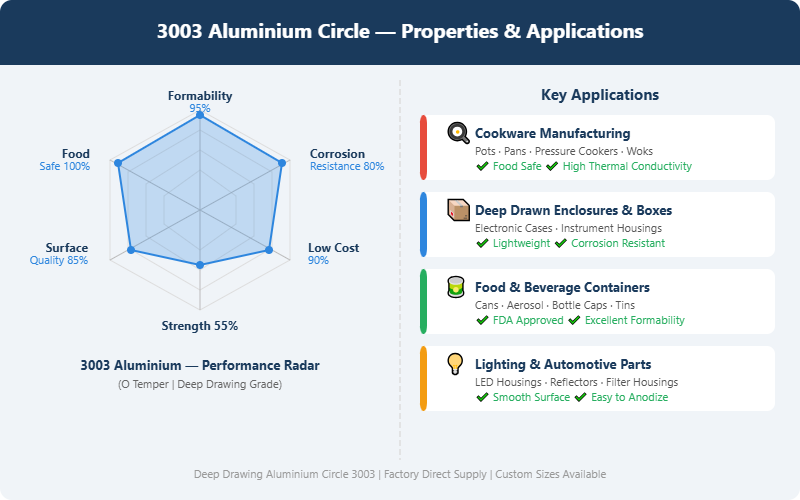
3003 aluminium circles are used in many industries for deep drawing production.
1. Cookware Manufacturing
This is the most common application. Manufacturers use 3003 aluminium circles to produce:
- Non-stick frying pans
- Cooking pots
- Pressure cookers
- Woks and saucepans
- Milk pots
3003 circles have excellent thermal conductivity. This makes them ideal for cookware. The food-safe surface meets international standards.
2. Deep Drawn Aluminum Boxes and Enclosures
3003 aluminium circles are formed into:
- Electronic enclosures
- Instrument cases
- Battery housings
- Waterproof boxes
Deep drawn aluminum enclosures offer lightweight, corrosion-resistant protection for sensitive equipment. They are widely used in electronics, aerospace, and military applications.
3. Food and Beverage Containers
- Cans and tins
- Food storage containers
- Aerosol cans
- Bottle caps and closures
4. Lighting Industry
- LED lamp housings
- Lamp shades
- Reflector discs
5. Automotive Parts
- Fuel filters
- Oil filter housings
- Brake cylinders
6. Industrial Components
- Pressure vessel heads
- Hydraulic cylinder caps
- Pump housings
Deep Drawing Process — Step by Step
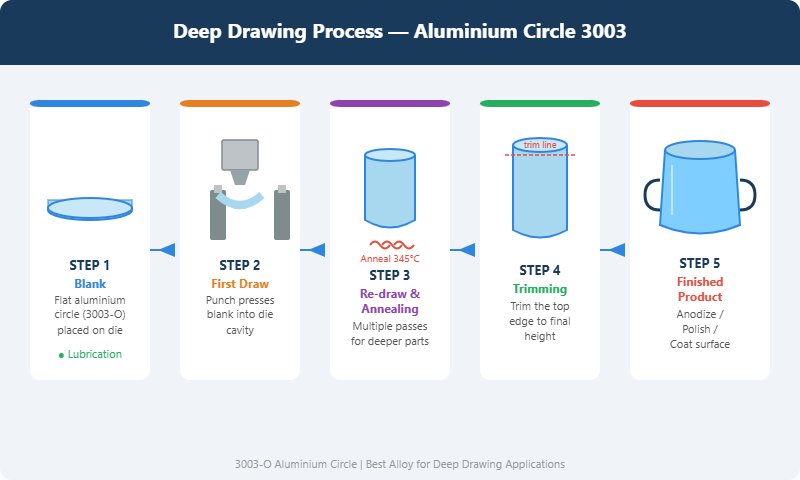
Understanding the deep drawing process helps you choose the right aluminium circle specifications.
Step 1: Blank Preparation
Start with a flat aluminium circle (the blank). The diameter of the blank determines the final part dimensions.
Step 2: Lubrication
Apply lubricant to the aluminium circle. This reduces friction and prevents surface damage during drawing.
Step 3: First Draw
Place the blank on the die. The punch presses down and draws the aluminium into the die cavity. The metal flows and takes the shape of the die.
Step 4: Re-drawing (If Needed)
For deep parts, multiple drawing passes are needed. Each pass reduces the diameter and increases the depth. Annealing between passes restores formability.
Step 5: Annealing (Inter-pass)
Heat the part to remove work hardening. This restores the ductility of the aluminium. 3003 anneals well at 345°C.
Step 6: Trimming and Finishing
Trim the top edge. Apply surface treatments such as anodizing, polishing, or painting.
Surface Finish Options for 3003 Aluminium Circle
| Surface Finish | Description | Application |
|---|---|---|
| Mill Finish | Natural, as-rolled surface | Industrial parts |
| Bright Finish | Polished, reflective surface | Cookware, lighting |
| Anodized | Hard oxide layer | Enclosures, outdoor use |
| Non-stick Coating | PTFE or ceramic coating | Cookware |
| Painted | Color coating | Decorative parts |
Deep Drawing Aluminium Circle 3003 Price
What Affects the Price?
The price of 3003 deep drawing aluminium circles depends on:
- Diameter and thickness — Larger and thicker circles cost more
- Temper — O temper circles may cost slightly more due to annealing process
- Surface finish — Bright finish and anodized circles cost more than mill finish
- Order quantity — Larger orders get lower unit prices
- Aluminum market price — Prices follow LME aluminum market rates
Typical Price Range
| Product | Price Range (USD) |
|---|---|
| 3003 O temper circle (1.0mm, 300mm dia) | $1.5 – $2.5 per piece |
| 3003 O temper circle (2.0mm, 400mm dia) | $3.5 – $5.5 per piece |
| Bulk order (1 ton+) | $2,200 – $3,200 per ton |
Prices are for reference only. Contact us for the latest quotation.
3003 vs Other Alloys for Deep Drawing
| Property | 3003 | 1050 | 1060 | 5052 |
|---|---|---|---|---|
| Elongation | 25% | 28% | 27% | 12% |
| Strength | Medium | Low | Low | High |
| Corrosion Resistance | Good | Excellent | Excellent | Excellent |
| Cost | Low | Low | Low | Medium |
| Deep Drawing Suitability | ★★★★★ | ★★★★☆ | ★★★★☆ | ★★★☆☆ |
| Food Safe | Yes | Yes | Yes | Yes |
| Best For | Cookware, containers | Chemical containers | General purpose | Marine parts |
3003 is the best balance of strength, formability, and cost for deep drawing applications.
Quality Standards We Follow
Our deep drawing aluminium circle 3003 meets the following international standards:
| Standard | Description |
|---|---|
| ASTM B209 | Standard specification for aluminum sheet and plate |
| EN 546 | European standard for aluminum foil |
| GB/T 3880 | Chinese national standard for aluminum sheet |
| EN 573 | Chemical composition standard |
| ISO 6361 | Wrought aluminum products standard |
Every batch comes with a full mill test certificate (MTC) and material traceability documentation.
Why Choose Us as Your Deep Drawing Aluminium Circle Supplier?
Direct Manufacturer
We produce aluminium circles in our own factory. No middlemen. You get factory-direct pricing and full quality control.
Advanced Production Equipment
We use modern rolling mills and circle cutting machines. Our equipment produces circles with tight dimensional tolerances and smooth surfaces.
Strict Quality Control
Every aluminium circle goes through:
- Thickness and diameter inspection
- Surface quality check
- Mechanical property testing
- Chemical composition verification
Custom Sizes and Tempers
We produce circles to your exact specifications. Any diameter, any thickness, any temper. No minimum order for standard sizes.
Fast Delivery
- In-stock standard sizes: ship within 3–5 business days
- Custom orders: ship within 10–15 business days
Global Export Experience
We export to:
- Middle East (cookware manufacturers)
- Southeast Asia (industrial manufacturers)
- Africa (packaging industry)
- Europe and North America
We handle all export documentation:
- Commercial invoice
- Packing list
- Certificate of origin
- Mill test certificate
- Bill of lading
Frequently Asked Questions
Q1: What is the best temper for deep drawing aluminium circle 3003?
O temper is the best. It is fully annealed, which gives the highest elongation and lowest yield strength. This makes forming easier and reduces the risk of cracking.
Q2: How many drawing passes can 3003 aluminium handle?
3003 aluminium can handle multiple drawing passes. Anneal the material between passes to restore ductility. Most cookware requires 3–5 drawing passes.
Q3: Can 3003 aluminium circles be anodized after deep drawing?
Yes. 3003 anodizes well after forming. Anodizing improves corrosion resistance and surface hardness. It also improves the appearance of the finished product.
Q4: What is the maximum diameter you can produce?
We produce aluminium circles up to 1,500 mm in diameter. Contact us for special sizes beyond this range.
Q5: Do you provide free samples?
Yes. We provide free samples for quality evaluation. You only pay for shipping costs.
Q6: What packaging do you use for shipping?
We pack aluminium circles on wooden pallets with PE film wrapping. Each circle is separated by paper interleaving to prevent surface scratches.