Aluminum Circle Plate
Aluminum circle plate is one of the most widely sourced aluminum products in global manufacturing. It is used in cookware, lighting, road signs, and dozens of industrial applications. Whether you need a standard round aluminum plate for spinning, stamping, or deep drawing, this guide covers everything: alloys, specifications, sizes, pricing, and how to choose a reliable supplier.


1. What Is an Aluminum Circle Plate?
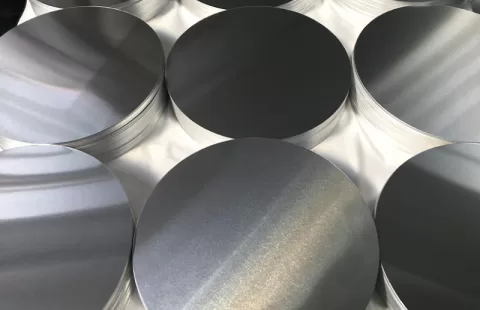
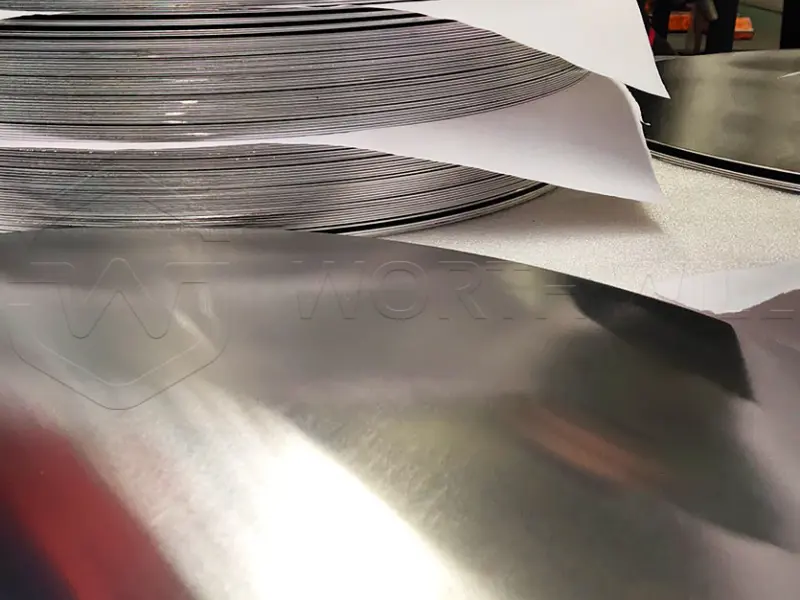
An aluminum circle plate is a flat, round disk cut or rolled from aluminum sheet or strip. It is also called a round aluminum plate, aluminum disc, or aluminum plate circular. The product is produced by punching or slitting continuous aluminum coil into precise circular blanks.
The terms “aluminum circle” and “aluminum disc” are used interchangeably in the B2B market. Some buyers also search for aluminum circle ring or aluminum discs with center holes — these are specialized variants with a pre-punched hole in the center, used in pulleys, flanges, and speaker grilles.
Our factory produces aluminum circle plates to custom diameters, thicknesses, and alloy grades. We supply both standard round discs and customized shapes, including aluminum circle ring and hole-punched variants.
2. Common Alloys and Tempers for Aluminum Circle Plate
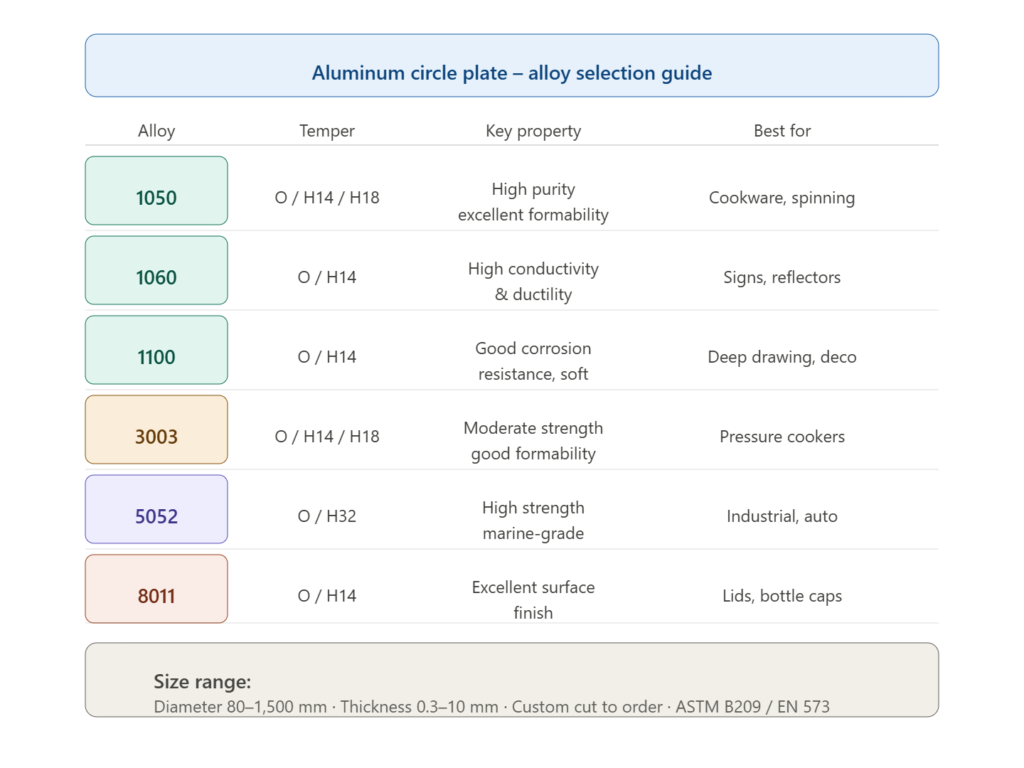
The alloy you choose determines the circle’s formability, strength, corrosion resistance, and anodizing quality. The table below covers the most widely ordered grades:
| Alloy | Temper | Key Property | Typical Application |
| 1050 | O / H14 / H18 | High purity, excellent formability | Cookware, kitchen utensils, spinning |
| 1060 | O / H14 | Excellent conductivity & ductility | Traffic signs, cookware, reflectors |
| 1100 | O / H14 | Good corrosion resistance, soft | Cookware, deep drawing, decorative |
| 3003 | O / H14 / H18 | Moderate strength, good formability | Pressure cookers, chemical equipment |
| 5052 | O / H32 | High strength, marine-grade | Industrial discs, automotive |
| 8011 | O / H14 | Excellent surface finish | Cookware lids, bottle caps |
The most commonly ordered alloys are 1050, 1060, 1100, and 3003. If you need anodized aluminum circle plates, 1050 and 1060 give the cleanest anodized surface. For pressure cookers and heavy-duty cookware, 3003-O or 3003-H14 is the standard choice.
3. Standard Sizes and Specifications
Aluminum circle plates are available in a wide range of diameters and thicknesses. Below is our standard production range:
| Parameter | Standard Range | Custom Available |
| Diameter | 80 mm – 1,500 mm (approx. 3″ – 60″) | Yes, any diameter |
| Thickness | 0.3 mm – 10 mm | Yes |
| 4 inch aluminum disc | 101.6 mm diameter | All common alloys |
| 12 inch aluminum disc | 304.8 mm diameter | All common alloys |
| Surface Finish | Mill finish, anodized, polished | PVDF / color coating on request |
| Edge Condition | Clean cut, deburred, chamfered | As required |
| Flatness | ≤ 1 mm per 1,000 mm | Custom tolerance available |
| Standard | ASTM B209 / EN 573 | — |
Popular sizes include the 4 inch aluminum disc for small cookware and hardware applications, and the 12 inch aluminum disc for larger pots, signs, and industrial discs. We stock a range of standard diameters and can cut to your exact specification from coil.
For buyers sourcing aluminum discs with center holes, we offer precision center-hole punching as part of our production process. Hole diameters from 5 mm upward are available.
4. Key Applications of Aluminum Circle Plate
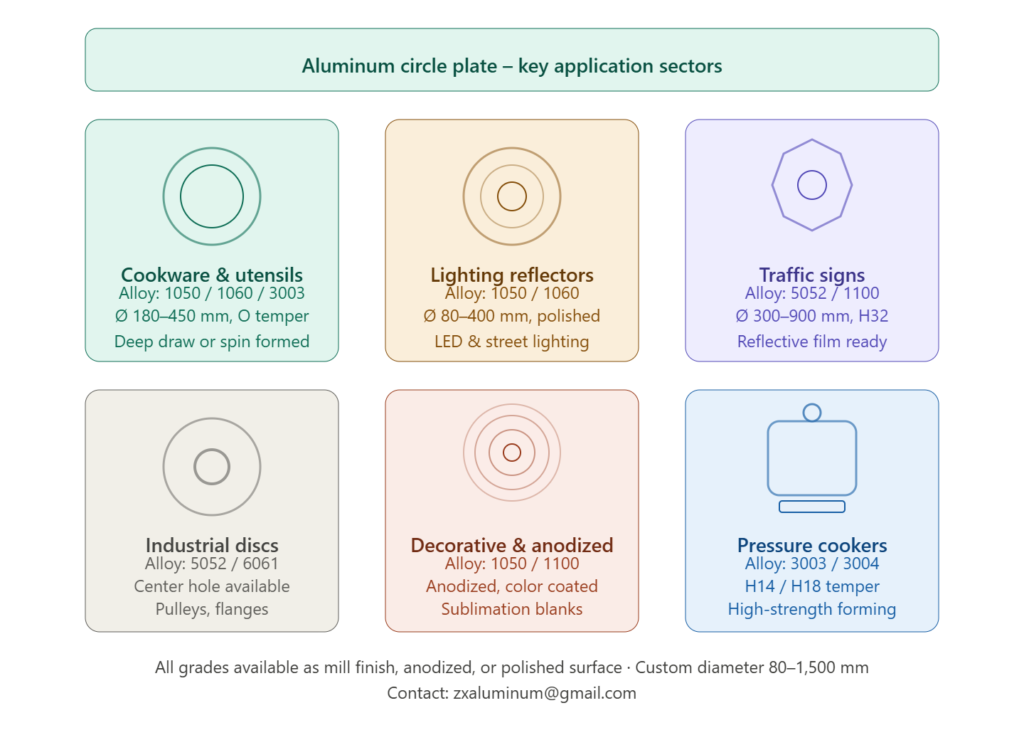
The round aluminum plate is used in virtually every sector that requires a lightweight, corrosion-resistant, formable disc. Here are the major end-use categories:
4.1 Cookware and Kitchen Utensils
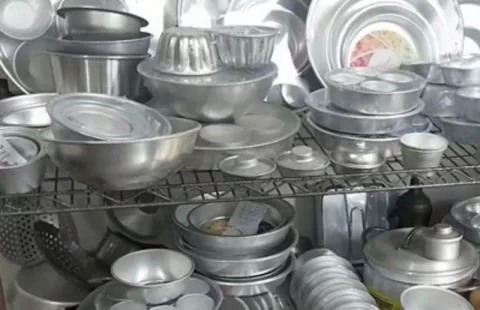
The largest application for aluminum circle plate globally is cookware. Alloys 1050, 1060, 1100, and 3003 are used to produce pots, pans, woks, pressure cooker bodies, and flat lids. The aluminum circle pan blank is the starting point for most non-stick and bare aluminum cookware. Deep drawing and spinning are the two main forming methods.
We supply cookware manufacturers in Turkey, Brazil, Vietnam, South Korea, and across Southeast Asia. Our circles are produced with tight thickness tolerance (±0.03 mm) and smooth, burr-free edges to reduce forming defects.
4.2 Road Signs and Traffic Equipment
Round traffic signs, regulatory signs, and reflective sign blanks use aluminum plate circular discs as the substrate. Alloy 5052-H32 and 1100-H14 are standard for this segment because of their high strength and good surface adhesion for screen printing and reflective film lamination.
4.3 Lighting Reflectors and LED Fixtures
High-purity 1050 and 1060 aluminum circle plates are spun or stamped into parabolic reflectors for street lights, industrial lighting, and LED downlights. The high reflectivity of polished aluminum makes it ideal for optical reflector applications.
4.4 Industrial and Engineering Discs
Aluminum discs with center holes are used as pulley blanks, flange components, and machine parts. Alloys 5052 and 6061 are chosen where strength is critical. Round aluminum plates are also used as base plates, end caps, and speaker grille frames.
4.5 Decoration and Arts
Anodized aluminum circle plates are popular for medallions, awards, nameplates, dye sublimation blanks, and decorative panels. The 1050 and 1100 alloys anodize cleanly and accept bright color finishes.
5. Aluminum Circle Plate vs. Other Aluminum Forms
| Product Form | Shape | Production Method | Typical Use |
| Aluminum Circle Plate | Round disc | Punched / rolled from coil | Cookware, signs, reflectors |
| Aluminum Sheet | Rectangular flat sheet | Rolling | Construction, fabrication |
| Aluminum Coil | Continuous rolled strip | Hot/cold rolling | Stamping, forming, slitting |
| Aluminum Circle Ring | Round disc with center hole | Punched from coil | Pulleys, flanges, grilles |
| Aluminum Strip | Narrow flat roll | Slitting from coil | Channel letters, fins, trim |
The key difference between a round aluminum plate and other forms is that circle plates are net-shape or near-net-shape — they are ready for immediate forming with minimal material waste compared to cutting circles from rectangular sheets.
6. Aluminum Circle Price: What Affects the Cost?
Aluminium circle price depends on several factors. Understanding these will help you budget accurately and compare supplier quotations:
| Price Factor | Impact | Notes |
| Alloy Grade | High | 1050/1060 < 3003 < 5052 < 6061 |
| Thickness | High | Thicker = more material = higher cost |
| Diameter | Medium | Larger blanks use more material |
| Temper (O vs H14/H18) | Medium | Soft temper (O) is lower cost; H18 costs more |
| Surface Treatment | Medium-High | Mill finish cheapest; anodized/polished adds cost |
| Order Quantity (MOQ) | High | Lower price per kg at higher tonnage |
| LME Aluminum Price | Variable | Tied to global commodity market |
| Delivery Requirement | Medium | FOB, CIF, or DDP affects final landed cost |
As a factory supplier, we quote directly without trading company markup. For orders above 1 MT, we offer competitive factory pricing. Please contact us with your alloy, diameter, thickness, and target quantity for a fast quotation.
Note: Aluminium circle price fluctuates with LME aluminum ingot prices. We recommend locking in pricing with a purchase order when the market is stable.
7. How to Cut a Circle in Aluminum Plate or Sheet
Many fabricators and workshops need to cut custom circles from rectangular aluminum sheet or plate. Here are the most common methods used in industry:
7.1 Circle Shear (Rotary Cutter)
A circle shear or circle cutter is the most common tool for cutting circles in aluminum sheet up to about 3 mm thick. The sheet is clamped at the center, and a rotating blade cuts the radius. This is the cleanest method for small to medium production runs.
7.2 CNC Plasma or Laser Cutting
For thicker aluminum plates (3 mm and above), CNC plasma cutting or fiber laser cutting gives accurate results. Laser cutting is preferred for high-tolerance applications because it leaves a clean, narrow kerf with minimal heat distortion.
7.3 Waterjet Cutting
Waterjet cutting is the best method for cutting a circle in aluminum plate where no heat-affected zone is acceptable. It works on all thicknesses and leaves a smooth edge. The downside is higher cost per piece compared to shearing.
7.4 Hole Saw or Jigsaw
For one-off or workshop use, a hole saw attached to a drill press cuts small aluminum circles cleanly. A jigsaw with a metal blade can cut larger circles using a pivot guide. Use cutting lubricant to extend blade life and improve edge quality.
If you need pre-cut aluminum circle plates in large quantities, ordering from a dedicated circle manufacturer like us is more cost-effective than cutting from sheet. We ship ready-to-form discs that reduce your scrap and processing time.
8. Why Source Aluminum Circle Plates from a Factory Supplier?
As a direct aluminum circle plate manufacturer and material supplier, we offer advantages that trading companies cannot match:
| Advantage | Details |
| Factory-Direct Pricing | No middleman markup. Mill pricing passed directly to buyers. |
| Full Alloy Range | 1050, 1060, 1100, 3003, 5052, 8011 and more in stock. |
| Custom Diameter & Thickness | Any size from 80 mm to 1,500 mm diameter, 0.3 mm to 10 mm thick. |
| Tight Tolerances | Thickness tolerance ±0.03 mm; diameter tolerance ±0.5 mm standard. |
| Surface Options | Mill finish, anodized, polished, color coated, PVDF on request. |
| Fast Sampling | Free samples available; standard samples ship within 3–5 business days. |
| Certifications | ASTM B209, EN 573, ISO 9001 quality system. |
| Flexible MOQ | Small trial orders accepted; volume discounts from 1 MT upward. |
| Export Packaging | Wooden pallet or iron frame packaging for sea freight. |
9. Export Markets We Serve
We export aluminum circle plates to buyers worldwide. Our main markets include:
| Region | Key Countries | Main Applications |
| Middle East | Saudi Arabia, UAE, Turkey, Iran | Cookware, traffic signs, pressure vessels |
| Southeast Asia | Vietnam, Thailand, Indonesia, Philippines | Cookware, LED reflectors, industrial |
| South Asia | India, Pakistan, Bangladesh | Cookware manufacturing, utensils |
| Africa | Nigeria, Kenya, Ethiopia, Egypt | Cookware, signs, general fabrication |
| South America | Brazil, Colombia, Peru, Mexico | Cookware, automotive, construction |
| Europe | Germany, Italy, Poland, Spain | Precision parts, reflectors, cookware |
| North America | USA, Canada | Industrial discs, signs, cookware |
We ship via sea freight (FCL and LCL) to all major ports. Air freight is available for urgent sample orders. Our team can assist with customs documentation, packing lists, and certificates of origin.
10. Frequently Asked Questions (FAQ)
Q1: What is the difference between aluminum circle plate and aluminum disc?
They refer to the same product. Aluminum circle plate, aluminum disc, and round aluminum plate are all terms used for a flat, circular aluminum blank. The term “disc” is more common in North America and Europe, while “circle” is standard in Asian manufacturing and trading markets.
Q2: What alloy is best for cookware aluminum circle plates?
For cookware, the most common choices are 1050-O, 1060-O, 1100-O, and 3003-O. These alloys have excellent deep-drawing formability. 3003 offers slightly higher strength and is preferred for pressure cookers. 1050 and 1060 give a better anodizing result for decorative finishes.
Q3: Do you supply aluminum discs with center holes?
Yes. We can produce aluminum discs with center holes to any specified inner diameter. This is common for pulley blanks, speaker grille discs, and flange components. Please specify the inner diameter and tolerance in your inquiry.
Q4: What is the minimum order quantity (MOQ)?
Our standard MOQ is 500 kg per alloy/size combination. For sample orders, we can arrange smaller quantities. Contact us to discuss your requirements.
Q5: How do I get an aluminium circle price quotation?
Send us your required alloy, diameter, thickness, surface finish, and quantity. We will reply with a factory price within 24 hours on business days. Email us at zxaluminum@gmail.com.
Q6: Can you cut a circle in aluminum plate to a custom diameter?
Yes. We produce aluminum circle plates to any diameter from 80 mm to 1,500 mm. Custom diameters are punched or cut from coil with tight tolerance. There is no extra tooling charge for standard circular shapes.
Q7: What certifications do your aluminum circle plates carry?
Our products comply with ASTM B209 (US standard) and EN 573 / EN 485 (European standard). We hold ISO 9001 quality management certification. Mill test reports (MTR) with chemical composition and mechanical properties are provided with every shipment.
Q8: What is the lead time for aluminum circle plates?
For in-stock alloys and standard sizes, lead time is 7–15 business days. For custom alloys or large quantities, lead time is 20–30 days. Please confirm with our sales team at the time of ordering.
11. Contact Us for a Free Quote
We are a direct manufacturer and supplier of aluminum circle plates, round aluminum plates, and aluminum discs. We supply B2B buyers, importers, cookware manufacturers, and industrial fabricators globally.
Get in touch for:
✔ Factory-direct pricing on any alloy and size
✔ Free samples (standard sizes and alloys)
✔ Custom diameter, thickness, and surface finish
✔ Fast quotation within 24 hours
Send us your specifications — alloy, diameter, thickness, quantity — and we will respond with a competitive factory price.