3003 O Aluminum Circle
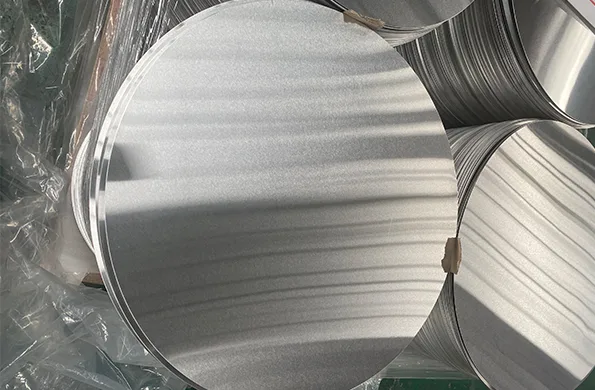
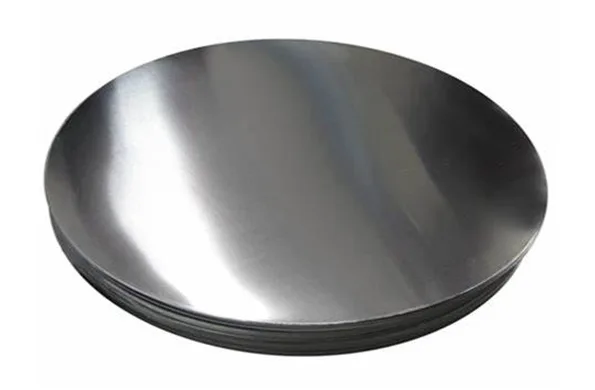
3003 O aluminum circle is a round aluminum disc made from 3003 alloy in the fully annealed (O) temper. The “O” temper means the aluminum has gone through a complete annealing process. This makes it the softest and most formable condition available for 3003 alloy.
The 3003 alloy belongs to the 3000 series aluminum family. Manganese is the primary alloying element. Manganese increases strength compared to pure aluminum while keeping excellent corrosion resistance and workability.
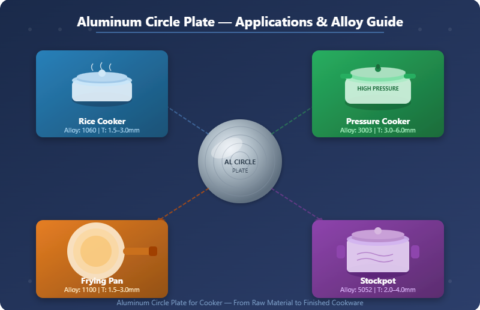
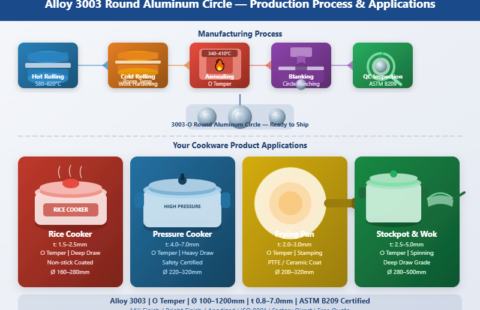
3003 aluminum circles serve as the primary raw material for cookware manufacturing. Factories stamp, spin, or deep-draw these discs into pots, pans, rice cookers, pressure cookers, and other kitchen products. The O temper is critical for deep drawing. It allows the metal to stretch and form without cracking.
If you manufacture cookware or need a highly formable aluminum disc, 3003 O aluminum circle is one of the best choices available.
What Is 3003 Aluminum?
3003 aluminum is the most widely used alloy in the 3000 series. It contains approximately 1.0–1.5% manganese as the main alloying addition. This small amount of manganese increases tensile strength by about 20% compared to pure 1100 aluminum.
Key characteristics of 3003 aluminum:
- Good formability — Easy to stamp, spin, roll, and draw
- Excellent corrosion resistance — Resists oxidation in food, water, and most chemical environments
- Good weldability — Welds well using all standard methods
- Non-heat-treatable — Strength comes from work hardening, not heat treatment
- Food safe — Widely approved for food contact applications
- Cost effective — More affordable than higher-strength alloys
These properties make 3003 aluminum the preferred choice for cookware, food containers, and chemical equipment.
3003 O Aluminum Circle — Chemical Composition
The chemical composition of 3003 aluminum circle follows strict international standards.
Chemical Composition Table
| Element | Content (%) |
|---|---|
| Aluminum (Al) | Balance (≥96.7%) |
| Manganese (Mn) | 1.00 – 1.50 |
| Copper (Cu) | 0.05 – 0.20 |
| Iron (Fe) | Max 0.70 |
| Silicon (Si) | Max 0.60 |
| Zinc (Zn) | Max 0.10 |
| Titanium (Ti) | Max 0.10 |
| Other (each) | Max 0.05 |
| Other (total) | Max 0.15 |
Role of Each Element
Manganese (1.00–1.50%)
Manganese is the key alloying element in 3003. It increases strength through solid solution strengthening. It also improves resistance to corrosion and maintains good formability.
Copper (0.05–0.20%)
A small amount of copper adds strength. The level is kept low to maintain corrosion resistance.
Iron (max 0.70%)
Iron is a natural impurity in aluminum production. It forms intermetallic particles that slightly increase strength.
Silicon (max 0.60%)
Silicon improves castability during the initial ingot production stage.
What Is the O Temper?
The “O” in 3003 O aluminum circle refers to the fully annealed temper. This is the softest condition for any aluminum alloy.
The Annealing Process
- Aluminum circles are heated to approximately 340–410°C
- They are held at temperature for a set time
- They cool slowly in a controlled manner
- The result is fully recrystallized, stress-free metal
Why O Temper Matters for Circles
O temper gives aluminum circles the maximum ductility and formability. This is essential for deep drawing operations. When a flat circle becomes a deep pot or bowl, the metal must stretch significantly without tearing.
Temper Comparison for 3003 Aluminum
| Temper | Tensile Strength | Elongation | Best Use |
|---|---|---|---|
| O | 110 – 145 MPa | 25 – 30% | Deep drawing, spinning |
| H12 | 130 – 165 MPa | 10 – 12% | Moderate forming |
| H14 | 150 – 185 MPa | 7 – 9% | Light forming |
| H16 | 170 – 205 MPa | 5 – 7% | Minimal forming |
| H18 | 195 – 230 MPa | 4 – 6% | No forming required |
For cookware manufacturing, O temper is the standard choice. It provides the highest elongation, which means the metal can deform deeply without breaking.
3003 O Aluminum Circle Properties
Understanding the properties of 3003 O aluminum circle helps manufacturers choose the right material for their production needs.
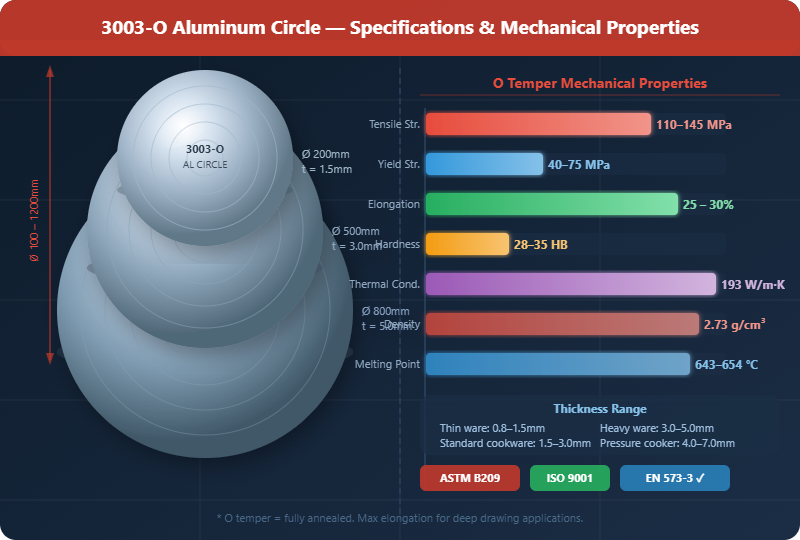
Mechanical Properties
| Property | 3003-O Value |
|---|---|
| Tensile Strength | 110 – 145 MPa |
| Yield Strength | 40 – 75 MPa |
| Elongation | 25 – 30% |
| Hardness (Brinell) | 28 – 35 HB |
| Shear Strength | 75 – 95 MPa |
Physical Properties
| Property | Value |
|---|---|
| Density | 2.73 g/cm³ |
| Melting Range | 643 – 654°C |
| Thermal Conductivity | 193 W/m·K |
| Electrical Conductivity | 41% IACS |
| Coefficient of Thermal Expansion | 23.2 µm/m·°C |
| Elastic Modulus | 68.9 GPa |
Key Performance Features
Deep Drawing Performance
3003 O temper achieves excellent drawing ratios. It can form pots and bowls with depth-to-diameter ratios that would crack lesser alloys. This makes it the top choice for cookware factories worldwide.
Corrosion Resistance
3003 aluminum resists corrosion from food acids, water, and most household chemicals. Cookware made from 3003 circles lasts for years in demanding kitchen environments.
Heat Distribution
The high thermal conductivity of 3003 aluminum ensures even heat distribution across cooking surfaces. Food cooks evenly without hot spots.
Surface Quality
3003 O aluminum circles have clean, smooth surfaces. They accept anodizing, non-stick coating, and polishing treatments well.
3003 Aluminum Circle Specifications
Buyers need precise specifications when ordering 3003 aluminum circles. Here are the standard parameters.
Diameter Range
| Category | Diameter Range |
|---|---|
| Small circles | 100mm – 200mm |
| Medium circles | 200mm – 400mm |
| Large circles | 400mm – 800mm |
| Extra large | 800mm – 1200mm |
Custom diameters are available from professional manufacturers.
Thickness Range
| Application | Thickness |
|---|---|
| Thin pots and lids | 0.8mm – 1.5mm |
| Standard cookware | 1.5mm – 3.0mm |
| Heavy cookware | 3.0mm – 5.0mm |
| Pressure cookers | 4.0mm – 7.0mm |
Surface Finish Options
- Mill finish — Standard, cost-effective
- Bright finish — Polished surface for premium products
- Anodized — Hard, wear-resistant surface
- Non-stick ready — Surface prepared for coating application
Dimensional Tolerances
| Parameter | Tolerance |
|---|---|
| Diameter | ±0.5mm – ±1.0mm |
| Thickness | ±4% – ±6% of nominal |
| Flatness | Max 1mm per 1000mm |
| Edge condition | Smooth, burr-free |
3003 Aluminum Disc vs 3003 Aluminum Circle
Buyers often search for both 3003 aluminum disc and 3003 aluminum circle. These terms describe the same product. Both refer to a round, flat aluminum blank cut from sheet or rolled directly into disc form.
The term “circle” is more common in manufacturing and industry contexts. “Disc” appears more often in general searches. Regardless of the term used, the product specifications remain the same.
3003 Aluminum Plate vs 3003 Aluminum Circle
3003 aluminum plate and 3003 aluminum circle serve different purposes.
| Feature | 3003 Aluminum Plate | 3003 Aluminum Circle |
|---|---|---|
| Shape | Rectangular | Round |
| Use | Structural, fabrication | Cookware, spinning |
| Cutting | Shear cut to rectangle | Blanked to round shape |
| Waste | Low for rectangular parts | Some scrap from blanking |
| Typical thickness | 6mm and above | 0.8mm – 7.0mm |
| Main temper | H14, H18 | O temper |
When a manufacturer needs round blanks for cookware production, 3003 O aluminum circles are more efficient than cutting rounds from rectangular plate. Less waste and better edge quality result from proper blanking operations.
3003 H14 Aluminum Sheet vs 3003 O Aluminum Circle
Many buyers compare 3003 H14 aluminum sheet with 3003 O aluminum circles.
3003 H14 aluminum sheet is strain-hardened to half-hard condition. It has higher strength than O temper but lower ductility. H14 sheet suits applications that need stiffness without deep forming.
3003 O aluminum circle is the right choice when:
- Deep drawing is required
- Complex shapes need to be formed
- Maximum elongation is needed
- Cookware or container production is the goal
3003 H14 sheet is the right choice when:
- Flat panels or shallow formed parts are needed
- Higher strength matters more than deep formability
- Roofing, siding, or structural panels are the product
- Minimal bending or forming is involved
For cookware manufacturing, always choose 3003 O temper circles.
3003 O Aluminum Circle Applications
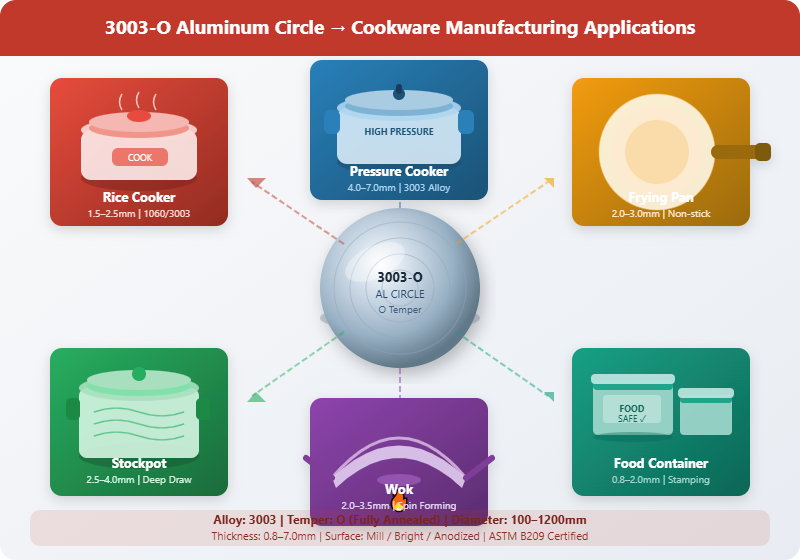
3003 aluminum circles serve a wide range of applications. Cookware is the largest market, but many other industries use this alloy.
Cookware Manufacturing
This is the primary application for 3003 O aluminum circles. The circle becomes the starting material for:
Rice Cookers
Rice cooker inner pots need deep drawing capability. 3003 O circles in 1.5mm – 2.5mm thickness work perfectly. The annealed temper allows the pot shape to form without cracking. After forming, manufacturers apply non-stick coating.
Soup Pots and Stockpots
Deeper pots require more material elongation. 3003 O temper handles these demands. Typical thickness is 2.0mm – 3.5mm.
Frying Pans and Skillets
Flat to slightly curved pans need less drawing depth. 3003 O circles in 2.0mm – 3.0mm thickness are standard. Non-stick or hard anodized surfaces are common finishes.
Pressure Cookers
Pressure cooker bodies need thicker material — typically 4.0mm – 7.0mm. 3003 O circles provide the needed formability even at these heavier gauges.
Steamer Pots and Inserts
Steamers often have multiple tiers. Each tier starts as a 3003 O aluminum circle.
Milk Pots and Small Saucepans
Smaller pots for milk, sauces, and individual servings use smaller diameter circles in 1.0mm – 2.0mm thickness.
Woks
Traditional wok shapes require significant metal forming. 3003 O circles handle the complex curved geometry.
Food Containers and Packaging
Beyond cookware, 3003 O circles make:
- Aluminum food trays and containers
- Disposable baking pans
- Pizza pans and baking molds
- Cake tins and pie dishes
- Catering and airline food containers
Industrial Applications
3003 aluminum circles also appear in industrial products:
- Chemical storage vessels
- Filter housings
- Liquid storage tanks
- Heat exchanger components
- Reflector discs for lighting
Other Applications
- Decorative discs and signs
- Spinning and turning blanks for custom shapes
- Traffic sign blanks
- Musical instrument components
How 3003 O Aluminum Circles Are Made
Understanding the production process helps buyers evaluate quality and select the right supplier.
Step 1: Ingot Casting
Raw aluminum is alloyed with manganese and other elements. The molten metal is cast into large rectangular ingots.
Step 2: Hot Rolling
Ingots are heated and rolled through heavy rolling mills. This reduces thickness from hundreds of millimeters to around 6–8mm.
Step 3: Cold Rolling
The hot-rolled coil goes through cold rolling mills. Multiple passes reduce thickness to the target gauge. Cold rolling also work-hardens the metal.
Step 4: Annealing
Cold-rolled coils or sheets are annealed in controlled atmosphere furnaces. This relieves work hardening and produces the soft O temper.
Step 5: Blanking
Annealed aluminum sheet or coil feeds into blanking presses. Circular dies punch out round discs of the specified diameter.
Step 6: Edge Treatment
Blanked circles have their edges trimmed and deburred. Smooth, clean edges prevent tearing during subsequent forming operations.
Step 7: Surface Treatment (Optional)
Some customers require surface treatment before delivery:
- Cleaning and degreasing
- Bright finish polishing
- Anodizing (less common at this stage)
Step 8: Quality Inspection
Each batch undergoes:
- Dimensional measurement (diameter, thickness)
- Visual surface inspection
- Mechanical property testing (tensile, elongation)
- Chemical composition verification
Step 9: Packaging and Shipping
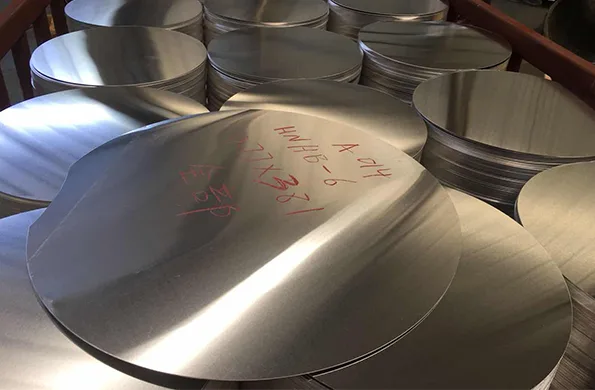
Circles are stacked with protective interleaving paper. Pallets are wrapped and secured for safe transport.
Quality Standards for 3003 O Aluminum Circles
Professional buyers require certified quality. Here are the key standards and quality checkpoints.
International Standards
| Standard | Region | Scope |
|---|---|---|
| ASTM B209 | USA | Aluminum sheet and plate |
| EN 573-3 | Europe | Chemical composition |
| EN 485 | Europe | Mechanical properties and tolerances |
| GB/T 3880 | China | General aluminum sheet standard |
| JIS H4000 | Japan | Aluminum sheet standard |
Quality Inspection Points
Chemical Composition
Every batch requires spectrometer testing. Manganese content must fall between 1.00% and 1.50%. Out-of-spec composition affects forming performance.
Mechanical Properties
Tensile strength, yield strength, and elongation must meet O temper requirements. Elongation below 25% indicates insufficient annealing.
Dimensional Accuracy
Diameter tolerance must be within ±0.5mm to ±1.0mm. Thickness must be consistent across the circle — no taper or variation.
Surface Quality
Check for:
- No scratches or roll marks
- No oxidation or staining
- No oil residue or contamination
- No edge cracks or tears
Flatness
Circles must lie flat. Warped or bowed circles cause problems in stamping and forming equipment.
Edge Quality
Edges must be smooth and free of burrs. Rough edges cause tearing during deep drawing.
How to Choose the Right 3003 O Aluminum Circle
Follow these steps to select the correct specifications for your production.
Step 1: Define Your Product
What cookware or container are you making? The product shape determines the drawing depth and therefore the material requirements.
Step 2: Calculate the Blank Diameter
For deep-drawn products, the blank diameter must be larger than the finished product. A general formula:
Blank Diameter = √(d² + 4dh)
Where d = finished diameter, h = finished height
For shallow products, add 15–20% to the finished diameter. For deep products, add 30–50%.
Step 3: Select Thickness
Match the blank thickness to your finished wall thickness requirement. Account for thinning during drawing. Typical thinning is 10–20% for standard operations.
Step 4: Confirm O Temper
Always specify O temper for deep drawing applications. Other tempers will crack during forming.
Step 5: Choose Surface Finish
- Mill finish for most applications
- Bright finish for premium visible surfaces
- Special surface for specific coating requirements
Step 6: Specify Edge Quality
Request smooth, burr-free edges. This is critical for automatic feeding into stamping presses.
Step 7: Request Samples
Order sample circles before placing large production orders. Test them in your actual forming process.
3003 O Aluminum Circle Price Guide
The price of 3003 O aluminum circles depends on several factors.
Price Factors
Aluminum Market Price
Base aluminum price follows the London Metal Exchange (LME). Price fluctuations in raw aluminum directly affect circle prices.
Manganese Premium
3003 carries a small alloy premium over pure aluminum alloys due to manganese content.
Thickness
Thicker circles use more material and cost more per piece. Thinner circles may cost more per kg due to additional rolling passes.
Diameter
Larger circles cost more per piece. However, price per kg stays similar across standard size ranges.
Surface Finish
Mill finish is the base price. Bright finish adds 5–15%. Anodized surfaces add more.
Order Quantity
Larger orders receive lower per-kg pricing. Typical MOQ starts at 1–3 tons per specification.
Certification
ASTM or EN certified material costs slightly more than uncertified material.
Indicative Price Range
| Product | Approximate Price |
|---|---|
| 3003 O circle (standard, mill finish) | $2.8 – $4.5 per kg |
| 3003 O circle (bright finish) | $3.2 – $5.0 per kg |
| 3003 O circle (custom size) | Add $0.3 – $0.8 per kg |
Prices change with LME aluminum rates. Contact us for current pricing.
3003 vs Other Aluminum Alloys for Circles
Buyers sometimes consider other alloys for aluminum circles. Here is how 3003 compares.
3003 vs 1060 Aluminum Circle
| Feature | 3003 O | 1060 O |
|---|---|---|
| Tensile Strength | 110–145 MPa | 70–95 MPa |
| Elongation | 25–30% | 23–28% |
| Corrosion Resistance | Excellent | Excellent |
| Cost | Slightly higher | Lower |
| Best Use | Heavier cookware, pressure cookers | Lightweight pots, rice cookers |
Choose 3003 when higher strength is needed in the finished product.
Choose 1060 when cost is the priority and lighter products are acceptable.
3003 vs 1100 Aluminum Circle
| Feature | 3003 O | 1100 O |
|---|---|---|
| Tensile Strength | 110–145 MPa | 75–105 MPa |
| Manganese Content | 1.0–1.5% | None |
| Strength | Higher | Lower |
| Formability | Excellent | Excellent |
| Cost | Slightly higher | Lower |
Choose 3003 for stronger finished products.
Choose 1100 for the most economical option when strength is less important.
3003 vs 5052 Aluminum Circle
| Feature | 3003 O | 5052 O |
|---|---|---|
| Tensile Strength | 110–145 MPa | 170–215 MPa |
| Elongation | 25–30% | 22–25% |
| Corrosion Resistance | Excellent | Superior |
| Cost | Lower | Higher |
| Best Use | Standard cookware | Marine, commercial cookware |
Choose 3003 for standard household cookware.
Choose 5052 when superior corrosion resistance or higher strength is needed.
Why Buy 3003 O Aluminum Circles from a Professional Manufacturer?
Working directly with a professional manufacturer gives cookware factories major advantages.
Consistent Quality Batch After Batch
Professional manufacturers maintain strict process control. Chemical composition, temper, dimensions, and surface quality stay consistent. Your production line runs smoothly without material-related stops.
Custom Sizes Available
We produce 3003 O aluminum circles in any diameter from 100mm to 1200mm. Any thickness from 0.8mm to 7.0mm. No minimum on size variety — just minimum on quantity per specification.
Large Production Capacity
Our production capacity handles both small trial orders and large volume production runs. We deliver on schedule without compromising quality.
Competitive Factory Pricing
Buying direct from the manufacturer eliminates trader margins. You get better pricing on every order. Volume discounts available for regular buyers.
Full Certification Support
We provide:
- Mill Test Certificates (MTC) for every batch
- Chemical composition reports
- Mechanical property test reports
- Third-party inspection coordination (SGS, BV, TUV)
Technical Support
Our technical team helps you:
- Calculate the right blank diameter for your product
- Select optimal thickness for your forming process
- Solve surface quality or forming problems
- Optimize specifications to reduce cost
Fast Sample Service
Sample orders ship within 3–7 days. Test our material in your production before committing to full orders.
Packaging and Shipping
Proper packaging protects 3003 O aluminum circles during transport.
Standard Packaging
- Circles stacked on wooden pallets
- Protective paper interleaved between circles
- Outer wrap: waterproof kraft paper or plastic film
- Steel strapping bands secure the pallet
- Pallet size: 1100mm × 1100mm standard
Export Packaging Options
- Sea-worthy wooden crates for sensitive surfaces
- Individual plastic film wrapping for bright finish circles
- Custom pallet sizes for specific container loading
Shipping Options
| Method | Best For | Lead Time |
|---|---|---|
| Sea freight | Large orders, cost sensitive | 15–40 days |
| Air freight | Urgent samples or small orders | 3–7 days |
| Rail freight | Europe and Central Asia | 15–25 days |
Container Loading
- 20-foot container: 18–22 tons of circles
- 40-foot container: 22–26 tons of circles
We provide complete export documentation: commercial invoice, packing list, bill of lading, certificate of origin, and mill test certificates.
Export Markets
We supply 3003 O aluminum circles to cookware manufacturers worldwide.
Southeast Asia
Vietnam, Thailand, Indonesia, Malaysia, Philippines — major cookware manufacturing hubs in this region rely on our circles.
South Asia
Bangladesh, Pakistan, India, Sri Lanka — growing cookware markets with strong demand for quality circles.
Middle East
Turkey, Iran, Egypt, UAE, Saudi Arabia — significant cookware production and distribution centers.
Africa
Nigeria, Ethiopia, Kenya, Ghana, Tanzania — fast-growing markets for affordable, quality cookware.
Europe
Germany, Poland, Italy, Spain, Netherlands — premium cookware manufacturers requiring certified material.
Americas
Brazil, Mexico, Colombia, Peru — active cookware manufacturing markets.
FAQ — Common Questions About 3003 O Aluminum Circles
What is 3003 O aluminum circle?
3003 O aluminum circle is a round aluminum blank made from 3003 alloy in the fully annealed condition. It is the primary raw material for cookware manufacturing. The O temper provides maximum formability for deep drawing operations.
What is the difference between 3003 O and 3003 H14?
3003 O is fully annealed and very soft with high elongation (25–30%). It suits deep drawing and forming. 3003 H14 is strain-hardened to half-hard condition. It is stronger but less formable. H14 suits flat panels and lightly formed products.
What sizes are available for 3003 O aluminum circles?
Standard diameters range from 100mm to 1200mm. Thickness ranges from 0.8mm to 7.0mm. Custom sizes are available from professional manufacturers.
Is 3003 aluminum food safe?
Yes. 3003 aluminum meets FDA and EU food contact material regulations. It is safe for cookware, food containers, and food processing equipment. Billions of households use 3003 aluminum cookware safely every day.
What is the best temper for aluminum circles used in cookware?
O temper is the best choice for deep-drawn cookware. It provides the highest elongation and best formability. Other tempers may crack during deep drawing operations.
How do I calculate the right blank diameter for my cookware?
A basic formula: Blank Diameter = √(d² + 4dh), where d is the finished inner diameter and h is the finished depth. For practical applications, add 10–15% for trimming allowance. Consult our technical team for precise calculations.
What is the minimum order quantity?
Minimum order quantity is typically 1–3 tons per specification. Contact us to discuss your specific requirements.
Contact Us for 3003 O Aluminum Circles
We are a professional manufacturer of 3003 O aluminum circles for cookware and container production. Our products serve factories in over 50 countries.
Product Summary
| Specification | Details |
|---|---|
| Alloy | 3003 |
| Temper | O (fully annealed) |
| Diameter | 100mm – 1200mm |
| Thickness | 0.8mm – 7.0mm |
| Surface | Mill finish, bright finish |
| Standard | ASTM B209, EN 573-3 |
| Certifications | ISO 9001, SGS, MTC |
| MOQ | 1 – 3 tons per spec |
| Lead Time | 15 – 25 days |
| Packaging | Pallets with interleaving paper |
Get Your Free Quote Today
Contact our sales team with your requirements. We respond within 24 hours.
Please provide:
- Diameter and thickness needed
- Quantity required
- Surface finish preference
- Certification requirements
- Destination country
Our team will send you competitive pricing and full technical specifications.