Alloy 1050, 1060 & 3003 Round Aluminum Circle Plate
What Is a Round Aluminum Circle Plate?
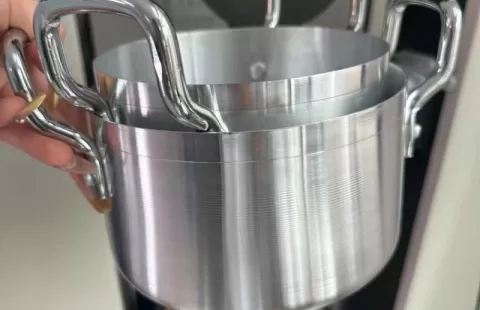
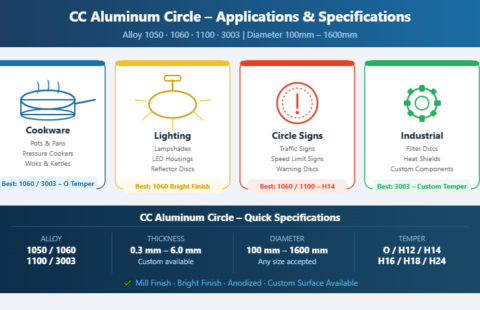
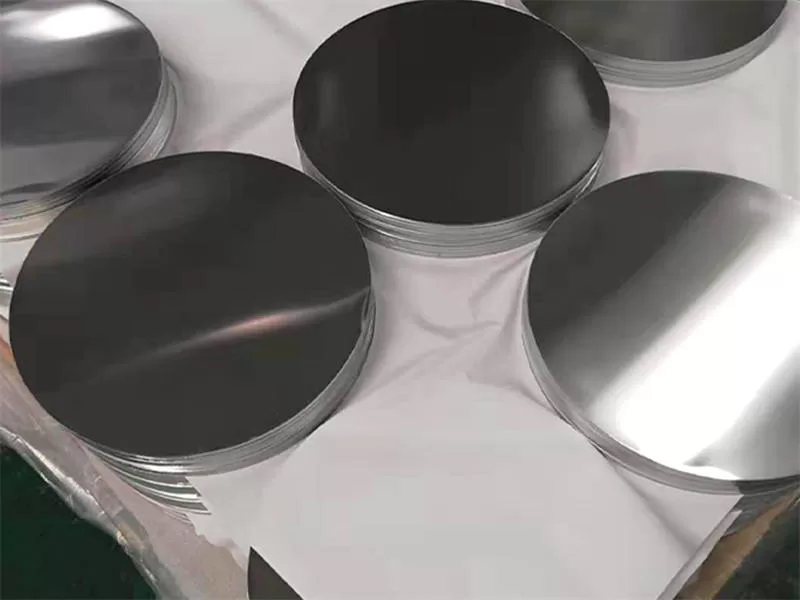
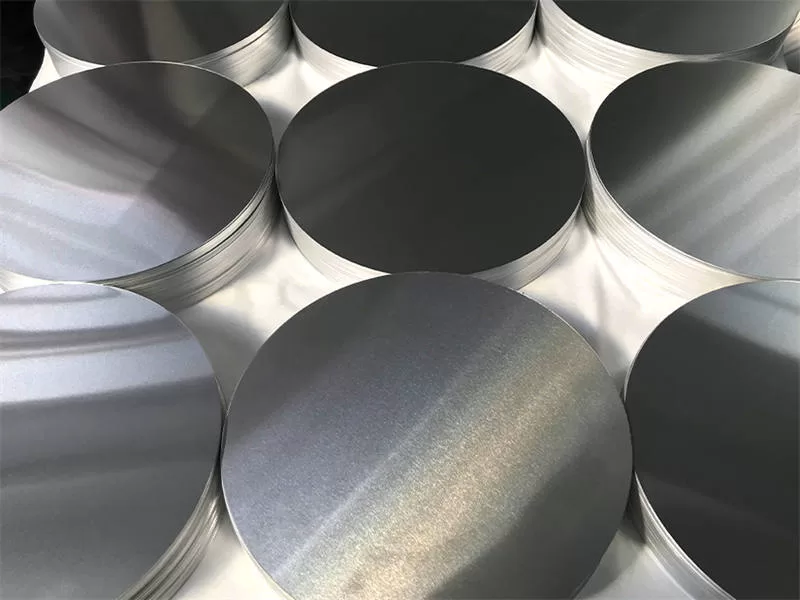
A round aluminum circle plate is a flat, disc-shaped aluminum product. Manufacturers cut it from aluminum sheets or coils into precise circular shapes. These plates are widely used in cookware, lighting, signage, and industrial applications.
The most popular alloys for aluminum circle plates are 1050, 1060, and 3003. Each alloy offers different properties. Choosing the right one depends on your specific application and budget.

Why Choose 1050, 1060, or 3003 Aluminum Circle Plate?
These three alloys are the top choices for round aluminum circle plates worldwide. Here is why:
- High purity – 1050 and 1060 contain over 99% pure aluminum
- Excellent formability – Easy to stamp, spin, and deep-draw
- Good corrosion resistance – Suitable for food contact and outdoor use
- Lightweight – Easy to handle and transport
- Cost-effective – Lower price compared to higher-series alloys
- Wide availability – Standard sizes available from stock
Customers choose these alloys because they offer reliable performance at a competitive price.
1060 Aluminum Circle Plate
What Is 1060 Aluminum?
1060 aluminum is a commercially pure aluminum alloy. It contains a minimum of 99.6% aluminum. This makes it one of the most widely used alloys for aluminum circle plates.
Key Features of 1060 Aluminum Circle Plate
- Aluminum content: ≥ 99.6%
- Excellent electrical and thermal conductivity
- Very good corrosion resistance
- Soft and easy to process
- Suitable for deep drawing and spinning
- Low strength compared to 3003
Common Applications of 1060 Aluminum Circle Plate
1060 aluminum circle plates are used in many industries:
- Cookware – Pots, pans, pressure cookers, and woks
- Lighting – Lamp shades and reflector discs
- Road signs – Traffic and street signs
- Chemical industry – Storage tanks and containers
- Electronics – Heat sinks and conductive components
1060 Aluminum Circle Plate Specifications
| Parameter | Value |
|---|---|
| Alloy | 1060 |
| Temper | O, H12, H14, H16, H18, H24 |
| Thickness | 0.3 mm – 6.0 mm |
| Diameter | 100 mm – 1600 mm |
| Tensile Strength | 60 – 95 MPa |
| Yield Strength | 15 – 75 MPa |
| Elongation | ≥ 15% |
| Density | 2.71 g/cm³ |
| Surface | Mill finish, bright, anodized |
1050 Aluminum Circle Plate
What Is 1050 Aluminum?
1050 aluminum is another high-purity aluminum alloy. It contains at least 99.5% aluminum. It is very similar to 1060 but with slightly lower purity. Still, it offers excellent performance for most applications.
Key Features of 1050 Aluminum Circle Plate
- Aluminum content: ≥ 99.5%
- Outstanding corrosion resistance
- Excellent workability and ductility
- Good thermal conductivity
- Very low strength – not suitable for structural use
- Ideal for non-structural applications requiring forming
Common Applications of 1050 Aluminum Circle Plate
1050 aluminum circle plates work well in:
- Kitchen utensils – Mixing bowls, plates, and trays
- Spinning applications – Lampshades and decorative discs
- Chemical equipment – Non-corrosive containers
- Electrical industry – Conductors and capacitors
- Food packaging – Caps and lids
1050 Aluminum Circle Plate Specifications
| Parameter | Value |
|---|---|
| Alloy | 1050 |
| Temper | O, H12, H14, H16, H18 |
| Thickness | 0.3 mm – 6.0 mm |
| Diameter | 100 mm – 1600 mm |
| Tensile Strength | 65 – 100 MPa |
| Yield Strength | 15 – 80 MPa |
| Elongation | ≥ 15% |
| Density | 2.71 g/cm³ |
| Surface | Mill finish, bright |
3003 Aluminum Circle Plate
What Is 3003 Aluminum?
3003 aluminum is an aluminum-manganese alloy. It contains about 1.0% – 1.5% manganese. This addition increases strength by about 20% compared to 1060 aluminum. It still keeps excellent formability and corrosion resistance.
Key Features of 3003 Aluminum Circle Plate
- Aluminum-manganese alloy with higher strength
- About 20% stronger than 1060 aluminum
- Excellent corrosion resistance in most environments
- Very good workability and deep-drawing ability
- Non-heat-treatable – strengthened by cold working
- Suitable for applications needing moderate strength
Common Applications of 3003 Aluminum Circle Plate
3003 aluminum circle plates are popular in:
- Cookware manufacturing – High-quality pots and pans
- Food processing – Trays, containers, and utensils
- Building materials – Roofing and cladding components
- Fuel tanks – Gasoline and oil tanks
- HVAC systems – Heat exchangers and ducting
- Marine applications – Boat hulls and fittings
3003 Aluminum Circle Plate Specifications
| Parameter | Value |
|---|---|
| Alloy | 3003 |
| Temper | O, H12, H14, H16, H18, H24, H26 |
| Thickness | 0.3 mm – 8.0 mm |
| Diameter | 100 mm – 1600 mm |
| Tensile Strength | 95 – 185 MPa |
| Yield Strength | 35 – 165 MPa |
| Elongation | ≥ 8% |
| Density | 2.73 g/cm³ |
| Surface | Mill finish, bright, anodized |
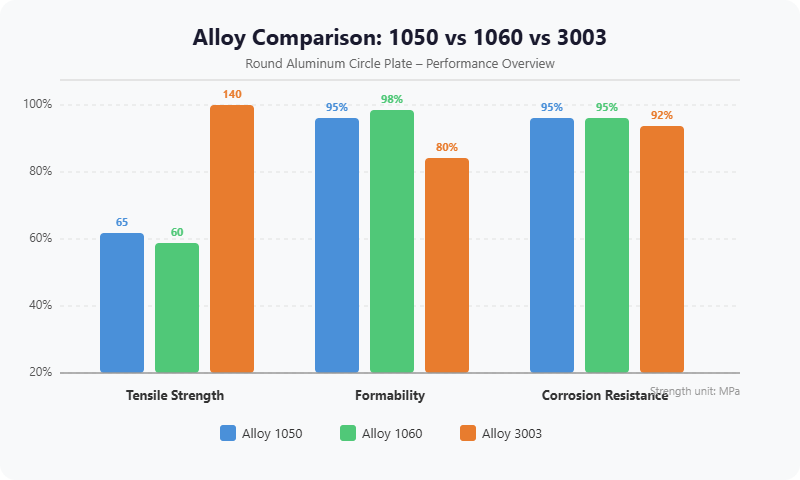
Aluminum Circle Plate – Alloy Comparison Table
This table helps you choose the right alloy quickly.
| Property | 1050 | 1060 | 3003 |
|---|---|---|---|
| Al Content | ≥ 99.5% | ≥ 99.6% | Balance |
| Mn Content | – | – | 1.0–1.5% |
| Tensile Strength | 65–100 MPa | 60–95 MPa | 95–185 MPa |
| Formability | Excellent | Excellent | Very Good |
| Corrosion Resistance | Excellent | Excellent | Excellent |
| Weldability | Good | Good | Excellent |
| Cost | Low | Low | Slightly Higher |
| Best Use | Spinning, drawing | Cookware, signs | Tanks, cookware |
Aluminum Alloy Plate – Surface Finish Options
The surface finish affects both appearance and performance. We offer several surface options:
- Mill finish – Standard smooth surface, no treatment
- Bright finish – Polished surface with high reflectivity
- Anodized – Oxide layer for extra corrosion protection and color
- Coated – PVDF or polyester coating for outdoor use
- Brushed – Decorative surface for consumer products
Most cookware customers choose mill finish or bright finish. Signage customers often prefer anodized surface.
Aluminum Plate Rounded Corners – What You Need to Know
Some customers ask about aluminum plates with rounded corners. This is different from a full circle plate. Rounded corner aluminum plates are rectangular or square sheets with curved corners.
We can produce both:
- Full round aluminum circle plates – Perfectly circular discs
- Aluminum plates with rounded corners – Rectangular plates with smooth curved edges
Rounded corner plates are common in:
- Electronic enclosures
- Decorative panels
- Architectural cladding
- Furniture components
Tell us your specific size and shape. We will provide a custom solution.
How Is a Round Aluminum Circle Plate Made?
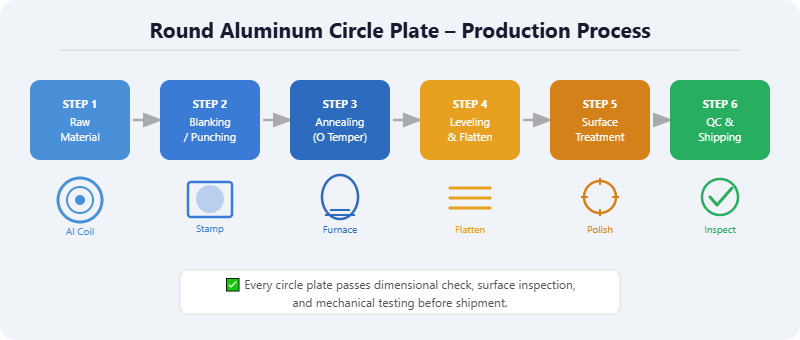
Understanding the production process helps you choose the right product.
Step 1 – Raw Material Selection
We start with high-quality aluminum coils or sheets. The alloy composition is tested before production begins.
Step 2 – Blanking / Punching
A stamping press cuts circular blanks from the aluminum sheet. The punch and die diameter determine the circle size.
Step 3 – Annealing (if required)
For soft temper (O temper) products, we anneal the circles in a furnace. This relieves internal stress and improves formability.
Step 4 – Leveling and Straightening
We flatten the circles to ensure uniform thickness and flatness.
Step 5 – Surface Treatment
Optional surface treatments include polishing, anodizing, or coating.
Step 6 – Quality Inspection
Each batch goes through dimensional checks, surface inspection, and mechanical testing.
Step 7 – Packing and Shipping
Circles are packed with interleaving paper and placed in wooden pallets or cartons. This prevents scratching during transport.
Quality Standards for Aluminum Circle Plates
Our aluminum circle plates meet international quality standards:
| Standard | Description |
|---|---|
| GB/T 3880 | Chinese national standard for aluminum sheets |
| ASTM B209 | American standard for aluminum sheet and plate |
| EN 485 | European standard for aluminum products |
| ISO 9001 | Quality management system certification |
We test every batch before shipment. Test reports are available upon request.
Aluminum Circle Plate Price – What Affects the Cost?
Many customers ask about the price of aluminum circle plates. Several factors affect the final cost:
1. Alloy Type
1050 and 1060 are lower in price because of their simpler composition. 3003 costs slightly more due to the manganese content.
2. Temper
O temper (annealed) is usually the most affordable. H-series tempers may cost more due to additional processing.
3. Thickness and Diameter
Larger and thicker circles require more material. This increases the price per piece.
4. Surface Finish
Mill finish is the cheapest option. Bright, anodized, or coated surfaces cost more.
5. Order Quantity
Larger orders get better unit pricing. MOQ is typically 1–2 tons per size.
6. Market Aluminum Price
Aluminum is a commodity. Its price changes with the LME (London Metal Exchange) rate.
Contact us for a real-time price quote. We provide transparent pricing with no hidden fees.
Standard Sizes Available
We keep common sizes in stock for fast delivery.
Thickness Range
0.3 mm – 8.0 mm (custom thickness available)
Diameter Range
100 mm – 1600 mm (custom diameter available)
Common Stock Sizes
| Diameter (mm) | Thickness (mm) | Alloy |
|---|---|---|
| 200 | 1.0 / 1.5 / 2.0 | 1050, 1060, 3003 |
| 300 | 1.0 / 1.5 / 2.0 / 2.5 | 1050, 1060, 3003 |
| 400 | 1.5 / 2.0 / 2.5 / 3.0 | 1060, 3003 |
| 500 | 2.0 / 2.5 / 3.0 | 1060, 3003 |
| 600 | 2.0 / 3.0 / 4.0 | 3003 |
| Custom | Custom | All alloys |
Non-standard sizes are also available. Lead time for custom orders is 7–15 days.
Who Uses Aluminum Circle Plates?
Our customers come from many different industries around the world.
Cookware Manufacturers
The largest users of aluminum circle plates. They use 1050, 1060, and 3003 circles for deep-drawing pots, pans, and pressure cookers.
Lighting Manufacturers
They use 1060 aluminum circles for lamp reflectors and shade stamping.
Traffic Sign Producers
1060 and 3003 aluminum circles work well for road signs and warning discs.
Chemical Equipment Companies
High-purity 1050 and 1060 circles resist chemical corrosion in storage tanks.
Packaging Companies
Thin aluminum circles serve as caps, lids, and sealing discs.
Why Choose Us as Your Aluminum Circle Plate Manufacturer?
We are a professional aluminum circle plate manufacturer with over 15 years of experience. Here is what makes us different:
✅ Direct Factory Price
We manufacture everything in-house. No middlemen. You get factory-direct pricing.
✅ Wide Product Range
We produce 1050, 1060, 3003, and other alloy aluminum circles. All sizes and tempers available.
✅ Strict Quality Control
Every batch is tested for dimensions, surface quality, and mechanical properties. We provide full test reports.
✅ Custom Production
We accept custom size, alloy, temper, and surface finish. OEM service is available.
✅ Fast Delivery
Stock items ship within 3–5 days. Custom orders take 7–15 days.
✅ Reliable Packaging
We use interleaved paper, wooden pallets, and waterproof wrapping. Products arrive damage-free.
✅ Professional Export Experience
We export to over 50 countries. Our team handles all documentation including CO, SGS, and mill certificates.
Export Markets – Countries We Serve
We supply aluminum circle plates to customers worldwide:
| Region | Countries |
|---|---|
| Middle East | Saudi Arabia, UAE, Turkey, Iran, Iraq |
| Africa | Nigeria, Kenya, Ethiopia, South Africa |
| Southeast Asia | Vietnam, Thailand, Indonesia, Malaysia |
| South America | Brazil, Colombia, Mexico, Argentina |
| Europe | Germany, Italy, Poland, Spain |
| North America | USA, Canada |
Our logistics team arranges sea freight, air freight, and land transport. We handle all customs documents.
Frequently Asked Questions
Q1: What is the difference between 1050 and 1060 aluminum circle plates?
Both are high-purity aluminum alloys. 1060 has slightly higher purity (99.6% vs 99.5%). In practice, they perform very similarly. 1060 is more commonly used in cookware. 1050 is more popular in Europe and for electrical applications.
Q2: Is 3003 aluminum circle plate better than 1060?
3003 is stronger than 1060 by about 20%. It is better for applications that need moderate strength. 1060 is cheaper and easier to deep-draw. Choose 3003 when strength matters. Choose 1060 when cost and formability are the priority.
Q3: What is the minimum order quantity?
Our standard MOQ is 1 ton per size. For stock items, smaller quantities may be available. Contact us to discuss your specific needs.
Q4: Can you produce aluminum circles with holes in the center?
Yes. We can punch a center hole during production. Provide the hole diameter and we will include it in the manufacturing process.
Q5: Do you provide SGS or third-party test reports?
Yes. We work with SGS and other third-party inspection companies. Test reports are available upon request.
Q6: What surface finishes are available?
We offer mill finish, bright finish, anodized, brushed, and coated surfaces. Most orders use mill finish or bright finish.
Summary – Choosing the Right Round Aluminum Circle Plate
Here is a quick guide to help you decide:
| Need | Best Choice |
|---|---|
| Lowest cost, good formability | 1060 aluminum circle plate |
| European market or electrical use | 1050 aluminum circle plate |
| Higher strength, cookware quality | 3003 aluminum circle plate |
| Deep drawing for pots and pans | 1060 or 3003, O temper |
| Signage and reflectors | 1060, H14 or H16 temper |
| Chemical storage | 1050 or 1060, mill finish |
Still not sure which alloy to choose? Contact our technical team. We will help you select the best product for your application and budget.