CC Aluminum Circle
What Is a CC Aluminum Circle?
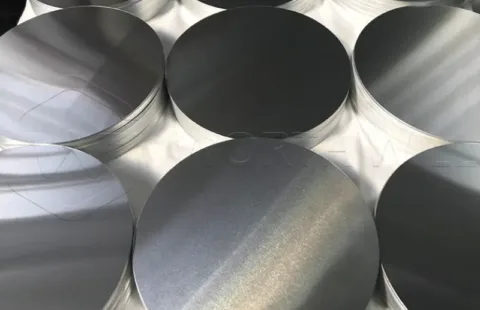
A CC aluminum circle is a round aluminum disc made from CC aluminum material. CC stands for Continuous Casting. This is a specific manufacturing process for producing aluminum coils and sheets.
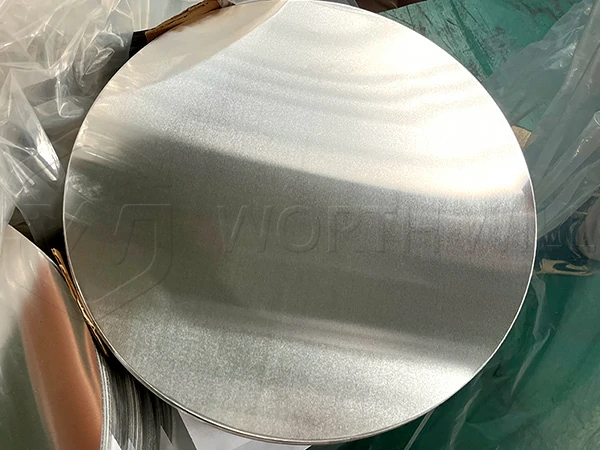
CC aluminum circles are flat, disc-shaped aluminum products. Manufacturers punch or stamp them from CC aluminum coils into precise circular shapes. They are widely used in cookware, lighting, signage, and many other industries.
Understanding the difference between CC and DC aluminum helps you choose the right product for your application.

What Is DC CC Aluminum? – CC vs DC Explained
This is one of the most common questions buyers ask.
What Is CC Aluminum?
CC stands for Continuous Casting and Rolling. In this process, molten aluminum feeds directly into a casting machine. The machine casts and rolls the aluminum into coils in one continuous process.
Key facts about CC aluminum:
- Lower production cost
- Faster production speed
- Suitable for general applications
- Slightly coarser grain structure
- Common alloys: 1050, 1060, 1100, 3003
What Is DC Aluminum?
DC stands for Direct Chill Casting. Molten aluminum pours into a mold and cools rapidly. The cast ingot then goes through multiple rolling processes to reach the final thickness.
Key facts about DC aluminum:
- Higher production cost
- Slower production speed
- Finer grain structure
- Better mechanical properties
- Suitable for high-demand applications
- Common alloys: 5052, 5083, 6061
What Is the Difference Between DC and CC?
| Feature | CC (Continuous Casting) | DC (Direct Chill) |
|---|---|---|
| Process | Continuous casting + rolling | Ingot casting + rolling |
| Cost | Lower | Higher |
| Production Speed | Faster | Slower |
| Grain Structure | Coarser | Finer |
| Surface Quality | Good | Excellent |
| Formability | Good | Excellent |
| Typical Alloys | 1050, 1060, 1100, 3003 | 5052, 5083, 6061 |
| Best For | Cookware, signs, lighting | Marine, aerospace, structural |
| Deep Drawing | Suitable | Better performance |
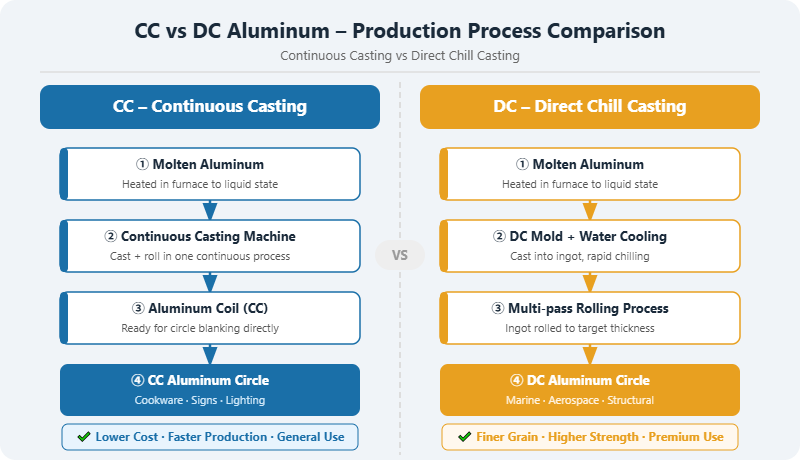
For most cookware and general aluminum circle applications, CC aluminum is the standard and cost-effective choice.
What Is the Circle of Aluminium?
An aluminum circle is a circular disc cut from aluminum sheet or coil. It is also called:
- Aluminum round circle
- Aluminum circle plate
- Aluminum disc
- Round aluminum blank
Aluminum circles come in many sizes, alloys, and thicknesses. They serve as blanks for further processing such as deep drawing, spinning, stamping, and anodizing.
The most common use is cookware manufacturing. Factories deep-draw aluminum circles into pots, pans, and pressure cookers.
CC Aluminum Circle – Key Specifications
Available Alloys
| Alloy | Purity | Key Feature | Best Application |
|---|---|---|---|
| 1050 | ≥ 99.5% Al | Excellent formability | Spinning, drawing |
| 1060 | ≥ 99.6% Al | High conductivity | Cookware, signs |
| 1100 | ≥ 99.0% Al | Good workability | General fabrication |
| 3003 | Al-Mn alloy | Higher strength | Quality cookware, tanks |
Available Tempers
| Temper | Description | Use |
|---|---|---|
| O | Fully annealed, softest | Deep drawing, spinning |
| H12 | Slightly strain-hardened | Moderate forming |
| H14 | Half hard | Signs, panels |
| H16 | Three-quarter hard | Structural parts |
| H18 | Full hard | Spring-like applications |
| H24 | Partially annealed | General forming |
Size Range
| Parameter | Range |
|---|---|
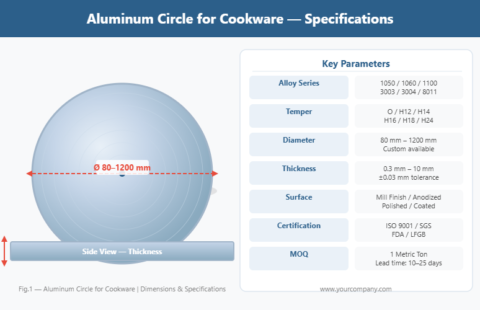
| Thickness | 0.3 mm – 6.0 mm |
| Diameter | 100 mm – 1600 mm |
| Common Diameter | 200 mm, 300 mm, 400 mm, 500 mm |
| Tolerance (Diameter) | ± 0.5 mm |
| Tolerance (Thickness) | ± 0.02 mm |
| Surface | Mill finish, bright, anodized |
Mechanical Properties
| Alloy | Temper | Tensile Strength | Yield Strength | Elongation |
|---|---|---|---|---|
| 1060 | O | 60 – 95 MPa | 15 – 35 MPa | ≥ 15% |
| 1060 | H14 | 95 – 125 MPa | 75 – 105 MPa | ≥ 3% |
| 3003 | O | 95 – 130 MPa | 35 – 65 MPa | ≥ 14% |
| 3003 | H14 | 145 – 185 MPa | 125 – 165 MPa | ≥ 3% |
Aluminum Circle – Main Applications
CC aluminum circles work across many industries. Here are the most important ones.
Cookware Manufacturing
This is the largest market for CC aluminum circles.
Manufacturers deep-draw aluminum circles into:
- Cooking pots and saucepans
- Frying pans and woks
- Pressure cookers
- Rice cookers and steamers
- Milk pots and kettles
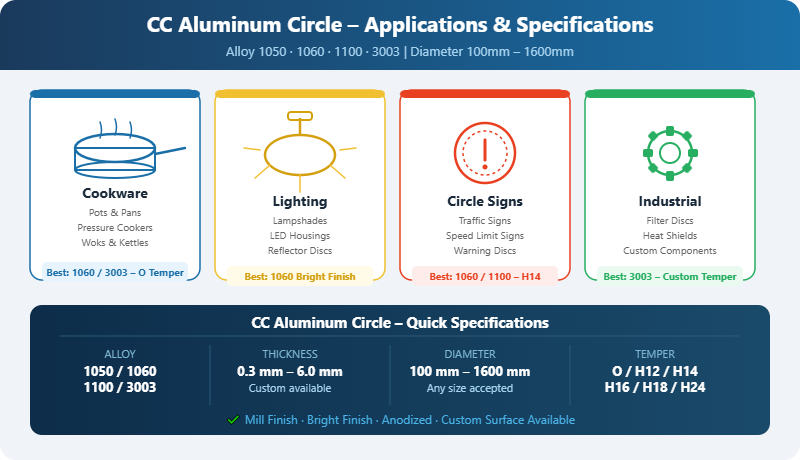
1060 and 3003 alloys in O temper are the top choices for cookware. They offer excellent deep-drawing performance and food-safe properties.
Aluminum Round Circle for Lighting
Aluminum circles are widely used in the lighting industry.
Common lighting applications:
- Lampshades and reflectors
- LED light housings
- Ceiling light panels
- Street light reflectors
1060 aluminum in bright finish is popular here. The high reflectivity improves lighting efficiency.
Circle Aluminum Sign – Traffic and Road Signs
Circle aluminum signs are a major application for aluminum circles.
Traffic and road sign uses:
- Round warning signs
- Speed limit signs
- Pedestrian crossing signs
- Parking signs
- Decorative public signs
1060 and 1100 alloys in H14 or H16 temper are standard for signs. Anodized or coated surfaces improve outdoor durability.
Circle Aluminum Sheets for Industrial Use
Industries use aluminum circles as blanks for various components:
- Electrical enclosure covers
- Instrument panels
- Filter discs
- Heat shields
- Machinery components
Custom Aluminum Circles
Many customers need custom aluminum circles for special applications.
We produce custom circles with:
- Non-standard diameters
- Special thickness
- Center holes
- Custom alloy and temper
- Specific surface finish
- Anodized color options
Custom orders are welcome. Send us your drawing or specifications and we will produce exactly what you need.
Custom Aluminum Circles – What Can We Customize?
We offer full customization for CC aluminum circles. Here is what you can specify:
1. Diameter
Any diameter from 100 mm to 1600 mm. We cut to your exact size.
2. Thickness
From 0.3 mm to 6.0 mm. Thin circles for lightweight applications. Thick circles for heavy-duty use.
3. Alloy
Choose from 1050, 1060, 1100, 3003, or other alloys. We recommend the best alloy for your application.
4. Temper
O temper for deep drawing. H14 or H16 for signs and panels. We anneal or strain-harden to your specification.
5. Surface Finish
- Mill finish – standard smooth surface
- Bright finish – polished, high reflectivity
- Anodized – protective oxide layer, color options available
- Brushed – decorative finish
6. Center Hole
We punch center holes during production. Specify the hole diameter and we include it in the manufacturing process.
7. Edge Treatment
Standard sheared edge or deburred smooth edge. Specify your preference.
CC Aluminum Circle – How It Is Made
Understanding the production process helps you evaluate quality.
Step 1 – Continuous Casting
Molten aluminum feeds into the casting machine. The machine produces aluminum coils in a continuous process. This is the key difference from DC casting.
Step 2 – Cold Rolling
The cast coil goes through cold rolling mills. This reduces thickness to the target specification.
Step 3 – Annealing
For O temper products, the coil goes into an annealing furnace. Heat treatment softens the material for deep drawing.
Step 4 – Slitting
The wide coil is slit to the required width for circle blanking.
Step 5 – Circle Blanking
A stamping press punches circles from the slit coil. The punch and die diameter determine the circle size.
Step 6 – Leveling
Circles pass through a leveling machine. This ensures flatness and removes any warping.
Step 7 – Surface Treatment
Optional polishing, anodizing, or coating is applied at this stage.
Step 8 – Inspection and Packing
Each batch passes dimensional, surface, and mechanical testing. Approved circles are packed with interleaved paper and placed on wooden pallets.
What Is the FCC Structure of Aluminum?
Some customers ask about the FCC structure of aluminum.
FCC stands for Face-Centered Cubic. This is the crystal structure of aluminum at room temperature.
In an FCC structure:
- Aluminum atoms sit at each corner of a cube
- One atom sits at the center of each face
- This structure gives aluminum 12 slip systems
The FCC structure explains why aluminum has:
- High ductility – easy to form and draw
- Good formability – suitable for deep drawing and spinning
- Excellent workability – easy to roll, extrude, and stamp
This is why CC aluminum circles are so easy to deep-draw into cookware and other shapes. The FCC crystal structure allows plastic deformation without cracking.
CC Aluminum Circle Price
What Affects the Price?
Several factors determine the price of CC aluminum circles:
1. Alloy
1060 is the most affordable. 3003 costs slightly more. Higher purity alloys like 1050 fall in between.
2. Temper
O temper requires annealing, which adds processing cost. H-series tempers vary by degree of cold working.
3. Diameter and Thickness
Larger and thicker circles use more material. Price increases with size.
4. Surface Finish
Mill finish is the base price. Bright and anodized surfaces cost more.
5. Quantity
Larger orders receive better unit pricing. MOQ is typically 1–2 tons.
6. LME Aluminum Price
The global aluminum market price changes daily. This directly impacts product pricing.
Estimated Price Range
| Alloy | Temper | Price Range (USD/ton) |
|---|---|---|
| 1060 | O | $2,600 – $3,000 |
| 1060 | H14 | $2,700 – $3,100 |
| 3003 | O | $2,800 – $3,200 |
| 3003 | H14 | $2,900 – $3,400 |
Prices change with market conditions. Contact us for a real-time quote.
Circle Aluminum Sheets – Packing and Shipping
Proper packing protects aluminum circles during transport.
Our Standard Packing
- Interleaved paper between each circle
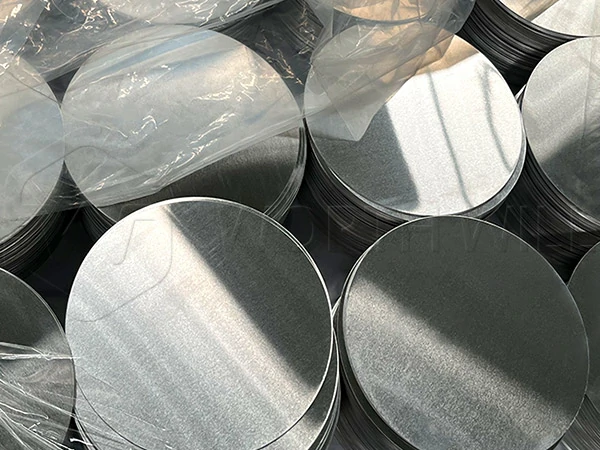
- Stacked circles wrapped in PE film
- Waterproof outer wrapping
- Wooden pallet base
- Steel strapping for security
Shipping Options
| Method | Transit Time | Best For |
|---|---|---|
| Sea Freight | 15 – 45 days | Large orders, cost-sensitive |
| Air Freight | 3 – 7 days | Small urgent orders |
| Land Transport | 3 – 15 days | Regional customers |
We handle all export documentation including packing list, commercial invoice, bill of lading, certificate of origin, and mill test certificate.
Quality Standards
Our CC aluminum circles meet international quality standards:
| Standard | Description |
|---|---|
| GB/T 3880 | Chinese national standard for aluminum sheet |
| ASTM B209 | American standard for aluminum sheet and plate |
| EN 485 | European standard for aluminum products |
| ISO 9001:2015 | Quality management system |
We provide mill test certificates with every shipment. Third-party inspection by SGS or BV is available on request.
Why Choose Us for CC Aluminum Circles?
We are a professional CC aluminum circle manufacturer with over 15 years of production experience.
✅ Factory Direct Price
No middlemen. We manufacture and sell directly. You get the best price.
✅ Full Alloy and Size Range
1050, 1060, 1100, 3003 available. Diameter 100–1600 mm. Thickness 0.3–6.0 mm.
✅ Custom Production
Any size, alloy, temper, or surface finish. OEM orders welcome.
✅ Consistent Quality
Strict process control from casting to packing. Every batch tested before shipment.
✅ Fast Delivery
Stock items ready in 3–5 days. Custom orders in 7–15 days.
✅ Global Export Experience
We export to over 50 countries. Full documentation support for all destinations.
✅ Responsive Support
Our team replies within 24 hours. Technical support available in multiple languages.
Export Markets
We supply CC aluminum circles and aluminum circle plates to customers worldwide:
| Region | Key Markets |
|---|---|
| Middle East | UAE, Saudi Arabia, Turkey, Iran |
| Africa | Nigeria, Ethiopia, Kenya, Egypt |
| Southeast Asia | Vietnam, Thailand, Indonesia |
| South America | Brazil, Mexico, Colombia |
| Europe | Germany, Italy, Poland |
| North America | USA, Canada |
Our logistics team handles shipping to all major ports worldwide.
Frequently Asked Questions
Q1: What does CC mean in CC aluminum circle?
CC stands for Continuous Casting. It refers to the casting method used to produce the aluminum coil. CC aluminum is cost-effective and suitable for most general applications including cookware and signs.
Q2: What is the difference between CC and DC aluminum circles?
CC aluminum uses continuous casting. DC aluminum uses direct chill casting. DC aluminum has a finer grain structure and better mechanical properties. CC aluminum costs less and is suitable for most standard applications.
Q3: Which alloy is best for deep-drawing cookware?
1060-O and 3003-O are the top choices. Both offer excellent deep-drawing performance. 3003 gives slightly higher strength in the finished product.
Q4: Can you produce aluminum circles with a center hole?
Yes. We punch center holes during the blanking process. Specify your required hole diameter when ordering.
Q5: What is the minimum order quantity?
Our standard MOQ is 1 ton per specification. Contact us for smaller trial orders.
Q6: Do you provide anodized aluminum circles?
Yes. We offer anodized surfaces in clear, black, gold, and other colors. Specify your anodizing requirements when requesting a quote.
Q7: How do I get a price quote?
Send us your requirements: alloy, temper, thickness, diameter, surface finish, and quantity. We will reply with a full price quote within 24 hours.
Summary – CC Aluminum Circle at a Glance
| Feature | Detail |
|---|---|
| Material | CC aluminum (continuous cast) |
| Alloys | 1050, 1060, 1100, 3003 |
| Tempers | O, H12, H14, H16, H18, H24 |
| Thickness | 0.3 – 6.0 mm |
| Diameter | 100 – 1600 mm |
| Surface | Mill finish, bright, anodized |
| Applications | Cookware, lighting, signs, industrial |
| Standards | ASTM B209, EN 485, GB/T 3880 |
| MOQ | 1 ton |
| Delivery | 3 – 15 days |