Aluminum Circle for Cookware
What Is an Aluminum Circle for Cookware?
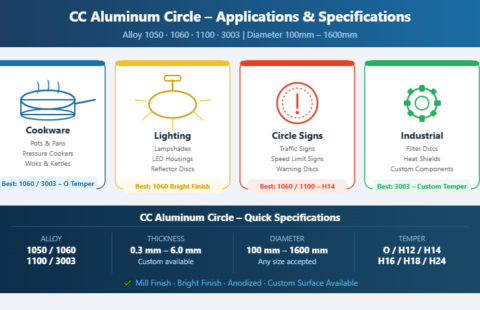
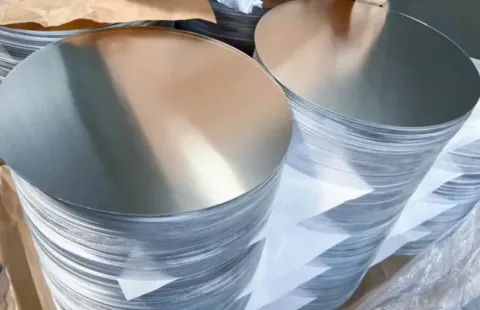
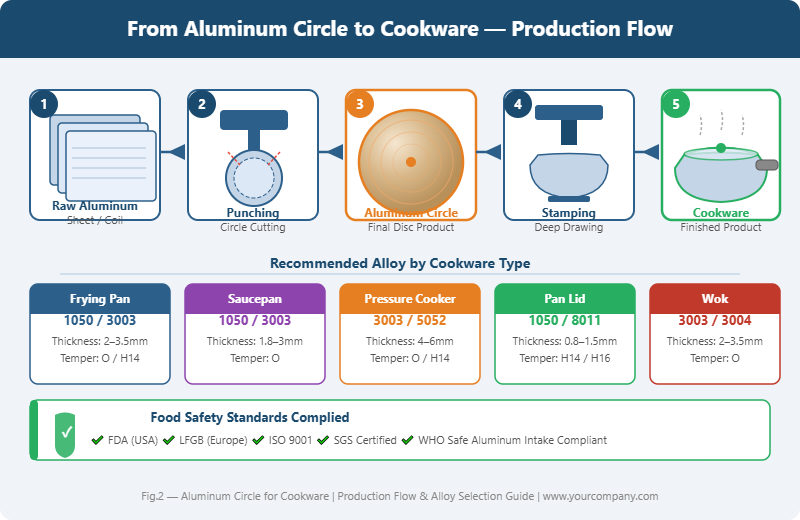
An aluminum circle for cookware is a flat, round disc of aluminum. Manufacturers stamp or spin these discs into pots, pans, lids, and other kitchen items. The disc starts as a rolled aluminum sheet. A punching machine cuts it into a precise circle shape. This process produces a clean edge and a smooth surface.
Cookware factories around the world rely on aluminum circles as their primary raw material. The circles come in many diameters and thicknesses. Each size suits a specific type of pan or pot.
Aluminum circle rings are a related product. They share the same round shape but have a hollow center. Both products come from the same aluminum sheet material.


Why Choose Aluminum Circles for Cookware?
Aluminum is the most popular metal for cookware production. Here are the main reasons:
- Lightweight — Aluminum weighs about one-third as much as steel. Cooks can handle pots and pans easily.
- Excellent heat conductivity — Aluminum conducts heat about four times faster than stainless steel. Food cooks evenly.
- Corrosion resistance — A natural oxide layer forms on the surface. This layer protects the metal from rust.
- Easy to form — Aluminum is soft enough to stamp, spin, and draw into complex shapes.
- Low cost — Aluminum raw material costs less than copper or stainless steel.
- Recyclable — Recycling aluminum uses only 5% of the energy needed to produce new metal.
These properties make aluminum circle pans a smart choice for both home kitchens and commercial restaurants.
Is Aluminum Cookware Safe to Use?
This is one of the most common questions buyers ask.
The short answer: yes, aluminum cookware is safe.
The World Health Organization (WHO) sets a safe daily intake of aluminum at 40 mg per kilogram of body weight. Studies show that cooking in aluminum pans adds only a tiny amount of aluminum to food. This amount is far below the WHO limit.
Anodized aluminum is even safer. An electrochemical process hardens the surface. The hard layer does not react with food. It also resists scratches.
Why did people stop using aluminum for pots and pans?
In the 1970s and 1980s, some studies suggested a link between aluminum and Alzheimer’s disease. Later research did not confirm this link. Most scientists and health agencies now agree that aluminum cookware is safe for everyday use.
Modern aluminum circle pans with lids often have a non-stick coating or an anodized surface. These coatings add an extra layer of protection between the metal and your food.
What Aluminum Alloy Is Best for Cookware?
Not all aluminum alloys work equally well for cookware. The alloy number tells you the chemical composition of the metal.
Common Food-Safe Aluminum Alloys
| Alloy | Main Alloying Elements | Key Features | Common Use |
|---|---|---|---|
| 1050 | 99.5% pure Al | Soft, easy to form, low strength | Simple pots, bowls |
| 1060 | 99.6% pure Al | Good corrosion resistance | Basic cookware |
| 1100 | 99% pure Al | Excellent workability | Frying pans, lids |
| 3003 | Al + Manganese | Higher strength than 1xxx | Pressure cookers |
| 3004 | Al + Mn + Mg | Good formability, stronger | Deep-drawn pans |
| 5052 | Al + Magnesium | High strength, marine grade | Commercial cookware |
| 8011 | Al + Fe + Si | Good surface finish | Lids, thin-wall pots |
Which aluminum alloys are food safe?
The 1xxx series (1050, 1060, 1100) and 3xxx series (3003, 3004) are the most widely used food-safe alloys. They meet international food contact standards including FDA (USA) and LFGB (Europe).
Key Specifications & Parameters
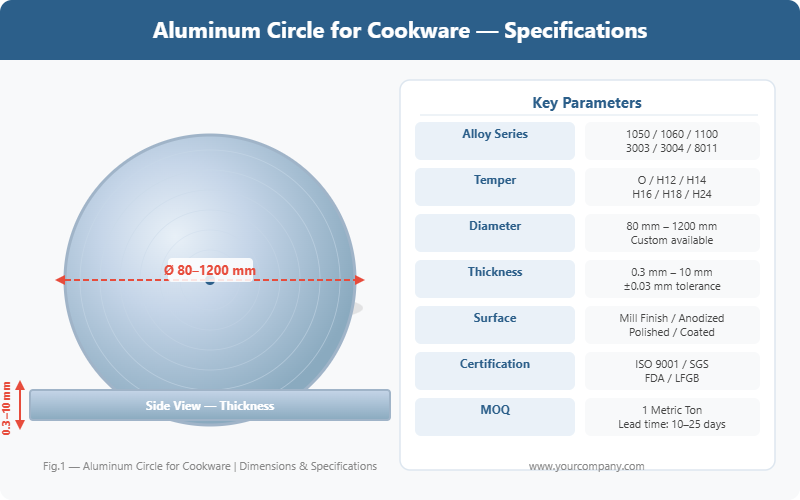
This table covers the standard parameters for aluminum circles for cookware. Custom sizes are available on request.
Standard Aluminum Circle Parameters
| Parameter | Standard Range | Common Cookware Size |
|---|---|---|
| Diameter | 80 mm – 1200 mm | 200 mm – 600 mm |
| Thickness | 0.3 mm – 10 mm | 1.5 mm – 4.0 mm |
| Alloy | 1050 / 1060 / 1100 / 3003 / 3004 / 8011 | 1050 / 3003 |
| Temper | O / H12 / H14 / H16 / H18 / H22 / H24 | O / H14 |
| Surface | Mill finish / Anodized / Polished | Mill finish |
| Edge | Smooth, no burr | Smooth |
| Flatness tolerance | ±0.5% of diameter | ±0.3 mm |
| Thickness tolerance | ±0.02 mm – ±0.05 mm | ±0.03 mm |
Temper Explanation
| Temper Code | Meaning | Hardness Level |
|---|---|---|
| O | Fully annealed (soft) | Lowest |
| H12 | Strain hardened, 1/4 hard | Low |
| H14 | Strain hardened, 1/2 hard | Medium |
| H16 | Strain hardened, 3/4 hard | Medium-High |
| H18 | Fully strain hardened | High |
| H22 / H24 | Strain hardened + partially annealed | Medium |
O temper is the most popular choice for deep-drawn cookware. It is the softest state. The metal flows easily during stamping without cracking.
Mechanical Properties (Alloy 1050, O Temper)
| Property | Value |
|---|---|
| Tensile strength | 65 – 95 MPa |
| Yield strength | 15 – 35 MPa |
| Elongation | ≥ 23% |
| Hardness (HB) | 20 – 25 |
| Density | 2.71 g/cm³ |
| Melting point | 645 – 658 °C |
| Thermal conductivity | 222 W/(m·K) |
Types of Aluminum Circle Pans
1. Aluminum Circle Pans (Basic)
These are the most common type. Manufacturers press an aluminum circle into a pan shape using a hydraulic press. The result is a lightweight, affordable pan. Basic aluminum circle pans work well for everyday cooking tasks like frying eggs, sautéing vegetables, and boiling water.
Key features:
- Lightweight design
- Fast, even heat distribution
- Available in diameters from 16 cm to 36 cm
- Suitable for gas, electric, and induction stoves (with a magnetic base added)
2. Aluminum Circle Pans with Lids
Aluminum circle pans with lids are a complete cooking solution. The lid traps steam inside the pan. This keeps food moist and cooks it faster.
The lid is also made from an aluminum circle. A smaller-diameter circle forms the lid. A handle attaches at the center.
Common lid types:
| Lid Type | Material | Feature |
|---|---|---|
| Flat aluminum lid | 1050 / 8011 alloy | Lightweight, stackable |
| Glass lid | Tempered glass + aluminum ring | See-through |
| Domed aluminum lid | 3003 alloy | Extra steam space |
| Silicone-sealed lid | Aluminum + silicone rim | Airtight seal |
3. Aluminum Ring Circles
Aluminum rings (also called aluminum circle rings) have a hole in the center. They serve different purposes:
- Cooking rings — Used to shape food like eggs, burgers, and pancakes on a flat griddle.
- Structural rings — Used as support frames in pot handles and lid knobs.
- Industrial rings — Used as gaskets and sealing elements in non-cookware applications.
For cookware, aluminum rings typically use 1050 or 3003 alloy with O temper.
4. Metal Circle Cookware (Multi-Layer)
Metal circle cookware sometimes refers to pans made from multiple metal layers. A common construction is:
- Outer layer: stainless steel
- Core layer: aluminum circle (for heat conduction)
- Inner layer: stainless steel or non-stick coating
This construction gives the pan the heat conductivity of aluminum and the durability of stainless steel. These pans work on all stovetop types including induction.
Applications of Metal Circle Cookware
Aluminum circles serve many cookware segments. Here is a breakdown:
Household Cookware
| Product | Diameter Range | Alloy | Thickness |
|---|---|---|---|
| Frying pan | 20 – 32 cm | 1050 / 3003 | 2.0 – 3.5 mm |
| Saucepan | 16 – 24 cm | 1050 / 3003 | 1.8 – 3.0 mm |
| Stock pot | 24 – 40 cm | 3003 / 3004 | 2.5 – 4.0 mm |
| Wok | 30 – 40 cm | 3003 | 2.0 – 3.5 mm |
| Pressure cooker | 20 – 28 cm | 3003 / 5052 | 3.0 – 5.0 mm |
| Pan lid | 16 – 36 cm | 1050 / 8011 | 0.8 – 1.5 mm |
Commercial & Industrial Cookware
| Product | Key Requirement | Recommended Alloy |
|---|---|---|
| Restaurant frying pans | High durability | 3003 / 3004 |
| Hotel chafing dishes | Large diameter | 3003 |
| Bakery molds | Non-stick surface | 1100 (anodized) |
| Hospital food trays | Food safety | 1050 / 1100 |
| Airline meal trays | Lightweight | 8011 / 1050 |
How to Choose the Right Aluminum Circle
Follow these steps to select the best aluminum circle for your cookware production:
Step 1: Choose the Right Alloy
- For simple pots and pans: Use 1050 or 1060.
- For pressure cookers and woks: Use 3003 or 3004.
- For lids and thin-wall products: Use 8011.
- For commercial heavy-duty cookware: Use 3004 or 5052.
Step 2: Choose the Right Temper
- Deep drawing (stamping into deep shapes): Use O temper.
- Shallow drawing: Use H14 temper.
- Spinning: Use O temper.
Step 3: Choose the Right Diameter
Measure the inside diameter of the finished pan. Add a forming allowance of 15%–25%. This accounts for metal movement during stamping.
Example:
- Finished pan diameter: 280 mm
- Add 20% allowance: 280 × 1.20 = 336 mm circle diameter
Step 4: Choose the Right Thickness
| Pan Type | Recommended Circle Thickness |
|---|---|
| Thin frying pan | 1.5 – 2.0 mm |
| Standard frying pan | 2.0 – 3.0 mm |
| Heavy-duty pan | 3.0 – 4.0 mm |
| Pressure cooker | 4.0 – 6.0 mm |
| Lid | 0.8 – 1.5 mm |
Step 5: Check Surface Quality
- Mill finish — Standard surface. Good for pans with coatings.
- Anodized — Harder surface. Better corrosion resistance.
- Polished — Shiny surface. Better appearance for premium products.
Our Manufacturing Advantages
We are a direct manufacturer of aluminum circles for cookware. Here is what sets us apart:
Production Capabilities
| Item | Detail |
|---|---|
| Annual capacity | 50,000+ metric tons |
| Circle diameter range | 80 mm – 1200 mm |
| Thickness range | 0.3 mm – 10 mm |
| Available alloys | 1050, 1060, 1100, 3003, 3004, 5052, 8011 |
| Surface options | Mill finish, anodized, polished, coated |
| Minimum order quantity | 1 metric ton |
| Lead time | 10 – 25 business days |
| Certifications | ISO 9001, SGS, FDA, LFGB |
Quality Control Steps
- Raw material inspection — Check chemical composition with spectrometer.
- Rolling tolerance check — Verify thickness with digital micrometer.
- Surface inspection — Check for scratches, oil spots, and inclusions.
- Diameter check — Measure each lot with calibrated gauges.
- Flatness test — Lay circles on a flat plate. Check for warping.
- Mechanical property test — Tensile and elongation tests per ASTM B209.
- Final packaging check — Inspect stacking, interleaving paper, and packaging integrity.
Export Markets
We supply aluminum circles to cookware manufacturers in:
- Southeast Asia: Vietnam, Thailand, Indonesia, Malaysia
- Middle East: Turkey, Egypt, Saudi Arabia, Iran
- Europe: Germany, Italy, Poland, Netherlands
- Americas: Mexico, Brazil, Colombia
- Africa: Nigeria, Kenya, Ethiopia
FAQ
Why did people stop using aluminum for pots and pans?
Many people stopped in the 1980s due to health concerns. Some early studies suggested aluminum might link to Alzheimer’s disease. However, later large-scale research did not confirm this connection. Major health organizations, including the WHO and FDA, confirm that aluminum cookware is safe for normal cooking use.
Is aluminum cookware safe to use?
Yes. Aluminum cookware is safe for everyday cooking. The amount of aluminum that enters food during cooking is very small. It falls well within safe limits set by international health authorities. Anodized aluminum cookware adds extra protection because the surface layer does not react with food.
What is the aluminum alloy for cookware?
The most common alloys for cookware are 1050, 1060, 1100 (pure aluminum series) and 3003, 3004 (aluminum-manganese series). These alloys are food-safe, easy to form, and offer good corrosion resistance.
What aluminum alloys are food safe?
The 1xxx series and 3xxx series alloys are food safe. Alloys 1050, 1060, 1100, 3003, and 3004 all meet FDA and EU food contact material standards. Always ask your supplier for a food safety certificate or compliance report.
What is the difference between aluminum circle pans and metal circle cookware?
Aluminum circle pans are made from a single aluminum disc. Metal circle cookware may refer to pans with multiple metal layers, such as an aluminum core bonded between stainless steel layers. Multi-layer pans are more expensive but offer better durability and wider stovetop compatibility.
Can I get custom sizes for aluminum circles?
Yes. We offer custom diameters, thicknesses, alloys, and surface finishes. Contact our sales team with your drawing or specification sheet. We will confirm feasibility and pricing within 24 hours.
Looking for a reliable supplier of aluminum circles for cookware? Contact us today for free samples, competitive pricing, and fast shipping to your country.