Aluminium Circle 3003
Aluminium circle 3003 is one of the most popular aluminum disc products in the global market. It combines good strength, excellent corrosion resistance, and outstanding formability — making it the preferred choice for cookware manufacturers, food processing equipment producers, and industrial fabricators worldwide.
Whether you need 3003 aluminum circles for deep-drawn pots and pans, pressure cookers, road signs, or chemical storage equipment, this guide covers everything you need to know. We explain what 3003 grade aluminum is, how it compares to other alloys, standard specifications, key applications, and pricing factors.
What Is 3003 Grade Aluminum?
3003 grade aluminum is a manganese-based aluminum alloy. It belongs to the 3000 series aluminum family. Manganese is the primary alloying element, typically making up 1.0–1.5% of the total composition.
The addition of manganese gives 3003 aluminum approximately 20% more strength than pure 1100 aluminum, while maintaining excellent formability, weldability, and corrosion resistance.
3003 is a non-heat-treatable alloy. This means you cannot increase its strength through heat treatment. Instead, strength is controlled through cold working (strain hardening), which determines the temper designation — such as O, H12, H14, H16, or H18.
Chemical Composition of 3003 Aluminum
| Element | Content (%) |
|---|---|
| Aluminum (Al) | Balance |
| Manganese (Mn) | 1.0 – 1.5 |
| Copper (Cu) | 0.05 – 0.20 |
| Iron (Fe) | Max 0.70 |
| Silicon (Si) | Max 0.60 |
| Zinc (Zn) | Max 0.10 |
| Others | Max 0.15 |
Key Characteristics of 3003 Grade Aluminum
- Strength: About 20% stronger than 1100 pure aluminum
- Corrosion resistance: Excellent — resists atmospheric corrosion, moisture, and mild chemicals
- Formability: Very good — easy to deep draw, spin, and stamp into complex shapes
- Weldability: Excellent — compatible with all standard welding methods
- Machinability: Fair — softer than heat-treatable alloys but adequate for most applications
- Anodizing: Good — accepts clear and color anodizing
- Non-toxic: Safe for food contact applications
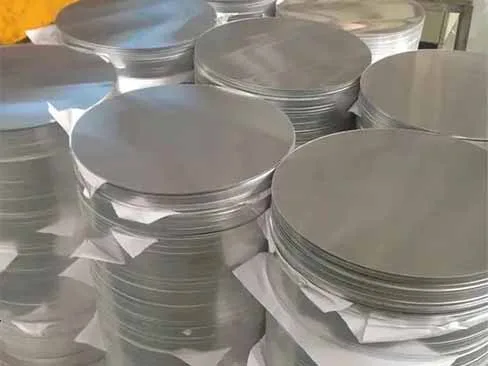
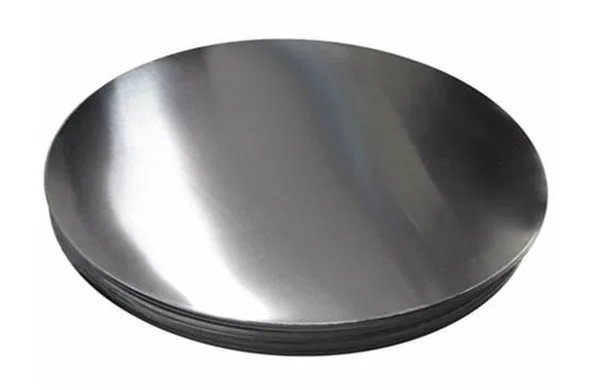
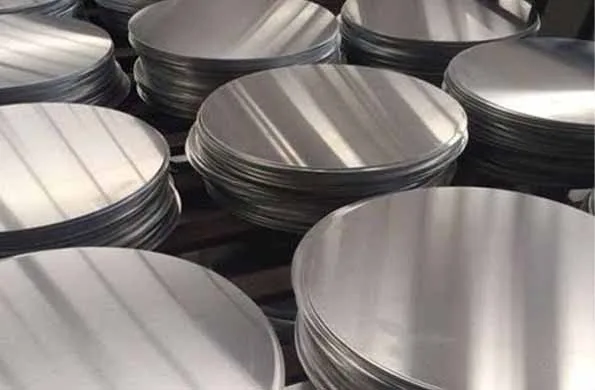
Aluminium Circle 3003: Full Specifications
When ordering aluminium circle 3003, confirm these key specifications:
Chemical Composition
Same as the 3003 alloy standard listed above. Always request a mill test report (MTR) to verify composition.
Mechanical Properties by Temper
| Temper | Tensile Strength | Yield Strength | Elongation | Common Use |
|---|---|---|---|---|
| O (Annealed) | 130 MPa | 52 MPa | 25–30% | Deep drawing, cookware |
| H12 | 150 MPa | 130 MPa | 6% | Light forming |
| H14 | 170 MPa | 145 MPa | 5% | General sheet metal |
| H16 | 185 MPa | 170 MPa | 4% | Higher strength panels |
| H18 | 200 MPa | 185 MPa | 3% | Maximum strength |
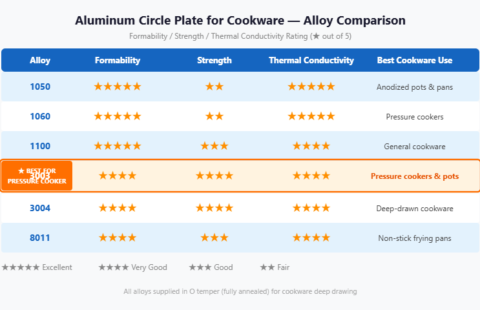
For aluminium circle 3003 used in cookware and deep drawing, always specify O temper (fully annealed). This provides maximum ductility and prevents cracking during forming.
Physical Properties
| Property | Value |
|---|---|
| Density | 2.73 g/cm³ |
| Melting Range | 643°C – 654°C |
| Thermal Conductivity | 163 W/m·K |
| Electrical Conductivity | 41% IACS |
| Modulus of Elasticity | 70 GPa |
Standard Dimensions
| Parameter | Standard Range |
|---|---|
| Diameter | 100 mm – 1,200 mm |
| Thickness | 0.3 mm – 6.0 mm |
| Diameter Tolerance | ± 0.5 mm |
| Thickness Tolerance | ± 0.05 mm |
| Surface Flatness | ≤ 1.0 mm per meter |
Compliance Standards
- ASTM B209 — Aluminum sheet and plate specification
- EN 573-3 — European standard for aluminum alloy composition
- EN 485 — European standard for sheet dimensions and tolerances
- GB/T 3880 — Chinese national standard for aluminum sheet
What Is an Aluminum Circle Sheet?
Many buyers search for aluminum circle sheet when looking for flat, round aluminum blanks. An aluminum circle sheet is simply a flat aluminum disc cut from sheet or coil.
It is also commonly called:
- Aluminum disc
- Aluminum round blank
- Aluminum circle blank
- Aluminum wafer
How Aluminum Circle Sheets Are Made
Step 1 — Coil or Sheet Preparation
Large aluminum coils or flat sheets are loaded onto a blanking press or CNC cutting machine.
Step 2 — Blanking / Cutting
The machine punches or cuts circular discs from the aluminum sheet. Common cutting methods include:
- Blanking press: High-speed production, best for large quantities
- Laser cutting: High precision, good for custom sizes and small batches
- Waterjet cutting: No heat-affected zone, good for thick circles
Step 3 — Deburring
The edges of freshly cut circles have burrs. Deburring removes sharp edges for safe handling and better forming results.
Step 4 — Annealing (if needed)
If the base material is in a hard temper, the circles are annealed in a furnace to achieve O temper for maximum formability.
Step 5 — Surface Inspection and Packaging
Each circle is inspected for surface defects, diameter, and thickness. Then they are stacked with interleaving paper and packed on pallets.
Key Difference: Circle vs. Sheet
| Product | Shape | Typical Use |
|---|---|---|
| Aluminum sheet | Rectangular flat panel | General fabrication, cladding |
| Aluminum circle sheet | Round flat disc | Cookware, signs, discs |
| Aluminum strip | Long narrow roll | Roll forming, trim |
Aluminium Circle Pan: From Disc to Finished Cookware
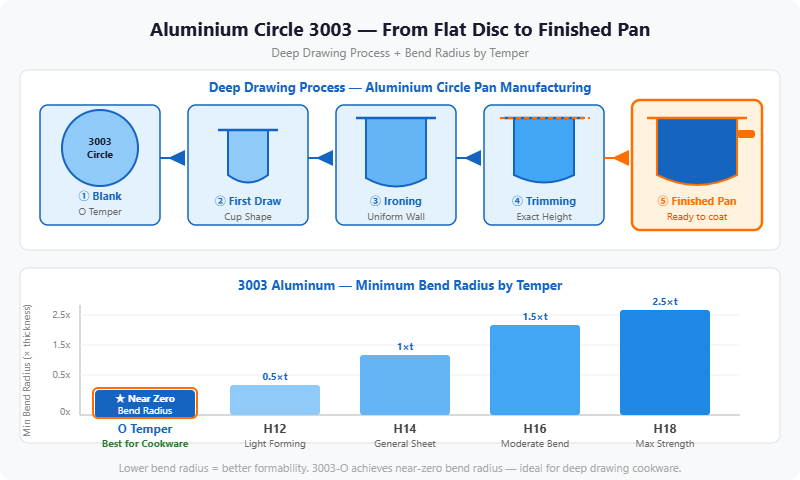
Aluminium circle pan manufacturing starts with a flat aluminium circle 3003 disc. Here is how the circle becomes a finished pan:
The Deep Drawing Process
1. Blank Placement
The aluminum circle 3003 blank is placed in the center of a deep drawing die.
2. First Draw
The punch presses the circle into the die. The flat disc starts to take the shape of a cup or pan body. The material flows inward and downward.
3. Redrawing (if needed)
For deeper pans or pots, the partly formed cup goes through additional drawing stages to reach the final depth.
4. Ironing
The pan wall is thinned and smoothed through an ironing process. This creates uniform wall thickness.
5. Trimming
The top edge is trimmed to the exact height. This also removes any uneven material from the drawing process.
6. Surface Treatment
The formed pan receives its final surface treatment:
- Hard anodizing for durability
- PTFE or ceramic non-stick coating
- Polishing for a bright finish
- External painting or powder coating
Why 3003 Is Ideal for Aluminium Circle Pans
- O temper ductility (25–30% elongation) prevents cracking during deep drawing
- Manganese content provides better strength than pure aluminum after forming
- Excellent corrosion resistance ensures long service life in kitchen environments
- Good thermal conductivity distributes heat evenly across the cooking surface
- Food-safe material — non-toxic and approved for direct food contact
- Accepts non-stick coatings very well due to clean, uniform surface
What Is 3003 Grade Aluminum?
We covered the basics above. Here is a deeper look at what makes 3003 grade aluminum unique compared to other popular alloys.
3003 in the Aluminum Alloy Family
| Series | Primary Alloying Element | Key Characteristic |
|---|---|---|
| 1000 | None (pure Al) | Highest conductivity, softest |
| 3000 | Manganese (Mn) | Good strength + formability |
| 5000 | Magnesium (Mg) | High strength, marine grade |
| 6000 | Mg + Si | Heat treatable, structural |
| 7000 | Zinc (Zn) | Highest strength, aerospace |
3003 sits in a practical middle ground — stronger than pure 1000 series but more formable than 5000 and 6000 series alloys. This makes it perfect for applications that need both shaping and moderate structural performance.
Where 3003 Excels
- Applications requiring deep drawing or complex forming
- Products needing good corrosion resistance without coating
- Food contact applications (non-toxic, no harmful alloying elements)
- Applications needing good weldability for assembly
Is 3003 Cheaper Than 6061?
A very common question from buyers: is 3003 cheaper than 6061?
Yes, 3003 aluminum is generally cheaper than 6061 aluminum. Here is why:
Reasons 3003 Costs Less Than 6061
1. Simpler Alloy Composition
3003 contains mainly manganese as the alloying element. 6061 contains magnesium, silicon, copper, and chromium — more complex and more costly to produce.
2. No Heat Treatment Required
3003 is a non-heat-treatable alloy. Strength comes from cold working alone. 6061 requires a full heat treatment cycle (solution heat treatment + artificial aging for T6 temper). Heat treatment adds significant production cost.
3. Lower Conversion Cost
Rolling 3003 into circles or sheets is simpler and faster than producing heat-treated 6061 plates.
Price Comparison
| Alloy | Approximate Price (USD/MT) | Reason for Difference |
|---|---|---|
| 1100 aluminum circle | $2,600 – $3,200 | Simplest composition |
| 3003 aluminum circle | $2,800 – $3,500 | Manganese addition |
| 5052 aluminum circle | $3,200 – $4,000 | Higher Mg content |
| 6061-T6 aluminum plate | $3,800 – $5,500 | Complex alloy + heat treatment |
Prices are approximate and vary with LME aluminum price fluctuations.
When to Choose 3003 Over 6061
| Application Need | Best Choice |
|---|---|
| Deep drawing, cookware | 3003 |
| Food containers, chemical tanks | 3003 |
| Structural machined parts | 6061 |
| Aerospace components | 6061 |
| General sheet metal forming | 3003 |
| High-strength structural frames | 6061 |
For cookware and forming applications, 3003 is not only cheaper but also technically superior to 6061 because of its much better formability in O temper.
Can You Bend 3003 Aluminum?
Yes — you can absolutely bend 3003 aluminum, and it is actually one of the best aluminum alloys for bending operations.
Why 3003 Bends So Well
High ductility in O temper:
3003-O has an elongation of 25–30%. This means the material can stretch significantly before breaking. High elongation directly translates to better bendability without cracking.
No hard intermetallic compounds:
Unlike 6061 or 7075, 3003 does not contain hard precipitates that cause cracking during bending. Its manganese-based structure remains ductile even after significant deformation.
Minimum Bend Radius for 3003 Aluminum
The minimum bend radius depends on the temper and thickness:
| Temper | Minimum Bend Radius | Formability |
|---|---|---|
| O (Annealed) | 0 × thickness | Exceptional |
| H12 | 0.5 × thickness | Very Good |
| H14 | 1 × thickness | Good |
| H16 | 1.5 × thickness | Moderate |
| H18 | 2.5 × thickness | Fair |
3003-O can be bent to nearly zero radius (tight bend against itself) without cracking. This is why it is the preferred alloy for deep drawing, spinning, and tight-bend fabrication.
Practical Bending Tips for 3003 Aluminum
- Use O temper for the tightest bends and most complex forming
- Bend across the grain direction when possible for best results
- Use proper tooling — sharp die edges can cause surface cracking
- Keep tools clean — aluminum is soft and picks up contamination easily
- For H14 or harder tempers, anneal the material first if tight bending is required
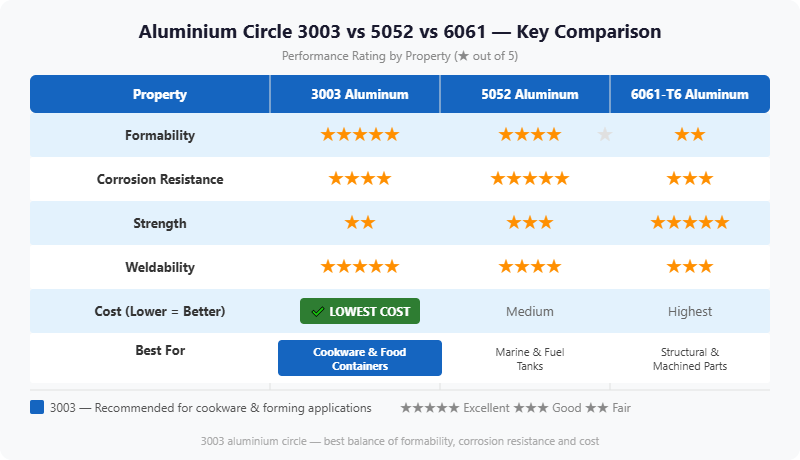
Which Aluminum Is Better, 3003 or 5052?
Another very common question: which aluminum is better, 3003 or 5052?
The answer depends entirely on your application. Both are excellent alloys, but they have different strengths.
Direct Comparison: 3003 vs. 5052
| Property | 3003 Aluminum | 5052 Aluminum |
|---|---|---|
| Primary Alloy Element | Manganese (Mn) | Magnesium (Mg) |
| Tensile Strength (O temper) | 130 MPa | 195 MPa |
| Yield Strength (O temper) | 52 MPa | 90 MPa |
| Elongation (O temper) | 25–30% | 25% |
| Corrosion Resistance | Excellent | Excellent (better in saltwater) |
| Formability | Excellent | Very Good |
| Weldability | Excellent | Excellent |
| Machinability | Fair | Fair |
| Anodizing Quality | Good | Good |
| Cost | Lower | Higher (15–25% more) |
When to Choose 3003
- Cookware and kitchen equipment — best formability, food-safe
- Chemical storage tanks — good resistance to mild acids and alkalis
- HVAC components — excellent for ductwork and heat exchangers
- Food and beverage containers — non-toxic, easy to deep draw
- General sheet metal forming — best cost-to-performance ratio
- Road signs and nameplates — good corrosion resistance at lower cost
When to Choose 5052
- Marine applications — superior saltwater corrosion resistance
- Fuel tanks — better resistance to gasoline and oil
- High-strength sheet metal — 50% stronger than 3003
- Pressure vessels — higher yield strength for pressurized applications
- Structural panels — better load-bearing capacity
Summary: 3003 vs. 5052
| Decision Factor | Winner |
|---|---|
| Formability and deep drawing | 3003 |
| Saltwater corrosion resistance | 5052 |
| Tensile and yield strength | 5052 |
| Cost-effectiveness | 3003 |
| Food contact applications | 3003 |
| Marine and offshore use | 5052 |
For aluminium circle 3003 applications like cookware, food containers, and general forming — 3003 is the better and more economical choice. For marine or high-strength structural applications, 5052 is worth the extra cost.
Aluminum Round Circle: Sizes and Custom Options
Aluminum round circles come in a wide range of standard and custom sizes. Here is a comprehensive size guide:
Standard Diameter Options
| Diameter Range | Common Applications |
|---|---|
| 100 mm – 200 mm | Small pans, lids, nameplates |
| 200 mm – 300 mm | Standard frying pans, saucepans |
| 300 mm – 400 mm | Large pots, woks, stockpots |
| 400 mm – 600 mm | Industrial containers, large cookware |
| 600 mm – 1,200 mm | Storage tanks, industrial discs |
Standard Thickness by Application
| Application | Recommended Thickness |
|---|---|
| Thin decorative panels | 0.3 mm – 1.0 mm |
| Small frying pans | 1.5 mm – 2.5 mm |
| Standard pots and pans | 2.0 mm – 3.5 mm |
| Pressure cookers | 3.0 mm – 5.0 mm |
| Industrial containers | 4.0 mm – 6.0 mm |
Custom Aluminum Round Circles
We supply aluminum round circles in any custom diameter and thickness. Custom options include:
- Any diameter from 100 mm to 1,200 mm
- Any thickness from 0.3 mm to 6.0 mm
- Custom edge finish — clean cut, deburred, or chamfered edges
- Custom surface finish — mill finish, bright finish, or anodized
- Custom temper — O, H12, H14, H16, H18
Top Applications of Aluminium Circle 3003
Aluminium circle 3003 serves a wide range of industries:
Cookware Manufacturing
The largest single application for aluminium circle 3003. It is used for:
- Frying pans and skillets
- Saucepans and stockpots
- Pressure cookers
- Woks and stir-fry pans
- Bakeware and cake tins
- Rice cooker inner pots
Food Processing Equipment
- Food storage containers and drums
- Chemical mixing vessels
- Liquid storage tanks
- Food processing machine components
Road Signs and Traffic Signs
3003 aluminum circles are widely used for:
- Round road signs and traffic signs
- Street name plates
- Parking and directional signs
- Reflective sign blanks
Lighting Equipment
- Lamp reflectors and light housings
- LED lighting back panels
- Spotlight reflector dishes
HVAC and Ventilation
- Round duct end caps
- Ventilation covers and grilles
- Heat exchanger components
Medical and Laboratory Equipment
- Laboratory dish and container bases
- Medical equipment panels
- Clean room equipment components
Why Source Aluminium Circle 3003 from Us?
As a professional manufacturer and global exporter of aluminium circle 3003, we offer:
🏭 Factory Direct Supply
We produce aluminum circles in our own facility. You buy directly from the manufacturer with no middlemen and no markup.
📐 Full Custom Specifications
We supply:
- Any diameter from 100 mm to 1,200 mm
- Any thickness from 0.3 mm to 6.0 mm
- All tempers: O, H12, H14, H16, H18
- All surface finishes: mill finish, bright finish, anodized
✅ Strict Quality Control
Every batch of aluminium circle 3003 undergoes:
- Spectrometer chemical composition analysis
- Mechanical property tensile testing
- Diameter and thickness dimensional inspection
- Surface quality and flatness inspection
- Edge quality check (no burrs)
Full material test reports with every shipment.
🍳 Food Safety Compliance
All our aluminium circle 3003 for cookware applications meets:
- FDA food contact material requirements (USA)
- LFGB food safety standards (Europe)
- SGS third-party test reports available on request
🌍 Global Export Experience
We export 3003 aluminum circles to:
- United States and Canada
- Germany, Italy, Turkey and Europe
- Middle East and Gulf countries
- India and South Asia
- Southeast Asia
- Over 60 countries worldwide
📦 Safe Packaging
- Interleaving paper between each circle
- Wooden pallets with full strapping
- Moisture-proof outer wrapping
- Edge protection for stacked circles
- Suitable for sea, air, and land transport
Frequently Asked Questions
Q1: What is 3003 grade aluminum?
3003 grade aluminum is a manganese-based aluminum alloy with approximately 1.0–1.5% manganese content. It offers about 20% more strength than pure 1100 aluminum while maintaining excellent formability, corrosion resistance, and weldability. It is widely used for cookware, food containers, HVAC, and chemical equipment.
Q2: Is 3003 cheaper than 6061?
Yes. 3003 aluminum is cheaper than 6061 for two main reasons: simpler alloy composition and no heat treatment required. 6061-T6 requires a full solution heat treatment and artificial aging process, which adds significant production cost. For forming and cookware applications, 3003 is both more affordable and more suitable than 6061.
Q3: Can you bend 3003 aluminum?
Yes. 3003 aluminum bends very well, especially in O (annealed) temper. With 25–30% elongation, 3003-O can be bent to a near-zero radius without cracking. It is one of the best aluminum alloys for deep drawing, spinning, and tight-bend fabrication.
Q4: Which aluminum is better, 3003 or 5052?
It depends on the application. 3003 is better for cookware, food containers, deep drawing, and cost-sensitive applications. 5052 is better for marine use, fuel tanks, and applications requiring higher strength. 5052 costs 15–25% more than 3003.
Q5: What temper should aluminium circle 3003 be for cookware?
Always use O temper (fully annealed) for cookware production. O temper provides maximum ductility (25–30% elongation) for deep drawing without cracking.
Q6: What is the maximum diameter for aluminum round circles?
We supply aluminum round circles up to 1,200 mm in diameter. Custom sizes are available on request. Standard production diameters range from 100 mm to 600 mm.
Q7: What is the minimum order quantity for aluminium circle 3003?
Minimum order quantity is typically 3–5 MT for standard diameters and thicknesses. Custom sizes may require higher minimums. Contact us to discuss your requirements.
Q8: Are aluminium circle 3003 products food safe?
Yes. 3003 aluminum contains no toxic alloying elements and is approved for food contact use. Our circles comply with FDA (USA) and LFGB (EU) food safety standards. Test reports are available on request.