Aluminum Circle Plate for Cookware
Aluminum circle plate for cookware is one of the most essential raw materials in the kitchenware manufacturing industry. It serves as the base material for producing pots, pans, pressure cookers, frying pans, and countless other cooking products.
Manufacturers worldwide choose aluminum circle plates because aluminum heats up quickly, distributes heat evenly, resists corrosion, and is lightweight. Whether you produce non-stick frying pans, hard-anodized cookware, or stainless-steel-clad pots, aluminum circle plates form the foundation of your production process.
This guide covers everything buyers and manufacturers need to know about aluminum circle plates for cookware — including alloy selection, specifications, surface finishes, applications, and pricing factors.


What Is an Aluminum Circle Plate for Cookware?
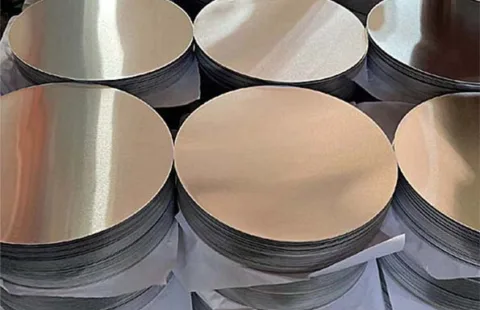
An aluminum circle plate is a flat, round disc cut or stamped from aluminum sheet or coil. It is also called an aluminum disc or aluminum round blank.
In cookware manufacturing, aluminum circle plates serve as the starting material. Factories stamp, draw, spin, or press these discs into the final shape of pots, pans, and other cooking vessels.
Why Aluminum for Cookware?
Aluminum is the most popular metal for cookware production for several reasons:
- Excellent thermal conductivity: 205 W/m·K — heats up fast and distributes heat evenly across the cooking surface
- Lightweight: Density of 2.70 g/cm³ — much lighter than stainless steel or cast iron
- Good corrosion resistance: Forms a natural oxide layer that protects against everyday moisture and food acids
- Easy to form: Aluminum is highly ductile and easy to stamp, draw, and spin into cookware shapes
- Cost-effective: Lower material and production cost compared to copper or stainless steel
- Recyclable: 100% recyclable, supporting sustainable manufacturing
Key Alloys for Aluminum Circle Plate for Cookware
Choosing the right alloy is the most important decision when sourcing aluminum circle plates for cookware. Different alloys suit different cookware types and manufacturing processes.
1050 Aluminum Circle
- Purity: 99.5% aluminum
- Key features: Highest thermal conductivity, excellent formability, easy to anodize
- Best for: Simple pots and pans, anodized cookware, aluminum foil containers
- Temper: O (fully annealed) for maximum formability
1060 Aluminum Circle
- Purity: 99.6% aluminum
- Key features: Slightly higher purity than 1050, excellent corrosion resistance
- Best for: Food-grade cookware, pressure cookers, medical-grade containers
- Temper: O temper
1100 Aluminum Circle
- Purity: 99% aluminum
- Key features: Good formability, slightly stronger than 1050/1060
- Best for: General-purpose cookware, bakeware, food containers
- Temper: O temper
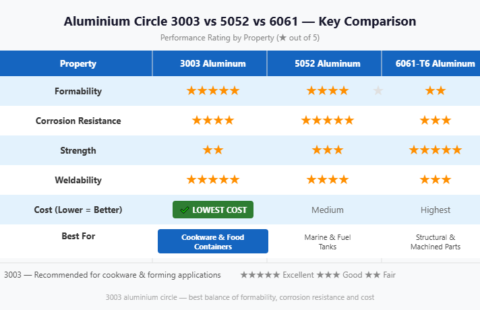
3003 Aluminum Circle
- Key features: Manganese alloy, 20% stronger than 1100, excellent corrosion resistance
- Best for: Pressure cookers, cookware requiring higher strength, food storage
- Temper: O temper or H12
3004 Aluminum Circle
- Key features: Higher magnesium content than 3003, better strength
- Best for: Deep-drawn cookware, beverage containers, high-demand pots
- Temper: O temper
8011 Aluminum Circle
- Key features: Good formability, excellent surface finish
- Best for: Non-stick frying pans, shallow pans, bakeware
- Temper: O temper
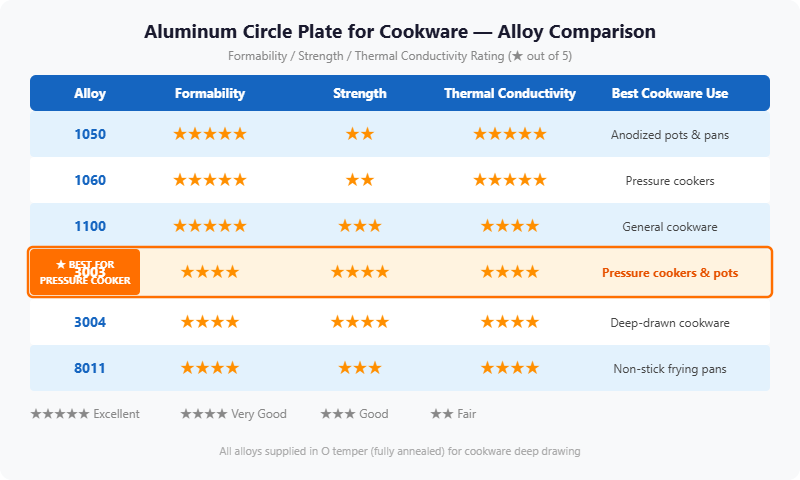
Alloy Comparison Table
| Alloy | Purity / Type | Strength | Formability | Thermal Conductivity | Best Cookware Use |
|---|---|---|---|---|---|
| 1050 | 99.5% pure | Low | ★★★★★ | Highest | Anodized pots, pans |
| 1060 | 99.6% pure | Low | ★★★★★ | Highest | Pressure cookers |
| 1100 | 99% pure | Low-Med | ★★★★★ | Very High | General cookware |
| 3003 | Al-Mn | Medium | ★★★★☆ | High | Pressure cookers, pots |
| 3004 | Al-Mn-Mg | Medium | ★★★★☆ | High | Deep-drawn cookware |
| 8011 | Al-Fe-Si | Medium | ★★★★☆ | High | Non-stick frying pans |
Aluminum Circle Plate Specifications for Cookware
When ordering aluminum circle plates for cookware, here are the key specifications to confirm:
Standard Dimensions
| Parameter | Standard Range |
|---|---|
| Diameter | 100 mm – 1,200 mm |
| Thickness | 0.3 mm – 10.0 mm |
| Diameter Tolerance | ± 0.5 mm |
| Thickness Tolerance | ± 0.05 mm |
| Flatness | ≤ 1.0 mm per meter |
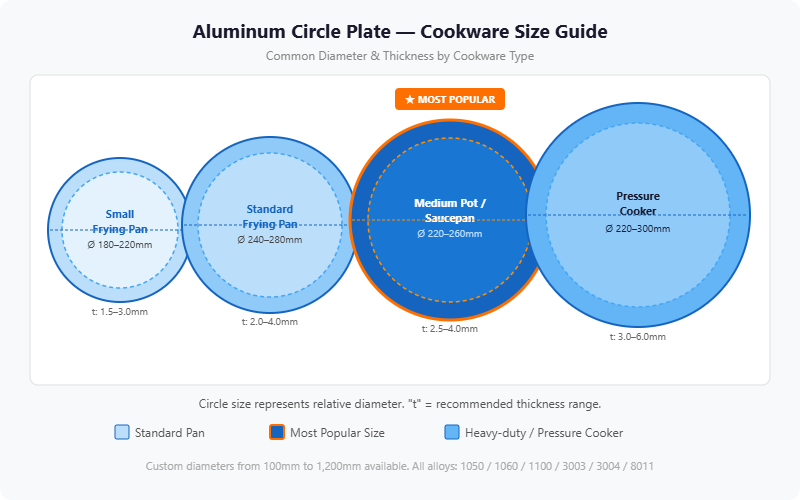
Common Cookware Circle Sizes
| Cookware Type | Common Diameter | Common Thickness |
|---|---|---|
| Small frying pan | 180 mm – 220 mm | 1.5 mm – 3.0 mm |
| Standard frying pan | 240 mm – 280 mm | 2.0 mm – 4.0 mm |
| Large frying pan | 300 mm – 320 mm | 2.5 mm – 4.0 mm |
| Small pot / saucepan | 160 mm – 200 mm | 2.0 mm – 3.5 mm |
| Medium pot | 220 mm – 260 mm | 2.5 mm – 4.0 mm |
| Large pot / stockpot | 280 mm – 360 mm | 3.0 mm – 5.0 mm |
| Pressure cooker | 220 mm – 300 mm | 3.0 mm – 6.0 mm |
| Wok | 300 mm – 400 mm | 2.0 mm – 4.0 mm |
Standard Compliance
- GB/T 3880 — Chinese national standard for aluminum sheet and strip
- ASTM B209 — American standard for aluminum sheet and plate
- EN 573 — European standard for aluminum alloy composition
- EN 485 — European standard for aluminum sheet dimensions and tolerances
- FDA / LFGB — Food safety compliance for cookware contact materials
Surface Finishes for Aluminum Circle Plates
The surface finish of your aluminum circle plate directly affects the final cookware product quality. Here are the main options:
Mill Finish
The standard surface finish straight from the rolling process. It has a smooth, slightly shiny appearance with natural aluminum color. This is the most common surface for cookware circles that will be further processed (anodized, coated, or clad).
Bright Finish (Mirror Finish)
A highly polished surface with high reflectivity. Used for cookware with an attractive shiny appearance or as a base for clear anodizing.
Anodized Surface
After stamping and forming, many cookware manufacturers anodize the finished product. Hard anodizing creates a very hard, scratch-resistant surface that is also non-reactive with food.
Non-Stick Coating Compatible
Most aluminum circle plates for cookware are designed to accept PTFE (Teflon), ceramic, or marble non-stick coatings after forming. The surface must be clean, flat, and free of oil for good coating adhesion.
Composite / Clad Surface
For premium cookware, aluminum circles can be bonded with stainless steel on one or both sides. This creates the best of both materials — aluminum’s heat conductivity with stainless steel’s durability and non-reactivity.
Aluminum Circle Pans: How Are They Made?
Understanding how aluminum circle pans are manufactured helps you specify the right circle plate material.
Step 1: Blanking
Large aluminum sheets or coils are fed into a blanking press. The press stamps out round discs (circles) of the required diameter. Material utilization is important — good nesting layouts minimize waste.
Step 2: Annealing (if needed)
If the aluminum circle is in a hard temper, it may be annealed (softened) before forming. Most cookware circles are supplied in O (annealed) temper for maximum formability.
Step 3: Deep Drawing or Spinning
The aluminum circle is placed in a forming press or spinning lathe. The disc is progressively formed into the shape of a pan or pot. Deep drawing presses are most common for mass production.
Step 4: Trimming and Ironing
The formed pan body is trimmed to exact height. Ironing (wall thinning) may be applied for uniform wall thickness.
Step 5: Handle Attachment
Handles, rivets, and other hardware are attached to the pan body.
Step 6: Surface Treatment
The pan receives its final surface treatment:
- Hard anodizing
- Non-stick PTFE or ceramic coating
- Polishing
- Exterior painting or coating
Step 7: Quality Inspection and Packaging
Finished pans are inspected for dimensions, surface quality, and coating adhesion before packaging.
Aluminum Circle Pans with Lids: Material Considerations
Many buyers source complete cookware sets including aluminum circle pans with lids. Here are important material considerations for both components:
Pan Body Material
- Use 1050, 1060, or 3003 aluminum circle for the pan body
- Thickness: 2.0 mm – 4.0 mm depending on pan size and type
- Temper: O (annealed) for deep drawing
Lid Material Options
Lids for aluminum cookware come in several material options:
| Lid Material | Features | Best For |
|---|---|---|
| Aluminum circle (same alloy) | Lightweight, matches pan | Budget cookware sets |
| Tempered glass | See-through, attractive | Mid-range and premium cookware |
| Stainless steel | Durable, premium look | High-end cookware |
| Aluminum with glass insert | Combination of both | Mid-range cookware |
Lid Specifications
When sourcing aluminum lids to match aluminum circle pans:
- Lid diameter is typically 2–5 mm larger than the pan inner diameter
- Common lid thickness: 1.0 mm – 2.0 mm
- Lid alloy: 1050, 1060, or 3003 — same as pan body for consistent appearance
- Handle attachment: Riveted or welded stainless steel or Bakelite knob
How to Choose the Right Aluminum Circle Plate for Cookware
Follow these steps to select the correct aluminum circle plate for your cookware production:
Step 1: Choose the Right Alloy
- For anodized cookware: Choose 1050 or 1060
- For pressure cookers: Choose 3003 for better strength
- For non-stick frying pans: Choose 8011 or 1100
- For deep-drawn pots: Choose 3004 or 1050 in O temper
Step 2: Confirm the Temper
For cookware production, always use O temper (fully annealed). This gives maximum formability for deep drawing and spinning without cracking.
Step 3: Select the Right Thickness
Match the thickness to your cookware type:
- Thin frying pans: 1.5 mm – 2.5 mm
- Standard pots: 2.5 mm – 3.5 mm
- Pressure cookers: 3.5 mm – 6.0 mm
Step 4: Confirm Diameter Tolerance
Tight diameter tolerance (±0.5 mm or better) is important for consistent stamping results and material yield.
Step 5: Check Food Safety Compliance
Make sure your supplier provides:
- FDA compliance (for US market)
- LFGB compliance (for European market)
- SGS or third-party food safety test reports
Aluminum Circle Plate for Cookware: Price Factors
The price of aluminum circle plates for cookware depends on:
1. LME Aluminum Price
The London Metal Exchange daily aluminum price forms the base of all aluminum circle pricing. Monitor LME prices when planning large purchases.
2. Alloy Grade
Higher purity alloys (1050, 1060) may carry a slight premium. Alloys with higher manganese or magnesium content (3003, 3004) also cost more than pure aluminum grades.
3. Thickness and Diameter
Larger and thicker circles require more aluminum material. Very small circles may cost more per kg due to higher blanking waste.
4. Surface Finish
Mill finish circles are the most affordable. Bright finish or pre-treated surfaces add cost.
5. Diameter Tolerance
Tighter tolerances require more precise tooling and quality control, adding a small premium.
6. Order Quantity
Larger orders consistently receive better pricing per kilogram. Full container loads (FCL) offer the best rates.
Approximate Price Range
| Product | Approximate Price (USD/MT) |
|---|---|
| 1050/1060 aluminum circle (mill finish) | $2,800 – $3,500 |
| 3003 aluminum circle (mill finish) | $3,000 – $3,800 |
| 8011 aluminum circle (mill finish) | $2,900 – $3,600 |
| Bright finish aluminum circle | $3,200 – $4,200 |
Prices vary with LME fluctuations and order quantity. Contact us for a current accurate quote.
Why Source Aluminum Circle Plates from Us?
As a professional manufacturer and global exporter of aluminum circle plates for cookware, we offer:
🏭 Factory Direct Supply
We produce aluminum circles in our own facility with full control over alloy composition, temper, dimensions, and surface finish. No middlemen, no markup.
📐 Custom Specifications
We supply:
- Any diameter from 100 mm to 1,200 mm
- Any thickness from 0.3 mm to 10.0 mm
- All cookware alloys: 1050, 1060, 1100, 3003, 3004, 8011
- O temper and other tempers on request
✅ Food Safety Compliance
All our aluminum circle plates for cookware meet:
- FDA food contact material requirements
- LFGB European food safety standards
- SGS third-party testing available on request
🔬 Strict Quality Control
Every batch undergoes:
- Chemical composition spectrometer analysis
- Mechanical property testing
- Diameter and thickness dimensional inspection
- Surface quality and flatness check
- Edge quality inspection (no burrs)
Full material test reports and food safety certificates with every shipment.
🌍 Global Export Experience
We export aluminum cookware circles to:
- United States and Canada
- Germany, Italy, and Europe
- Turkey and Middle East
- India and South Asia
- Southeast Asia
- More than 60 countries worldwide
📦 Safe Packaging
- Interleaving paper between each circle
- Wooden pallets with strapping
- Moisture-proof wrapping
- Suitable for sea and air freight
Frequently Asked Questions
Q1: What is the best aluminum alloy for cookware circle plates?
For most cookware applications, 1050 or 1060 aluminum is the best choice due to their high purity, excellent formability, and superior thermal conductivity. For pressure cookers requiring more strength, 3003 aluminum is recommended.
Q2: What temper should aluminum cookware circles be in?
Always use O temper (fully annealed) for cookware production. O temper provides maximum ductility and formability for deep drawing and spinning without cracking or tearing.
Q3: What diameter sizes are available for aluminum circle plates?
We supply aluminum circles from 100 mm to 1,200 mm in diameter. Custom sizes are available on request with a minimum order quantity.
Q4: Are your aluminum circle plates food safe?
Yes. All our aluminum circle plates for cookware comply with FDA (United States) and LFGB (European Union) food contact material standards. SGS test reports are available on request.
Q5: Can I order aluminum circle pans with lids?
We supply aluminum circle plates for both pan bodies and lids. For complete cookware sets including aluminum circle pans with lids, we can supply matching circles for both components in the same alloy and finish.
Q6: What is the minimum order quantity?
Minimum order quantity is typically 3–5 MT for standard sizes and alloys. Custom diameters or special specifications may require higher minimums.
Q7: How long is the lead time?
Standard orders ship within 15–20 business days. We maintain inventory of popular sizes (1050, 3003 in common diameters) for faster delivery.